
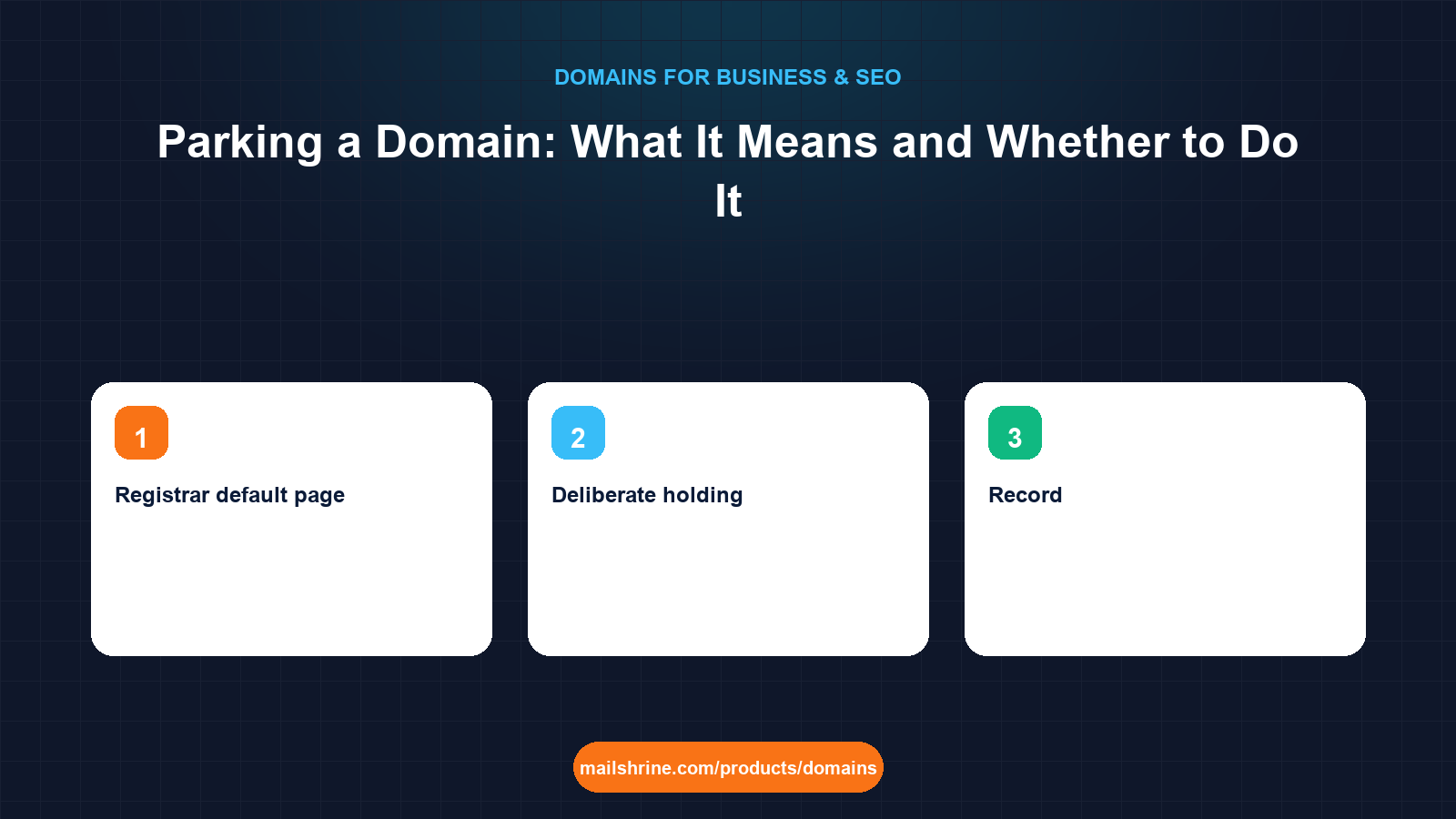
Domain parking is registering a domain and leaving it without a real website. In its narrowest sense it means pointing the name at a parking service that shows a page of advertising links and pays the owner a share of click revenue. In the looser sense most people mean, it is simply holding a name you are not using yet: a future project, a defensive variant, a name you plan to sell. The two senses have very different consequences for your brand, your email security and, if you ever build on the name, your search rankings.
The important thing to understand is that a parked domain is never neutral. It either shows something, or it shows an error, and both are visible to customers, search engines and spammers. This guide explains what parking really involves, what the ad-revenue model pays in 2026 (very little for almost everyone), the risks of a name left with no DNS at all, and the three sensible things to do with a domain you are holding.
MailShrine Domains gives every registered name Anycast DNS with a full record editor, so a held domain can redirect to your main site, carry a coming-soon page, or publish the records that stop anyone sending mail in its name. WHOIS privacy and transfer lock are on by default, and renewal reminders arrive at 30, 7 and 1 day so a held name does not quietly expire.
Real-life example: Marisol's second brand
Marisol Vega runs a tamale catering business in Austin on vegatamales.com. She has registered vegakitchen.com for a meal-prep service she plans to launch next spring and vega-tamales.com because a customer kept typing the hyphen. Right now both names show the registrar's default page. A friend suggested "parking them for ad money". Marisol wants to know what parking actually means and whether the two idle names are a risk.
Marisol's goals this week:
- Understand what parking does and whether the ad income is real.
- Make sure the idle names cannot be used to spoof email from her business.
- Put each held name to work in a way that helps the launch in spring.
The three kinds of parking
| Kind | What visitors see | Revenue | Effect on your brand and SEO |
|---|---|---|---|
| Monetised parking | A page of pay-per-click ad links, often for competitors | Cents per click; most domains earn under $1 a month | Looks abandoned or spammy; Google treats parked pages as low value and may deindex them |
| Registrar default page | "This domain is registered" or a coming-soon template | None | Neutral but wasted; signals nothing is happening |
| Deliberate holding | A redirect to your main site, a real coming-soon page, or a for-sale page | None, or a future sale | Can build anticipation, catch typo traffic and protect email |
Monetised parking made money in the mid-2000s when type-in traffic was high and ad rates were generous. Today the traffic has moved to search apps and browser address bars, and parking revenue has collapsed for everything but high-volume generic names. For a small business's spare domains, the realistic payout is nothing.
The risk nobody mentions: email on a parked domain
A parked domain usually has no mail records, which means no SPF, no DKIM and no DMARC. Mail servers receiving a message "from" that domain have no way to know it is fake, so a spammer can send invoice@vegakitchen.com to Marisol's customers and some of it will land. The fix costs nothing and takes two minutes in the DNS editor.
| Record | Value for a domain that sends no mail | What it does |
|---|---|---|
| SPF (TXT at root) | v=spf1 -all | Declares that no server is authorised to send mail for this domain |
DMARC (TXT at _dmarc) | v=DMARC1; p=reject; rua=mailto:dmarc@vegatamales.com | Tells receivers to reject anything that fails authentication and report it to you |
| Null MX (MX at root) | 0 . | Declares, per RFC 7505, that the domain accepts no mail, so senders get an immediate bounce |
Publishing these three on every held domain is standard practice for security teams and should be standard for small businesses too.
What you need before you start
| You need | Why |
|---|---|
| A list of every domain you hold but do not actively use | Each one needs a decision and protective DNS. |
| Your primary domain's URL | Held names will redirect to it. |
| Access to the DNS editor for each held name | On MailShrine this is the record editor in the dashboard. |
| A decision per name: redirect, coming soon, or for sale | Determines which records to add. |
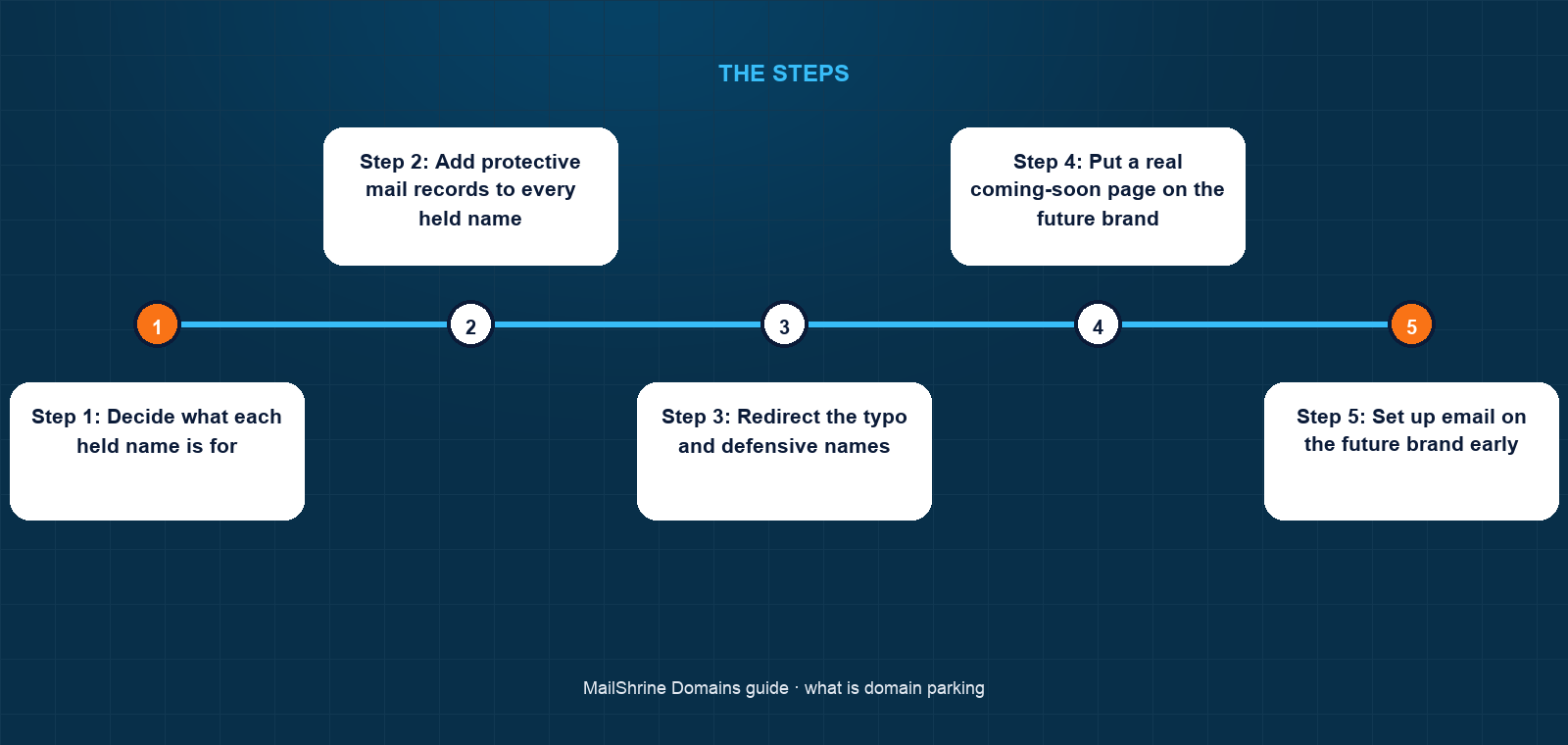
Step 1: Decide what each held name is for
Write one line per domain. Marisol's are: vegakitchen.com, future brand, launch in spring; vega-tamales.com, typo catcher, redirect forever. A name with no purpose you can write in one line is a renewal you can stop paying.
Step 2: Add protective mail records to every held name
In the DNS editor add the SPF, DMARC and null MX records from the table above. Point the DMARC reports at a mailbox on your main domain. This makes the held name useless to spammers from the moment the records propagate, which with MailShrine's default TTLs is within an hour.
Step 3: Redirect the typo and defensive names
For vega-tamales.com, set the DNS to point at your web host and configure a permanent 301 redirect to vegatamales.com. Google's guidance treats this as consolidating the two, so the typo domain neither competes with nor dilutes the main one. Visitors who type the hyphen land on the real site without noticing.
Step 4: Put a real coming-soon page on the future brand
For vegakitchen.com, host a single page with the brand name, a sentence about what is coming, and an email sign-up. This is the one case where a page beats a redirect: it starts collecting interested customers months before launch and gives Google a real page to index rather than a parked placeholder.
Step 5: Set up email on the future brand early
When the launch is a few months out, create the mailboxes on vegakitchen.com. MailShrine writes MX, SPF, DKIM and DMARC at registration, replacing the protective null-mail records, and the two free Business Email mailboxes mean hello@vegakitchen.com can start answering enquiries from the coming-soon page immediately.
Step 6: Keep the held names renewing
Leave auto-renew on and keep the card current. Align terms so the held names expire in the same month as the primary. A held domain that lapses is exactly the one a drop-catcher registers to sell back to you, or to a competitor.
Marisol's checklist
- Wrote a one-line purpose for both held namesCompleted
- Added
v=spf1 -all, DMARCp=rejectand a null MX to bothCompleted - Set a 301 redirect from
vega-tamales.comtovegatamales.comCompleted - Published a coming-soon page with a sign-up form on
vegakitchen.comCompleted - Create
hello@vegakitchen.comtwo months before launchNot completed - Align all three domains to renew in the same month on 2-year termsNot completed
Common mistakes
Parking for ad revenue. The income is negligible for a business's spare domains, the pages often advertise your competitors, and search engines treat them as low-quality.
Leaving a held name with no mail records. This is the open door for spoofed invoices and phishing in your business's name. Three records close it.
Letting a held name expire because "it was not doing anything". It was protecting you. If you truly do not need it, drop it deliberately after confirming nothing points to it.
Building the future brand's reputation from zero on launch day. A coming-soon page, early mailboxes and a few months of low-volume mail give the domain history before you need it.
Pointing the held name at a competitor's host or an unrelated page. A redirect to anything but your own site confuses customers and search engines alike.
Check your work
Request each held name in a browser: typo and defensive names should land on your primary domain in one hop; the future brand should show your coming-soon page. Run an SPF and DMARC lookup on each held name and confirm the records resolve. Try sending a message to test@ a held name with null MX and confirm it bounces immediately. In MailShrine every name should show Active, privacy and lock on, and auto-renew on.
FAQ
Can I make money parking a domain?
Almost never with ordinary names. Parking revenue depends on type-in traffic, which has fallen sharply, and most parked business domains earn well under $1 a month. Short, generic, high-traffic names are the exception.
Does parking a domain hurt its SEO later?
Monetised ad parking can leave the domain with little or no index history and, in some cases, an association with low-quality pages. A coming-soon page or a redirect is a cleaner starting point when you build.
Is a parked domain a security risk?
Yes, if it has no mail records. Anyone can send email appearing to come from it. Publishing v=spf1 -all, a DMARC reject policy and a null MX removes the risk.
Should I redirect a parked domain or leave it blank?
Redirect it to your main site if it is a typo or defensive name. Leave it with a real coming-soon page if it is a future brand. Blank is the only option that helps nobody.
How long can I park a domain?
As long as you keep renewing it; MailShrine supports terms of 1 to 10 years. The registry does not care whether a site exists, only whether the registration is paid.
Next steps
- Should You Buy Multiple Domain Extensions for Your Brand? — deciding which held names are worth the renewal.
- Selling a Domain Name: Marketplaces, Pricing and Escrow — if the held name is for sale rather than for later.
- Domain Portfolio Management for Agencies — tracking several held names so none lapse.
Citations & References
- Reference: RFC 7505: A "Null MX" No Service Resource Record for Domains That Accept No Mail
- Reference: RFC 7208: Sender Policy Framework (SPF)
- Reference: RFC 7489: Domain-based Message Authentication, Reporting, and Conformance (DMARC)
- Reference: Google Search Central: Redirects and Google Search
Written by Daniel O., security editor. Daniel covers the ways domains and mailboxes get stolen, hijacked or lost, and the habits that stop it.