
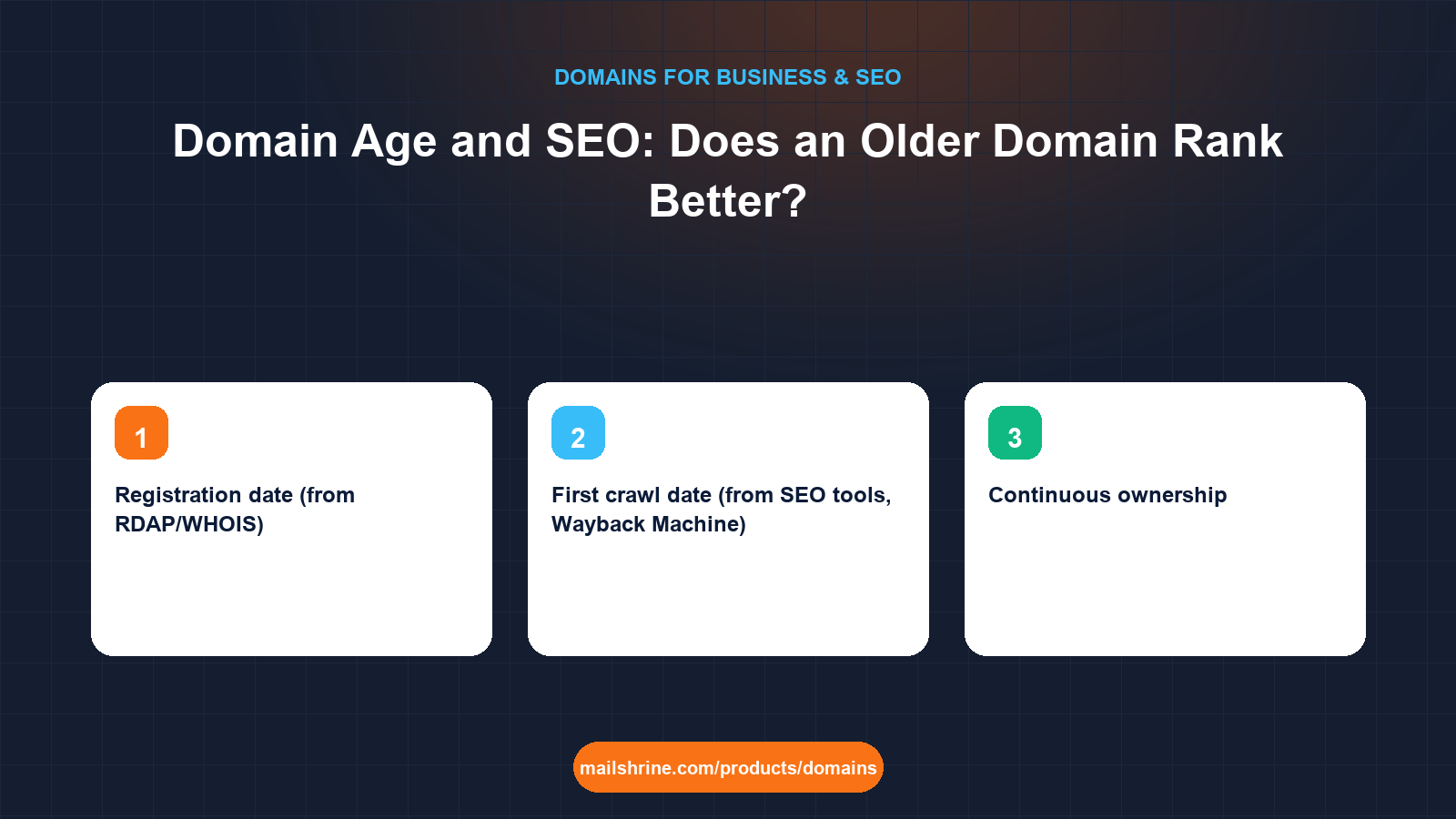
Domain age is the time since a name was first registered, or, in the version SEO tools measure, the time since Google first crawled a page on it. Those are two different clocks, and neither is a ranking factor on its own. Google's Search team has said plainly that it does not use registration age to rank pages. Yet the belief persists, because old domains do tend to rank better, and the reason is worth understanding before you spend $2,000 on a "15-year-old aged domain" at auction.
What old domains usually have is a history of content, links and consistent ownership. Those are the things that rank. A domain registered in 2009 and parked ever since has none of them. A domain registered last year with fifty earned links and a hundred useful pages has more. This guide shows how to tell the two apart, when buying an aged name is worth it, and how to check a name's past before it becomes your future.
MailShrine Domains shows aftermarket names that are for sale with a Buy Now price up to a cap, alongside fresh registrations across 150+ extensions. Whichever you choose, the name arrives with WHOIS privacy, transfer lock, and two Business Email mailboxes whose SPF, DKIM and DMARC records are written at registration.
Real-life example: Kwame's accounting firm
Kwame Mensah runs Ledgerline, a four-person accounting practice in Accra. A broker has offered him ledgerline.com, "registered in 2008, aged domain, instant authority", for $1,800. The fresh ledgerline.co is $9.99 on promo. His web designer says the old one will rank "years faster". Kwame wants evidence before he spends a quarter of his marketing budget.
Kwame's goals this week:
- Learn whether registration age itself changes rankings.
- Audit the 2008 name to see if its history is an asset or a liability.
- Pick the name that gets
kwame@ledgerlineworking with the least long-term risk.
Two clocks, one myth
| What people measure | What it actually tells you | Does Google use it? |
|---|---|---|
| Registration date (from RDAP/WHOIS) | When someone first paid for the name. Says nothing about whether a site ever existed. | No, by Google's own statements |
| First crawl date (from SEO tools, Wayback Machine) | When content first went live. Correlates with how long links have been accumulating. | Not as a factor; the links and content are what count |
| Continuous ownership | Whether the name changed hands. A drop and re-registration resets most accumulated value. | Indirectly, through link relevance |
| Link profile age | How long other sites have pointed here and whether they still do. | Yes, links are a core signal |
| Content history | What the name used to host. Gambling or pharmacy history can persist as a penalty. | Yes, through manual actions and spam systems |
Google's guidance for new sites says that it can take time for a site to be crawled, indexed and understood. That delay is about discovery, not age. A new domain with good internal linking and a submitted sitemap is typically indexed within days.
Auditing an "aged" domain before you pay
Kwame spent an hour on the 2008 name. Here is what he checked and what it revealed.
| Check | Tool | What Kwame found |
|---|---|---|
| Registration history | RDAP lookup at the registry | Registered 2008, dropped 2016, re-registered 2017 by a reseller. Continuity broken. |
| Archived content | Wayback Machine (web.archive.org) | A furniture shop until 2015, then a parked page with ads. No accounting relevance. |
| Indexed pages | site:ledgerline.com in Google | Zero results. Nothing indexed, so no "instant authority". |
| Backlinks | Any backlink tool's free tier | 23 referring domains, 19 of them Russian furniture directories. Irrelevant anchors. |
| Spam signals | Google Safe Browsing status page | Clean, but the parked period hosted redirect ads. |
| Trademark conflicts | Local IP office search | No "Ledgerline" mark registered in Ghana or the US. |
The verdict: the name's age is cosmetic. It was a furniture site that died, and its surviving links point at furniture pages that no longer exist. For an accounting firm the SEO value is close to zero.
What you need before you start
| You need | Why |
|---|---|
| The exact name under consideration | Age checks are per name, not per brand. ledgerline.com and ledgerline.co have unrelated histories. |
| Access to RDAP and the Wayback Machine | Both are free and show registration and content history respectively. |
| A free backlink tool account | To see who links in and with what anchor text. |
| A realistic budget comparison | Aged domain price plus cleanup time, against a fresh registration plus the content you would create anyway. |
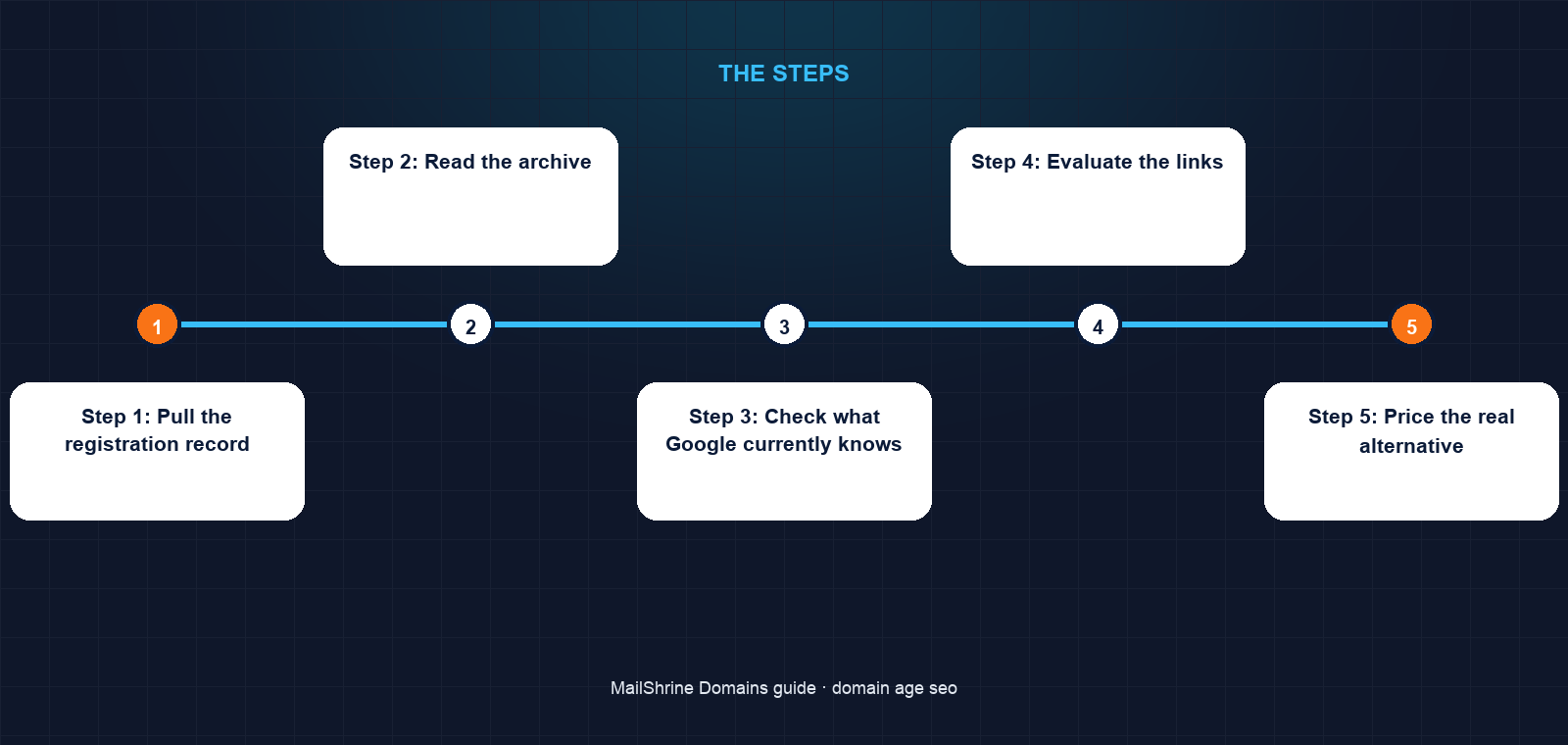
Step 1: Pull the registration record
Run an RDAP query for the name. Note the creation date, the last update, and the current registrar. A creation date far in the past with an "updated" date in the last year often means the name dropped and was re-registered, which severs any continuity Google might have tracked.
Step 2: Read the archive
Open the name in the Wayback Machine and click through snapshots across the years. You are looking for three things: what the site was about, whether it ever went dark or parked, and whether it ever showed content that violates Google's spam policies. Any gambling, pharmacy, or redirect period is a red flag.
Step 3: Check what Google currently knows
Search site:name.com. If nothing is indexed, there is no ranking to inherit. If pages are indexed under someone else's content, you will have to wait for them to drop out and redirect or return 410 for the old URLs.
Step 4: Evaluate the links
Export the referring domains. Count how many are topically related to your business and still live. Twenty irrelevant directory links are worth less than three from relevant local sites, and if the anchors are all in another language or industry, Google will not treat them as endorsements of an accounting firm.
Step 5: Price the real alternative
A fresh .com on MailShrine is typically $12.99 per year. A multi-year term locks that price and gets you the same privacy, lock and mailboxes. The aged domain must deliver more than the gap in price and the hours spent cleaning up, or it is a worse deal.
Step 6: Register and start the clock that matters
Whichever name wins, register it for 2 or more years, verify it in Search Console the same day, submit a sitemap, and publish the pages your customers search for. The history Google rewards begins the day real content and real links appear.
Kwame's checklist
- Ran RDAP and saw the 2016 drop that broke the 2008 "age"Completed
- Reviewed Wayback snapshots and found a dead furniture shopCompleted
- Confirmed zero indexed pages and 19 irrelevant backlinksCompleted
- Declined the $1,800 offer and registered
ledgerline.cofor 3 yearsCompleted - Verified the domain in Search Console with a TXT recordNot completed
- Published the first six service pages and submitted the sitemapNot completed
Common mistakes
Paying for registration age alone. Age without content and links is a date in a database. Pay for live, relevant links and a clean history, or pay the registration fee and build your own.
Skipping the Wayback Machine. It takes five minutes and is the only way to see whether a name once hosted something that could still carry a penalty.
Assuming a drop does not matter. When a domain expires and is re-registered, Google generally treats it as a new owner. Most of the prior value disappears, especially if content and links changed.
Buying an aged domain in an unrelated niche. Links from furniture directories do not help an accounting firm. Relevance matters more than count.
Check your work
In the MailShrine dashboard the domain should show Active, your chosen expiry year, and privacy and lock on. In Search Console, the Manual Actions and Security Issues reports should both read "No issues detected". If you bought an aged name, the Links report should show the referring domains you audited and none you did not expect.
FAQ
Does Google use domain age as a ranking factor?
No. Google's Search team has stated that domain registration age is not used for ranking. The advantage older domains often show comes from the links and content they accumulated over time.
Is a new domain penalised or put in a "sandbox"?
Google has said there is no sandbox. New sites take time to be crawled and to earn links, which can look like a waiting period, but a well-structured new site with a sitemap is usually indexed within days.
Does registering for 10 years help SEO?
There is no evidence that term length affects rankings. A long term does protect you from accidental expiry, which is the one domain event that does destroy rankings.
Is an expired aged domain worth buying?
Only if its link profile is relevant to your business, the content history is clean, and the price beats building those links yourself. Most aged domains at auction fail at least one of those tests.
How long before a new domain starts ranking?
Indexing takes days. Competitive rankings take months of content and links regardless of the domain's age. Focus the budget on those rather than on the registration date.
Next steps
- Do Domain Names Affect SEO? What Google Actually Says — the full picture on names, extensions and rankings.
- How to Value a Domain Name (Appraisal Basics) — what actually sets the price of an aftermarket name.
- Exact-Match Domains in 2026: Still Worth It? — the other popular reason people overpay for a name.
Citations & References
- Reference: Google Search Central: Spam policies for Google web search
- Reference: Google Search Central: Search Console Manual Actions report
- Reference: ICANN: Registration Data Access Protocol (RDAP)
- Reference: Internet Archive: Wayback Machine
Written by Isabelle R., domains editor. Isabelle explains how names, DNS and registrars fit together so first-time buyers know exactly what they are paying for.