
Domain names and SEO are linked, but not in the way most "buy this keyword domain" advice claims. Google has said repeatedly, in public documentation and in statements from its Search team, that the words in a domain are not a meaningful ranking signal on their own. What a domain does affect is everything around ranking: how memorable the brand is, how often people click your result instead of the one above it, how many of them type the name directly, and whether the name carries a history that helps or hurts you before you publish a single page.
This guide separates the three things people mean when they ask the question: the words in the name, the extension after the dot, and the history attached to the registration. Each has a different answer, and only one of them should change what you buy.
MailShrine Domains sells 150+ extensions with the first-year promo and the renewal price shown side by side, so you can weigh a brandable .com against a keyword .co on total cost rather than a teaser. Every name comes with WHOIS privacy, transfer lock and two free Business Email mailboxes, and the mail DNS is written for you at registration.
Real-life example: Tunde's repair shop
Tunde Bakare runs a phone and laptop repair shop in Yaba, Lagos. A freelancer told him that lagosphonerepair.com would "rank by itself" and that his preferred brand name, fixpoint.ng, would never show up in search. He has $40 to spend on names this year and wants to know which claim is true before he prints flyers.
Tunde's goals this week:
- Find out whether keywords in the domain still move rankings in 2026.
- Decide between the keyword name and the brand name without regret in two years.
- Register the winner with privacy on and a working
hello@address the same day.
What Google has actually said
| Claim people repeat | What Google's documentation and Search team say | Verdict |
|---|---|---|
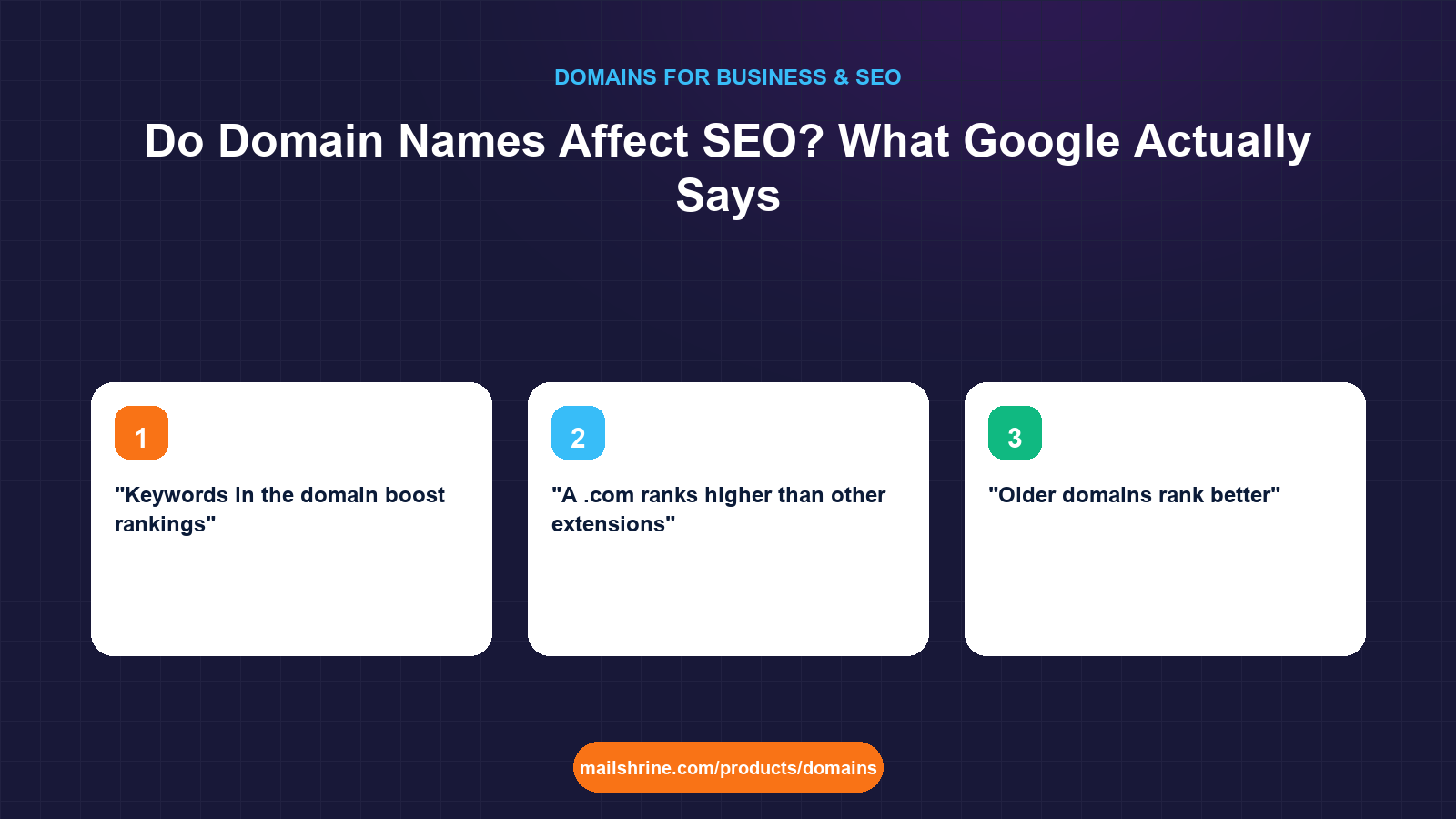
| "Keywords in the domain boost rankings" | The 2012 exact-match-domain update reduced the weight of low-quality keyword domains. Google staff have since described keyword-in-domain as a very small or non-existent factor. | Mostly false |
| "A .com ranks higher than other extensions" | Google treats generic TLDs (.com, .net, .org, .io, .shop and the rest) the same for ranking. Country-code TLDs act as a geotargeting signal, not a quality signal. | False for gTLDs |
| "Older domains rank better" | Google says domain age is not a factor it uses. What correlates with age is accumulated links and content. | Misleading |
| "Hyphens and numbers are penalised" | There is no penalty. They are harder to say out loud and type, which lowers direct visits and word-of-mouth. | False, but still avoid |
| "A domain with a bad history can hurt" | A previous owner's spam or manual action can persist until reviewed and cleaned. | True |
The pattern is consistent. Google ranks pages, not names. The name influences people, and people influence rankings through clicks, links and return visits.
The indirect effects that do matter
Google's own guidance on search appearance notes that the URL is shown in results and that a readable, descriptive URL helps users understand the page. That is the honest version of "domain SEO": the domain is part of the snippet a searcher sees for roughly a second before deciding where to click.
| Indirect effect | How it works | Example for Tunde |
|---|---|---|
| Click-through rate | A name that looks trustworthy and relevant earns more clicks from the same position. | fixpoint.ng reads as a business; lagosphonerepair.com reads as a directory. |
| Brand searches | People who remember the name search for it directly, which is a strong relevance signal for that query. | "fixpoint yaba" is searchable; nobody searches "lagos phone repair dot com". |
| Links and mentions | Journalists and bloggers link to brands by name. Keyword-stuffed names get rewritten or left unlinked. | A tech blog will write "Fixpoint", not the keyword string. |
| Email deliverability | Mail from a stable, properly authenticated domain lands in inboxes, which keeps customers coming back to the site. | MailShrine writes SPF, DKIM and DMARC at registration. |
| Anchor text | When sites link using your brand, the anchor text matches the name, which reinforces brand queries. | Dozens of "Fixpoint" anchors beat one "phone repair" anchor. |
None of these are ranking factors in the strict sense. All of them change the numbers that ranking factors measure.
What you need before you start
| You need | Why it matters for SEO |
|---|---|
| A short list of two or three candidate names | You will compare them on memorability and cost, not on keyword count. |
| A history check on each name | A previously used name can carry a manual action or spam links. Search site:name.com and check the Wayback Machine. |
| A decision on the extension | Generic TLDs rank equally; a ccTLD such as .ng tells Google your primary market is Nigeria. |
| A registrant email you will keep | Renewal and transfer notices go there. Losing the domain is the only domain decision that truly destroys rankings. |
Step 1: Test each name for history
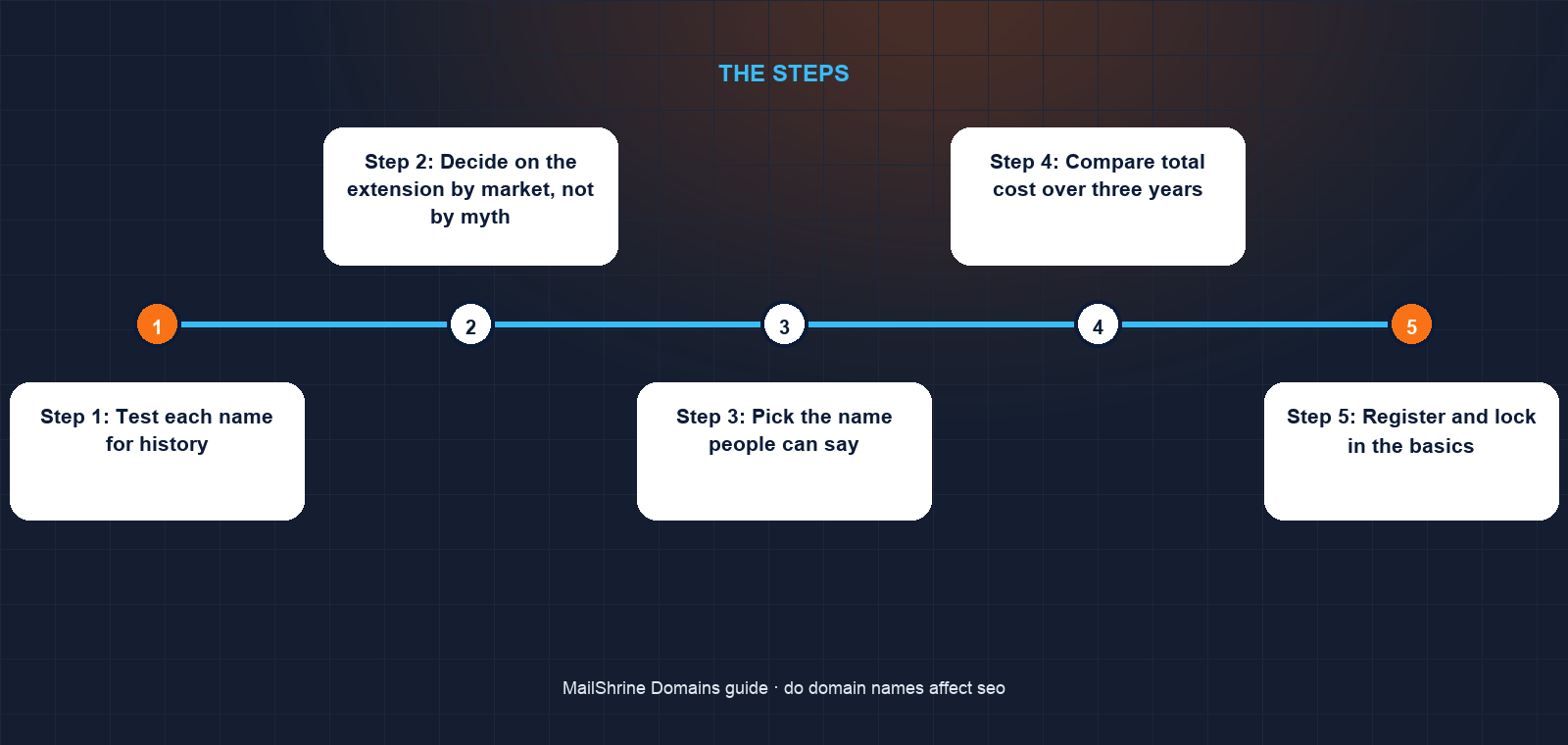
Before paying for anything, search Google for the exact name in quotes and run a site: query. A name that returns results you did not create was registered before. Look it up on the Wayback Machine at web.archive.org. If the snapshots show a pharmacy, casino or link farm, expect to spend months cleaning it up through Search Console's disavow tool, and consider a different name.
Step 2: Decide on the extension by market, not by myth
If 90 percent of your customers are in one country, that country's ccTLD is a legitimate geotargeting signal and often signals trust locally. If you sell across borders, a generic TLD lets you set targeting per section in Search Console. Google explicitly lists .com, .org, .net and most new extensions as generic, meaning no built-in country signal.
Step 3: Pick the name people can say
Say each candidate out loud to someone who has not seen it written. If they cannot spell it back, it will leak direct traffic to typos. Avoid hyphens and numbers for the same reason. This test eliminates most keyword-stuffed names on its own.
Step 4: Compare total cost over three years
On MailShrine the first-year price and the renewal price sit next to each other. A .com at $12.99 renewing at $12.99 costs $38.97 over three years. A promotional extension at $2.99 renewing at $29.99 costs $62.97. The cheap teaser is the expensive option.
Step 5: Register and lock in the basics
Register for at least two years so the name does not lapse during the slow early months of a new site. Leave WHOIS privacy and transfer lock on. MailShrine writes MX, SPF, DKIM and DMARC records at registration, so your hello@ address authenticates from day one and customers can reply to you without the mail going to spam.
Step 6: Build the signals the name cannot give you
Set up Search Console, submit a sitemap, write the pages that answer what your customers actually search, and earn links by being mentioned. A brandable name makes every one of those steps easier. It does none of them for you.
Tunde's checklist
- Searched both names in quotes and with
site:to check for a past lifeCompleted - Confirmed
.ngmatches his market and.comwould be neutralCompleted - Read both names aloud to two customers; only
fixpointsurvivedCompleted - Registered
fixpoint.ngfor 2 years with privacy and lock onCompleted - Added the domain to Search Console and verified with a DNS TXT recordNot completed
- Printed flyers with
hello@fixpoint.nginstead of the old Gmail addressNot completed
Common mistakes
Buying the keyword name and the brand name "to be safe". Two live sites with the same content split your links and confuse Google about which is canonical. If you buy both, redirect one to the other with a 301.
Treating a ccTLD as a penalty. A .ng, .ke or .de does not rank lower. It tells Google where your audience is. It only hurts if you later want to rank in a different country.
Ignoring the renewal price. A lapsed domain is the one domain decision that erases rankings overnight. Choose a name you can afford to renew for years, not just register once.
Changing the name later for SEO reasons. Every domain move costs a temporary dip while Google reprocesses redirects. Pick once, pick a brand, and keep it.
Check your work
Open the domain in your MailShrine dashboard and confirm status Active, an expiry at least two years out, and privacy and lock on. Then open Search Console, add the domain property, and verify through the DNS TXT record MailShrine lets you add in the record editor. A verified property with no manual actions listed means the name is clean and ready to earn rankings through its content.
FAQ
Does having a keyword in my domain help at all?
Marginally at most. Google's John Mueller has said that keywords in the domain do not give a ranking bonus. Any benefit you see usually comes from people clicking a result that looks relevant, not from the algorithm reading the name.
Do new extensions like .shop or .io rank worse than .com?
No. Google classifies them as generic TLDs and ranks them the same way. The practical difference is that some users still trust .com more, which can affect click-through rate rather than position.
Will a hyphenated domain hurt my SEO?
Not directly. Hyphens make a name harder to say and type, which reduces direct visits and increases typo traffic going elsewhere. Choose a hyphen-free name if one is available.
Can a domain's history hurt my rankings before I publish anything?
Yes. If a previous owner received a manual action or built spam links, that can carry over. Check Search Console after verifying the domain and use the disavow tool if the backlink profile is toxic.
Should I switch to a .com if I already rank on another extension?
Only for a brand reason. Moving domains costs a temporary dip and weeks of redirect maintenance, and Google treats generic extensions equally, so there is no ranking gain to recover that cost.
Next steps
- Domain Age and SEO: Does an Older Domain Rank Better? — what Google says about age and what actually correlates with it.
- Exact-Match Domains in 2026: Still Worth It? — the full story on keyword domains since the 2012 update.
- Country Domains vs .com for International Business — when a ccTLD helps and when it boxes you in.
Citations & References
- Reference: Google Search Central: SEO Starter Guide
- Reference: Google Search Central: Managing multi-regional and multilingual sites
- Reference: Google Search Central: Site moves with URL changes
- Reference: ICANN: List of top-level domains
Written by Isabelle R., domains editor. Isabelle explains how names, DNS and registrars fit together so first-time buyers know exactly what they are paying for.