
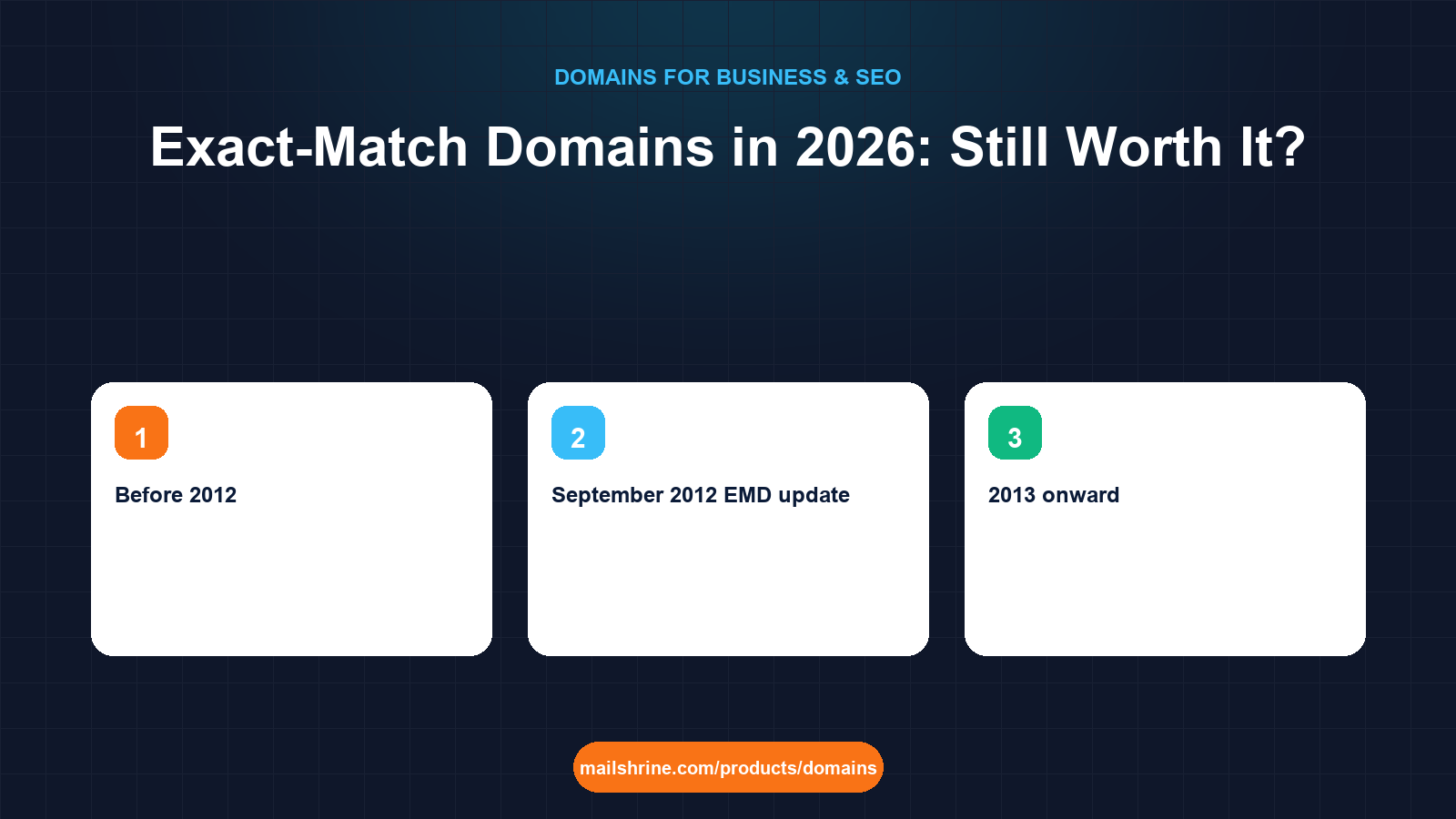
An exact-match domain (EMD) is a domain whose name is the exact search phrase you want to rank for: cheapcarinsurance.com, plumberlagos.com, bestcoffeebeans.co.uk. For a stretch of the late 2000s they were a shortcut. A thin site on a keyword domain could outrank established competitors because the name matched the query. In September 2012 Google shipped an update specifically aimed at low-quality exact-match domains, and the shortcut closed. The domains did not become toxic; they simply stopped getting credit for the name alone.
Fourteen years later the question still gets asked because EMDs still appear to work in some results. The honest answer is that a keyword domain is neither a boost nor a penalty in 2026. It is a branding choice with a specific set of trade-offs, and most small businesses make it for the wrong reasons. This guide gives you the history, the current evidence, and a way to decide that does not depend on folklore.
MailShrine Domains shows keyword names and brandable names side by side with first-year and renewal prices across 150+ extensions. Whichever you choose arrives with WHOIS privacy and transfer lock on, mail DNS written for you, and two Business Email mailboxes.
Real-life example: Sarah's cleaning company
Sarah Whitfield runs a four-van domestic cleaning business in Manchester. Her company is called Brightside Cleaning, but a marketing agency has pitched her cleanersmanchester.co.uk as "the SEO play", claiming it will rank for her main search term within months. She already owns brightsidecleaning.co.uk, which ranks on page two. She wants to know whether to switch, run both, or ignore the pitch.
Sarah's goals this week:
- Understand what the 2012 EMD update changed and what it left alone.
- Decide whether the keyword name would help, hurt or do nothing for her rankings.
- Avoid splitting her existing authority across two domains.
What changed in 2012 and what did not
| Period | How Google treated keyword domains | What that meant for owners |
|---|---|---|
| Before 2012 | The name matched the query and gave a visible lift, even for thin sites | Buying the phrase as a domain was a ranking tactic |
| September 2012 EMD update | Google reduced rankings for low-quality sites that relied on the exact-match name | Thin EMDs fell; quality EMDs were largely unaffected |
| 2013 onward | Keyword-in-domain weight continued to decline as Google's relevance systems improved | The name became one small signal among hundreds |
| 2026 | Google staff describe keyword domains as neither helping nor hurting | The decision is about branding, memorability and trust |
Google's announcement at the time described the change as targeting "low-quality exact-match domains". The important word was quality. An EMD with excellent content was fine then and is fine now. The myth that survives is that the name itself does the work.
EMD versus brand: the trade-offs that actually exist
| Factor | Exact-match domain | Brandable domain |
|---|---|---|
| Click-through in results | Can look relevant for the exact query; can also look like spam or a directory | Looks like a company; relies on reputation to earn the click |
| Expansion | Boxed in. cleanersmanchester cannot sell in Leeds or offer gardening | Grows with the business |
| Word of mouth | Hard to recommend; "which cleaners Manchester site?" | Easy to say and search for |
| Brand searches | Nearly impossible; the name is a generic phrase | Each brand search is a strong signal for that query |
| Links and press | Journalists write "a local cleaning firm", not the URL | Journalists write "Brightside Cleaning" and link it |
| Trademark protection | Generic phrases cannot be trademarked | A distinctive name can be registered and defended |
| Availability and price | Most English keyword .coms are taken or priced in the thousands | More options available at standard registration prices |
The one legitimate case for a keyword domain is a single-location, single-service business that will never expand and whose customers find it only through search. Even then, the advantage is a possible lift in click-through rate, not in position.
What you need before you start
| You need | Why |
|---|---|
| Your current rankings for the target phrase | If you already rank, a new domain means starting the clock again. |
| The exact keyword name's availability and price | Many are taken; aftermarket prices for short English phrases run from hundreds to tens of thousands. |
| A two-year view of the business | Will you add services or locations the keyword excludes? |
| A plan for the second domain if you buy it | Redirect it to the primary, or do not buy it. |
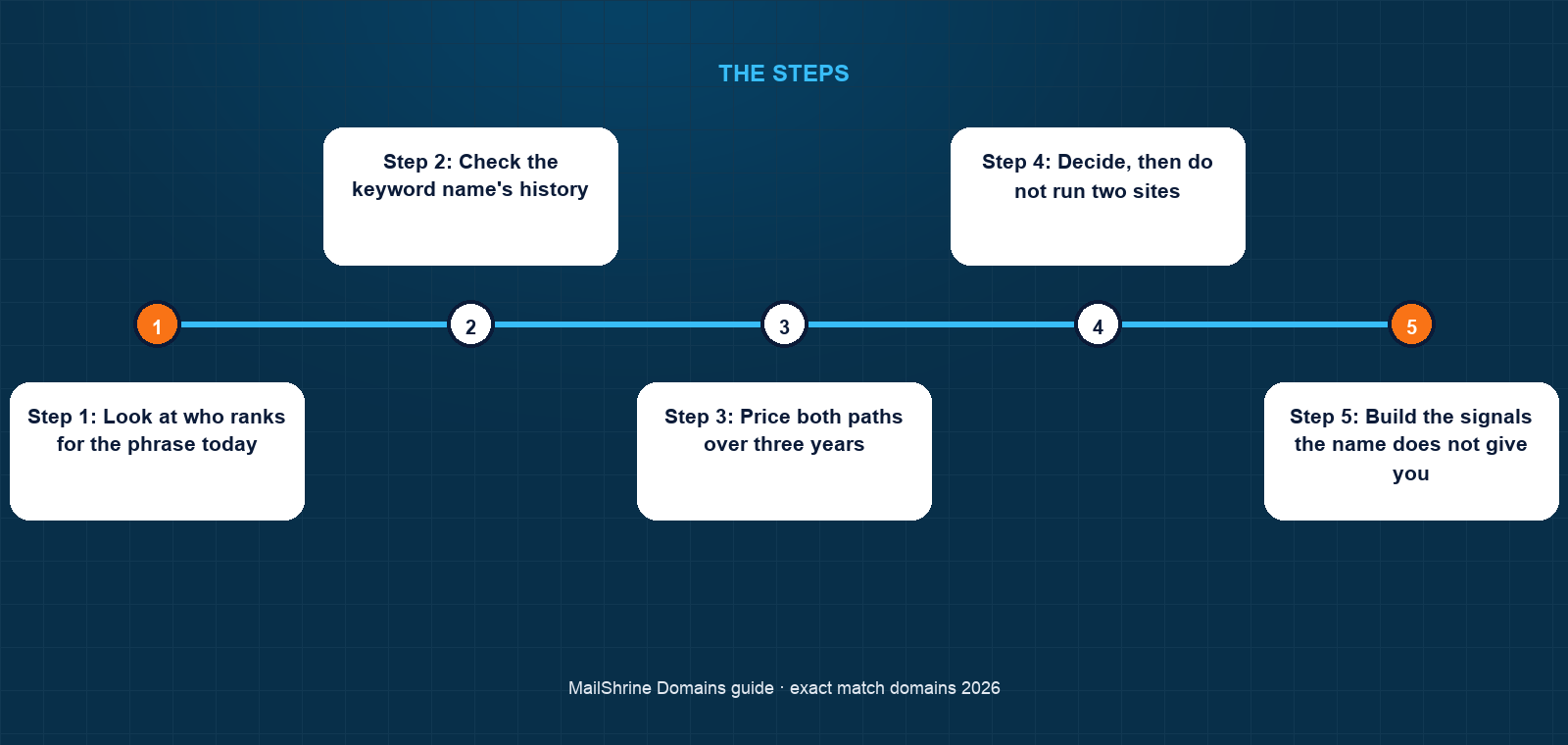
Step 1: Look at who ranks for the phrase today
Search the phrase and read the top ten results. Count how many are exact-match domains. In most local service markets in 2026 it is zero or one, and the pages that rank are brand sites with strong reviews, local citations and detailed service pages. That tells you what Google is actually rewarding.
Step 2: Check the keyword name's history
If the keyword domain is available or for sale, run an RDAP lookup and open the Wayback Machine. Keyword domains were heavily used for thin affiliate sites in the EMD era, and a name that carried that content may still carry a manual action or toxic backlinks.
Step 3: Price both paths over three years
A brand name on MailShrine is typically $12.99 per year for a .com with the renewal price shown up front. A keyword .com on the aftermarket may be $500 to $5,000. If the keyword name only buys a possible click-through improvement, compare that against spending the same money on service pages and reviews.
Step 4: Decide, then do not run two sites
If you choose the brand name, keep it and build. If you choose the keyword name, redirect the brand name to it with a 301 and move the content properly. Two live sites targeting the same phrase split your links, dilute reviews across two listings, and can trigger duplicate-content filtering. Nothing is worse than owning both and using both.
Step 5: Build the signals the name does not give you
Write a service page for every service and area. Collect reviews on your Google Business Profile. Earn local links from suppliers, community sites and press. These are the factors that put the current top ten where they are, and they work on either domain.
Step 6: Register and protect the primary
Register the chosen domain for 2 or more years with privacy and lock on. Verify it in Search Console. MailShrine writes SPF, DKIM and DMARC at registration so your quotes and invoices from sarah@ authenticate from the first send.
Sarah's checklist
- Read the top ten for "cleaners Manchester"; none were exact-match domainsCompleted
- Ran RDAP on
cleanersmanchester.co.uk: registered 2009, dropped 2019, parked sinceCompleted - Priced the keyword name at $1,200 on the aftermarket versus $12.99 for the brand renewalCompleted
- Kept
brightsidecleaning.co.ukas the only live siteCompleted - Published area pages for Didsbury, Chorlton and SaleNot completed
- Asked the last 30 customers for Google reviewsNot completed
Common mistakes
Buying the keyword domain and pointing it at a one-page site. This is exactly the pattern the 2012 update targeted. A thin EMD does not rank and can attract scrutiny.
Running the keyword site and the brand site in parallel. Your links, reviews and content split in two. Choose one domain and 301 the other.
Paying aftermarket prices for a phrase you could rank for anyway. Most local phrases are won with pages and reviews, not names.
Confusing keyword domains with descriptive brand names. Brightside Cleaning describes the service and is distinctive. cleanersmanchester is a search query. Only the first can be trademarked and recommended.
Ignoring the name's past. EMDs were the favourite of spam networks for years. Audit before you buy.
Check your work
In Search Console, your single domain should be verified with no manual actions. In Google, searching your brand name should return your site first. In the MailShrine dashboard the domain should show Active, an expiry at least two years out, and privacy and lock on. If you own a second domain, request it in a browser and confirm it redirects in one hop to the primary.
FAQ
Did Google penalise exact-match domains?
No. The 2012 update lowered rankings for low-quality sites that depended on the matching name. High-quality sites on keyword domains were largely unaffected, and the name itself has never been a penalty.
Do exact-match domains still rank better in 2026?
Not because of the name. Where an EMD ranks well, it has the same content, links and reviews that any brand site would need. Google staff have said keyword domains give no ranking bonus.
Is a partial-match domain any different?
A partial-match domain includes the keyword plus other words, such as brightsidecleaningmanchester. It is treated the same way: no bonus, no penalty, and the same branding trade-offs, with a longer name to type.
Can I rank a brand name for a keyword phrase?
Yes. Most top-ranking local businesses have brand names. Service pages that use the phrase naturally, reviews and local links do the ranking.
Should I buy the keyword domain just so a competitor cannot?
Only if the renewal fits your defensive budget and you redirect it to your brand. It will not add ranking value, and a competitor owning it would not either.
Next steps
- Do Domain Names Affect SEO? What Google Actually Says — the wider evidence on names and rankings.
- Domain Age and SEO: Does an Older Domain Rank Better? — the other reason people overpay for aftermarket names.
- How to Value a Domain Name (Appraisal Basics) — what a keyword domain is actually worth.
Citations & References
- Reference: Google Search Central: Spam policies for Google web search
- Reference: Google Search Central: Creating helpful, reliable, people-first content
- Reference: Google Search Central: Consolidate duplicate URLs
- Reference: ICANN: Registration Data Access Protocol (RDAP)
Written by Marcus T., DNS and deliverability editor. Marcus has run mail and DNS for registrars and ISPs and writes about what the evidence shows, not what the sales deck says.