
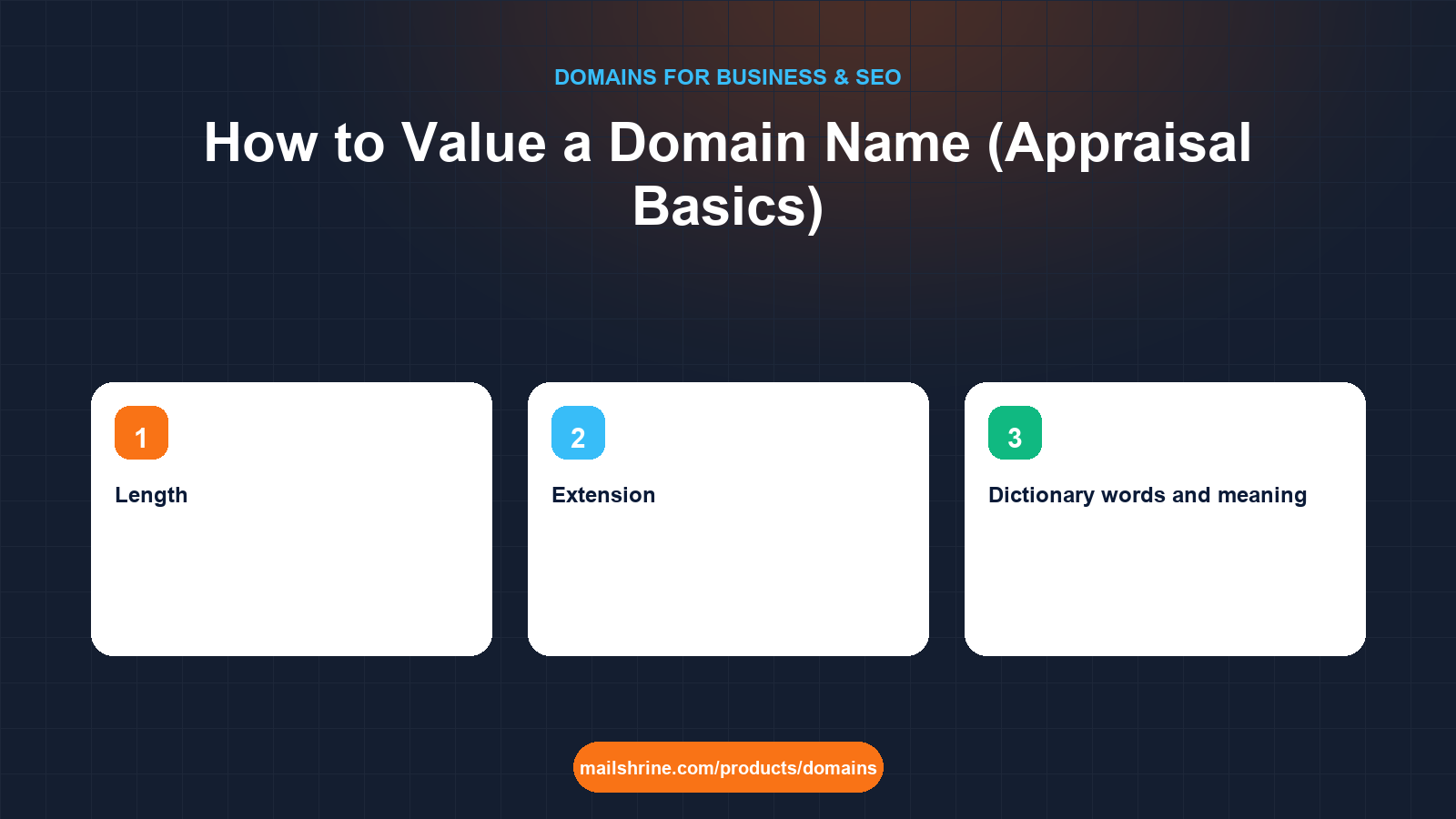
Domain appraisal is the attempt to put a price on a name that has no intrinsic value, no cash flow, and a market where the same name can sell for $200 to one buyer and $20,000 to another. There is no official price list. What there is, is a set of factors that reliably move the number, a public record of what comparable names actually sold for, and a handful of automated tools that estimate within a very wide band. Learn those three and you can tell whether an offer on your name is fair, whether a name you want is overpriced, and whether a "$5,000 appraisal certificate" is worth the paper.
The anchor fact is this: the vast majority of registered domains have a resale value of zero beyond the registration fee. Value concentrates in a thin slice of short, memorable, generic or brandable names on the right extension. This guide shows how to tell which slice a name sits in and how to estimate within it.
MailShrine Domains shows aftermarket names that are listed for sale with their Buy Now price, up to a cap, alongside fresh registrations across 150+ extensions. That makes it easy to see what sellers are asking for comparable names before you set or accept a price of your own.
Real-life example: Rohan's unused name
Rohan Mehta is a software consultant in Mumbai who registered payflow.in in 2019 for a fintech side project that never launched. Last week a startup emailed offering $600. A friend says it is worth $10,000. An online appraisal tool says $2,100. Rohan does not know which number to believe and does not want to leave money on the table or scare off the only buyer.
Rohan's goals this week:
- Learn which factors actually set the price of a name like his.
- Find real sales of comparable names, not guesses.
- Arrive at a defensible asking price and a floor he will not go below.
The factors that move the price
| Factor | Why it matters | Effect on value |
|---|---|---|
| Length | Shorter names are easier to remember, type and brand. Four- and five-letter names command a premium. | Strong |
| Extension | .com sells for several times the same name on another extension. ccTLDs are valued mostly by in-country buyers. | Strong |
| Dictionary words and meaning | A real word or a clear two-word compound has many potential buyers. Made-up strings have few. | Strong |
| Brandability | Easy to say, spell and hear. "payflow" passes; "pay-fl0w" does not. | Medium to strong |
| Commercial intent | Names tied to markets where companies spend money (finance, insurance, software) attract corporate buyers. | Medium |
| Search volume for the term | Indicates how many people think about the phrase; relevant for keyword names. | Medium, declining |
| Hyphens and numbers | Reduce memorability and signal that the clean version was taken. | Negative |
| Trademark conflicts | A name matching a registered mark can be taken through UDRP, so buyers avoid it. | Strongly negative |
| Existing traffic and links | Type-in visitors or a clean backlink profile add value for some buyers. | Small to medium |
| Comparable sales | What similar names actually sold for is the best evidence of all. | Decisive |
Three ways to estimate, and what each is good for
| Method | How it works | Accuracy | Cost |
|---|---|---|---|
| Automated appraisal tools | Algorithms trained on past sales score the name on length, words and extension | Wide band; good for ruling out worthless names, poor for pricing a specific sale | Free |
| Comparable sales research | Search public sales databases for names of similar length, words and extension and look at the median | The best evidence available; what brokers actually use | Free, takes an hour |
| Professional broker appraisal | A broker who sells names in that niche gives a market opinion, usually ahead of listing with them | Good for premium names; unnecessary below a few thousand dollars | Often free when listing, otherwise a fee |
Public sales records are the key. NameBio and similar databases publish reported sales going back decades, searchable by keyword and extension. For payflow.in, Rohan should look at two-word .in names with a finance word, and at payflow and its near-neighbours on other extensions.
What you need before you start
| You need | Why |
|---|---|
| The exact name and extension | Value is specific to the full string; payflow.com and payflow.in are different assets. |
An RDAP lookup on the .com and major siblings | If payflow.com is an active company, your name's buyer pool shrinks to them and their competitors. |
| A trademark search in the relevant countries | A name that infringes a mark is close to unsellable. |
| An hour on a sales database | Comparable sales are the only objective evidence. |
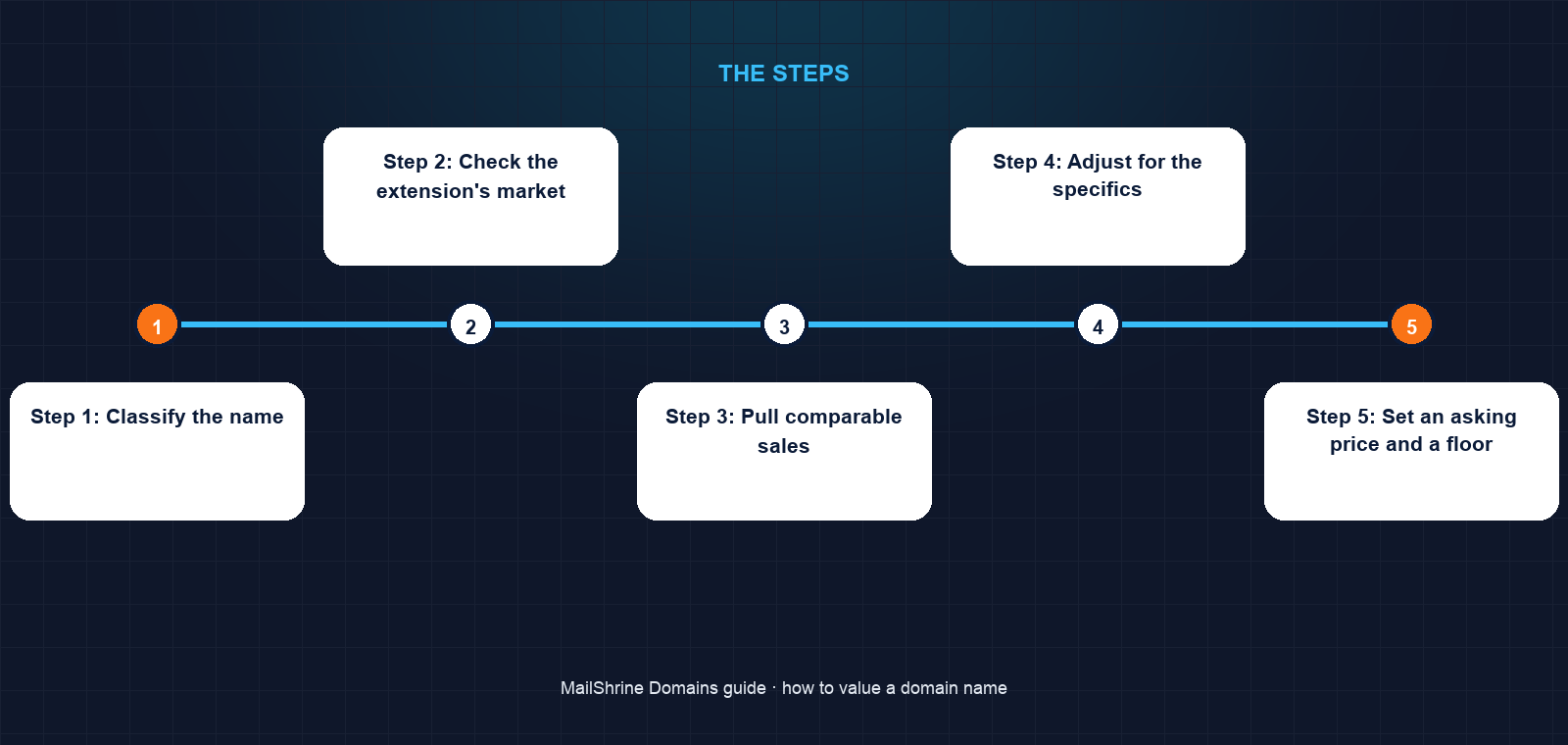
Step 1: Classify the name
Decide which bucket it is in: short and generic (high value), brandable two-word compound (moderate), keyword phrase (modest and declining), or long and specific (registration value only). payflow is a brandable compound with commercial intent in fintech. That is the moderate bucket.
Step 2: Check the extension's market
Look at who holds the same name on .com, .io and .co. If payflow.com is a funded company, two things follow: there is a motivated buyer who might want the .in for an India launch, and nobody else will want to build a competing brand on it. Rohan found a US payments company on the .com.
Step 3: Pull comparable sales
Search the sales database for .in names of two words, six to eight letters, in finance. Note the median and the range over the last three years. Rohan found eleven comparable .in sales between $350 and $2,800, with a median around $900.
Step 4: Adjust for the specifics
Move the estimate up for brandability and the obvious strategic buyer; down for the ccTLD's smaller buyer pool and the lack of traffic. Rohan lands on a fair-market range of $900–2,000.
Step 5: Set an asking price and a floor
Ask toward the top of the range with room to negotiate, and decide privately on the lowest number you will accept. Rohan asks $1,800 and sets a floor of $1,000. The $600 offer is below the floor, so he counters rather than accepts.
Step 6: Keep the name registered while you negotiate
Nothing collapses a sale like an expiring domain. Confirm the expiry is at least a year out, auto-renew is on, and lock stays on until a sale closes through escrow. MailShrine sends reminders at 30, 7 and 1 day, but check the date yourself before listing.
Rohan's checklist
- Classified
payflow.inas a brandable fintech compound on a ccTLDCompleted - Found a funded US company on
payflow.comvia RDAPCompleted - Pulled eleven comparable
.insales, median around $900Completed - Set an asking price of $1,800 and a floor of $1,000Completed
- Countered the $600 offer with the comparable sales as evidenceNot completed
- Confirmed the expiry is 14 months out with auto-renew onNot completed
Common mistakes
Trusting one automated appraisal. Tools disagree with each other by a factor of five on the same name. Use them to confirm a name is not worthless, then do the comparable research.
Pricing from the extension's best sale. A .in that sold for $50,000 once does not make every .in valuable. Use the median of names like yours.
Ignoring trademark conflicts. A name that matches a registered mark can be transferred away through UDRP after you sell it, leaving the buyer with nothing and you with a dispute.
Letting the domain expire mid-negotiation. A buyer who sees a pending-delete status simply waits for the drop.
Confusing registration cost with value. The $12.99 you paid, or the $200 you paid over ten years, is sunk. The market does not care what you spent.
Check your work
Your estimate should sit inside the range of at least five comparable sales you can name. You should be able to state the name's bucket, its extension's buyer pool, and any trademark risk in one sentence each. In the MailShrine dashboard the domain should show Active, expiry over a year out, lock on, and auto-renew on.
FAQ
How accurate are free domain appraisal tools?
Roughly within an order of magnitude. They are useful for separating names worth listing from names worth letting go, but should not set your asking price. Comparable sales do that.
Does traffic add value to a domain?
A little, for names with genuine type-in visitors. Most unused domains have none, and buyers rarely pay for traffic they cannot verify. Brandability and extension matter far more.
Is my .ng or .in domain worth less than the .com?
Usually, because the buyer pool is smaller. But a ccTLD can be worth a lot to a company launching in that country, especially if they already own the .com.
What is a reasonable price for a decent brandable .com?
Reported sales for brandable, two-word .com names commonly fall in the low thousands of dollars, with short dictionary words going far higher. Check the sales databases for names like yours rather than relying on averages.
Should I pay for a professional appraisal?
Only if the name plausibly sells for five figures or more, where a broker's market knowledge earns its fee. Below that, an hour of comparable-sales research is just as good.
Next steps
- Selling a Domain Name: Marketplaces, Pricing and Escrow — turning the appraisal into a safe sale.
- Domain Age and SEO: Does an Older Domain Rank Better? — why buyers overpay for "aged" names.
- Parking a Domain: What It Means and Whether to Do It — what to do with the name while you wait for a buyer.
Citations & References
- Reference: ICANN: Uniform Domain-Name Dispute-Resolution Policy
- Reference: NameBio: Domain name sales history database
- Reference: Verisign: Domain Name Industry Brief
- Reference: WIPO: Domain name dispute resolution
Written by Marcus T., DNS and deliverability editor. Marcus has run mail and DNS for registrars and ISPs and writes about what the evidence shows, not what the sales deck says.