
A country-code top-level domain (ccTLD) is a two-letter extension assigned to a country or territory under ISO 3166: .ng for Nigeria, .ke for Kenya, .de for Germany, .ca for Canada, .in for India. There are about 250 of them, each run by a registry chosen by that country, each with its own rules on who may register. A generic TLD (gTLD) like .com, .org or .shop has no country attached and is open to anyone.
For search engines the difference is not cosmetic. Google treats a ccTLD as a strong signal that a site targets that country, and a gTLD as neutral, targetable per section through Search Console. For customers the difference is trust: a .de reads as a German company to a German buyer, and a .com reads as international or American. For a business about to sell across borders, the choice determines how you structure the whole site. This guide lays out the options, the registry rules that constrain them, and a way to pick.
MailShrine Domains sells 150+ extensions including many ccTLDs, with the first-year promo and renewal shown together, and routes each to the right registry through Openprovider or Dynadot. Every name gets WHOIS privacy where the registry permits it, transfer lock, and two Business Email mailboxes with mail DNS written at registration.
Real-life example: Aminata's textile exports
Aminata Diallo runs Teranga Textiles in Dakar, selling hand-dyed fabric to boutiques in Senegal, France and increasingly the United States. Her site is on terangatextiles.sn. French buyers find her easily; American buyers mostly do not, and two of them have asked whether she is "a real company" because of the unfamiliar extension. She is deciding whether to move to .com, add it, or stay.
Aminata's goals this quarter:
- Rank in France and the US without losing her Senegalese presence.
- Look credible to buyers who have never seen
.sn. - Keep one set of mailboxes and one inbox regardless of how many domains she holds.
How Google reads the extension
| Extension type | Google's geotargeting treatment | Can you change it? | Examples |
|---|---|---|---|
| ccTLD | Automatically targeted to that country | No | .sn, .ng, .de, .fr |
| gTLD | No default target; set per domain, subdomain or folder in Search Console | Yes | .com, .org, .net, .shop |
| "Generic" ccTLDs | Treated by Google as generic despite being country codes, because they are used globally | Yes | .io, .co, .me, .tv, .ai |
The third row trips people up. Google maintains a list of ccTLDs it treats as generic because the world uses them that way. .co (Colombia) and .io (British Indian Ocean Territory) are on it. .sn is not, so Aminata's current domain tells Google her audience is in Senegal, which explains the US problem.
Three ways to structure an international site
| Structure | Example | Strengths | Weaknesses |
|---|---|---|---|
| Separate ccTLD per country | teranga.sn, teranga.fr, teranga.com | Strongest local signal and trust; clear legal separation | Each domain starts from zero authority; several registrations and renewals; some ccTLDs require local presence |
| One gTLD with country subfolders | teranga.com/fr/, teranga.com/us/ | One domain accumulates all authority; cheapest; easy to add markets | Weaker local trust signal; needs hreflang tags and Search Console targeting per folder |
| One gTLD with country subdomains | fr.teranga.com, us.teranga.com | Can be hosted separately; targetable per subdomain | Google may treat subdomains as semi-separate sites; authority partly split |
Google's documentation on multi-regional sites lists exactly these three and says all are workable. For a small exporter the subfolder approach is usually best: one domain, one renewal, one email setup, with hreflang telling Google which page is for which country and language.
Registry rules that affect the choice
ccTLD registries set their own eligibility rules, and they matter before you buy.
| ccTLD | Who may register | Notes |
|---|---|---|
| .de | Anyone, but an administrative contact with a German address is required | DENIC rules; many registrars provide a trustee service |
| .fr | Residents and companies in the EU/EEA | Open to EU addresses since 2011 |
| .ca | Canadian citizens, residents, businesses or trademark holders | CIRA's Canadian Presence Requirements |
| .ng | Anyone; .com.ng and .ng both open | NiRA; no local presence needed |
| .ke | Anyone for .co.ke; .ke second level open since 2017 | KeNIC |
| .us | US citizens, residents or entities with a bona fide US presence | Nexus requirement; WHOIS privacy not permitted |
| .in | Anyone | NIXI; no residency rule |
Two things follow. First, if you cannot meet a country's presence requirement, the subfolder structure on a gTLD is your only clean route into that market. Second, some ccTLDs such as .us forbid WHOIS privacy, which affects what personal data appears publicly.
What you need before you start
| You need | Why |
|---|---|
| A list of the countries you actually sell to, ranked by revenue | Structure follows markets, not ambition. |
| Each target ccTLD's eligibility rules | Decides whether a ccTLD is even possible for you. |
| A decision on primary domain | Everything else redirects to or hangs off this one. |
| hreflang knowledge or a developer who has it | Required for any multi-country site on a single domain. |
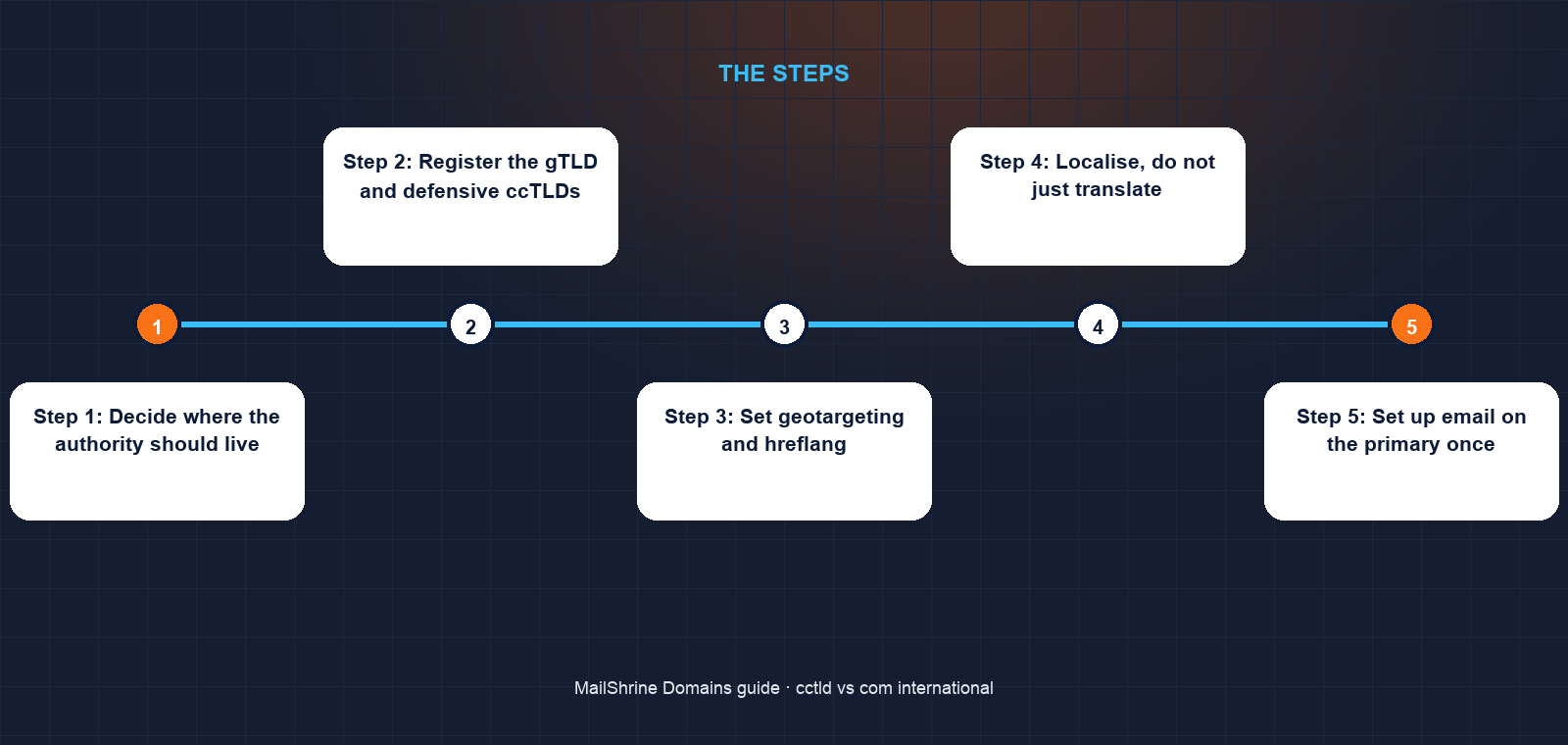
Step 1: Decide where the authority should live
If one market will always dominate, make its ccTLD the primary and treat other markets as secondary. If you are genuinely multi-market or growing, make a gTLD the primary so every link from every country strengthens one domain. Aminata's revenue is shifting toward France and the US, so a .com primary with /fr/ and /us/ folders fits.
Step 2: Register the gTLD and defensive ccTLDs
Register teranga.com on MailShrine for 2 or more years. Keep terangatextiles.sn for its local audience and redirect it, or keep it live for Senegalese buyers with hreflang pointing to the .com pages for other markets. Only register a ccTLD you will actually use or must defend.
Step 3: Set geotargeting and hreflang
In Search Console, add the .com property and set the international targeting for each folder. On every page, add hreflang link elements listing each language and country version, including an x-default. This is what stops the French and American pages competing with each other.
Step 4: Localise, do not just translate
Google's guidance warns against serving the same content to every country with only the currency swapped. Give the /fr/ pages French prices, shipping terms and contact details, and the /us/ pages the same for the US. Local content is what earns local links.
Step 5: Set up email on the primary once
Create mailboxes on the .com. MailShrine writes MX, SPF, DKIM and DMARC for it at registration. Point the .sn MX at the same mailboxes or forward its addresses so Aminata keeps one inbox and buyers can reply to either name.
Step 6: Watch Search Console by country
After a few weeks, filter the Performance report by country. Impressions from France and the US should rise on the .com. If a market stays flat, check that its hreflang tags are reciprocated and that the folder's content is actually localised.
Aminata's checklist
- Ranked markets by revenue: Senegal 45%, France 35%, US 20% and climbingCompleted
- Confirmed she cannot meet
.usnexus rules, ruling out a US ccTLDCompleted - Registered
teranga.comfor 3 years as the new primaryCompleted - Kept
terangatextiles.snrenewing and pointed its MX at the same mailboxesCompleted - Added hreflang tags across
/fr/and/us/with anx-defaultNot completed - Set geotargeting for each folder in Search ConsoleNot completed
Common mistakes
Assuming a ccTLD ranks lower. It does not. It ranks well in its country and poorly elsewhere, by design. The problem is only when your customers are elsewhere.
Registering ccTLDs for markets you cannot serve. A .de with no German stock, pricing or support earns nothing and a renewal bill. Follow the revenue.
Skipping hreflang on a single-domain site. Without it, Google may show the French page to Americans or treat the versions as duplicates.
Buying a "generic" ccTLD for its country. .co and .io do not geotarget Colombia or the Indian Ocean Territory in Google's eyes. If you want a country signal, pick a ccTLD Google treats as a country code.
Translating without localising. Same product, same price in dollars, same shipping note, different language. Google notices and so do buyers.
Check your work
In Search Console, each folder should show its target country and the International Targeting report should list no hreflang errors. In MailShrine, every domain should show Active, expiry years out, and lock on, with privacy on where the registry allows. Send a test email to an address on each domain and confirm it reaches the single inbox.
FAQ
Does a .com rank better internationally than a ccTLD?
A .com has no country attached, so it can rank anywhere you target it. A ccTLD ranks strongly in its country and weakly elsewhere. Neither is "better"; they target differently.
Can I use one ccTLD to target several countries?
Not in Google. A true ccTLD is automatically targeted to its country and cannot be re-targeted in Search Console. Use a gTLD if you need multiple countries on one domain.
Which ccTLDs does Google treat as generic?
Google publishes the list, which includes .ad, .ai, .co, .io, .me, .tv and others. These can be geotargeted like a .com.
Do I need a local address for every ccTLD?
Depends on the registry. .de requires a German administrative contact, .ca requires a Canadian presence, .us requires a US nexus. .ng, .ke, .in and many others are open to anyone.
Should I move from my ccTLD to .com?
Only if a large share of customers is outside your country and the ccTLD is holding you back. Keep the ccTLD registered and redirecting or serving local buyers; moving means a temporary dip while Google reprocesses.
Next steps
- Should You Buy Multiple Domain Extensions for Your Brand? — deciding which ccTLDs to hold defensively.
- How to Rebrand and Move to a New Domain Without Losing Traffic — if you decide the
.comshould become primary. - Do Domain Names Affect SEO? What Google Actually Says — the broader evidence on extensions and rankings.
Citations & References
- Reference: Google Search Central: Managing multi-regional and multilingual sites
- Reference: Google Search Central: Tell Google about localized versions of your page (hreflang)
- Reference: IANA: Root zone database of top-level domains
- Reference: CIRA: Canadian Presence Requirements for .ca
Written by Isabelle R., domains editor. Isabelle explains how names, DNS and registrars fit together so first-time buyers know exactly what they are paying for.