
A TLD, or top-level domain, is the last part of a domain name: the .com in example.com, the .ng in example.ng, the .io in example.io. It is also called the extension. Every TLD is a separate database run by a separate organisation called a registry, under rules set by ICANN and listed in the root zone that IANA maintains. There are roughly 1,500 TLDs in the root zone today, of which about 1,200 are generic and around 300 are country codes.
The TLD matters more than most buyers expect. It decides which registry's rules you live under, what the yearly price is, whether you need to prove residency, how the name reads to a customer in Toronto versus Lagos, and in some cases whether the registry can be trusted to exist in ten years.
MailShrine Domains registers names in more than 150 extensions, routed to the registry through Openprovider or Dynadot. Every search result shows the first-year and renewal price for each TLD so you can compare .com against .co or .com.ng on cost before you compare them on feel. Whatever extension you pick, email DNS is written at registration and two business mailboxes come with it.
Real-life example: Priya's analytics startup
Priya Raman is founding a data-analytics tool in Mumbai with two co-founders. The product is called Ledgerly. ledgerly.com is taken and listed for sale at $8,500. ledgerly.io, ledgerly.ai, ledgerly.in and ledgerly.co are all available at very different prices. Her investors want "a real domain" and her engineers want .io.
Priya's goals:
- Understand what each type of TLD is and who controls it.
- Learn the hidden rules behind
.io,.aiand.inbefore betting a brand on one. - Register the primary name and one defensive extension this week.
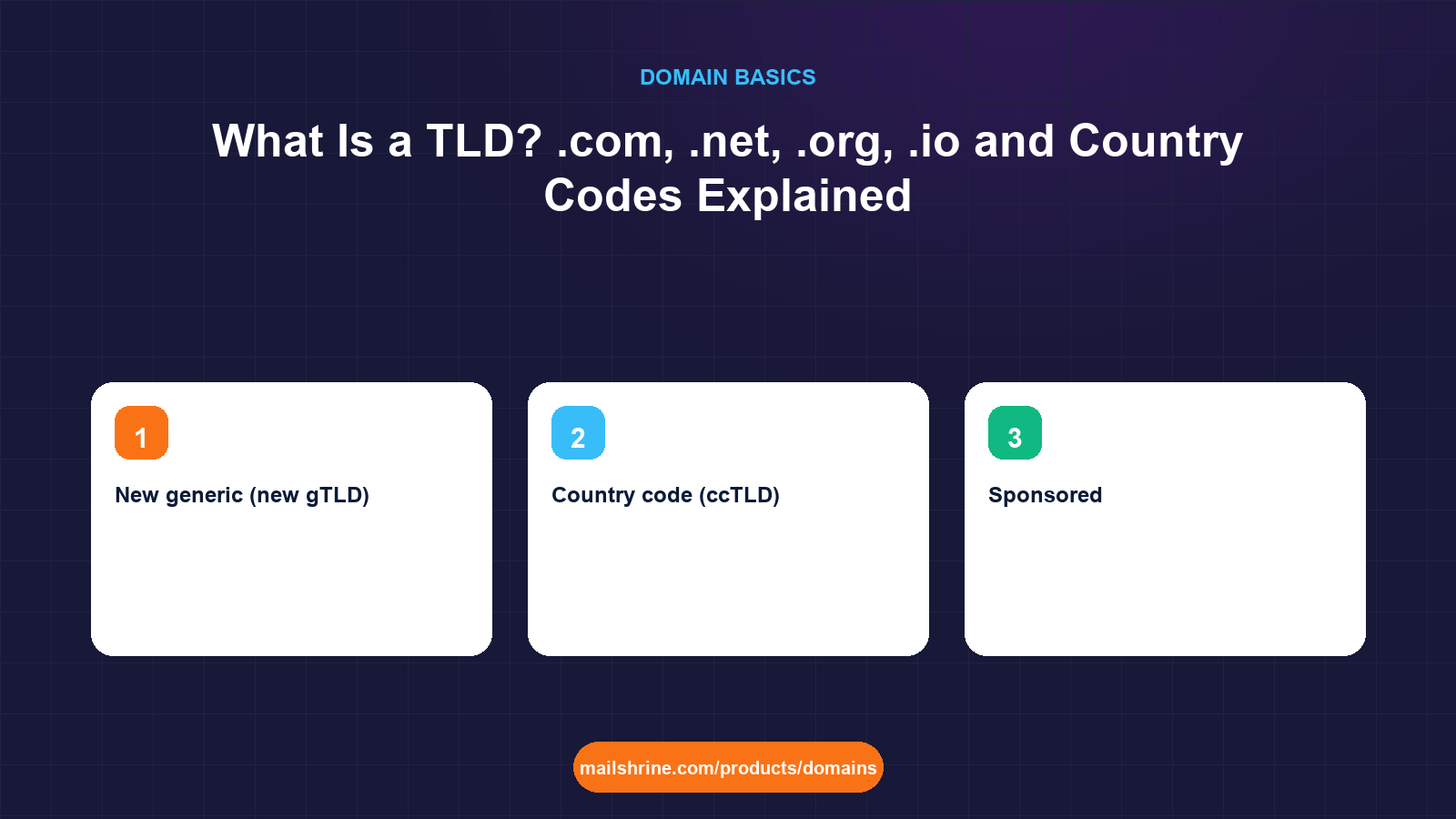
The three kinds of TLD
| Type | Examples | Who runs them | Who can register |
|---|---|---|---|
| Generic (gTLD) | .com, .net, .org, .info | Verisign (.com, .net), Public Interest Registry (.org), Identity Digital (.info) | Anyone, anywhere |
| New generic (new gTLD) | .io is not one; .app, .shop, .online, .coffee, .xyz are | Google Registry (.app), GMO (.shop), Radix (.online), Identity Digital (.coffee) | Anyone, though some such as .bank or .pharmacy verify eligibility |
| Country code (ccTLD) | .ng, .ke, .gh, .in, .uk, .ca, .de, .io, .ai | A national body or delegate: NiRA (.ng), KeNIC (.ke), NIXI (.in), Nominet (.uk), CIRA (.ca), DENIC (.de) | Set by each country; some require local presence |
| Sponsored | .edu, .gov, .mil, .museum, .travel | A sponsor organisation for a specific community | Only members of that community |
The surprise for most founders is in the third row. .io and .ai are not tech extensions by design. .io is the country code for the British Indian Ocean Territory and .ai for Anguilla. Both happen to be open to anyone and were adopted by developers, but they are governed as ccTLDs, which means ICANN's generic-TLD protections, such as the right to a redemption period, do not automatically apply.
Where TLDs come from
ICANN approves TLDs and delegates each to a registry. The original seven generic extensions, including .com, .net and .org, date from 1985. Country codes were assigned from the ISO 3166-1 two-letter list, which is why every ccTLD is exactly two letters and every generic TLD is three or more. In 2012 ICANN ran an application round that added more than 1,200 new generic TLDs, from .app to .zip, and a further round opened for applications in 2026.
Each registry sets its own wholesale price and rules. Verisign's .com wholesale price is capped by contract with ICANN and the US Department of Commerce, which is why .com renews at a predictable $12.99 on MailShrine. A new gTLD registry can price however it likes, which is why .inc costs a few thousand dollars a year and .xyz can cost a dollar.
What the extension signals to a customer
| TLD | What a typical visitor assumes | Good fit | Watch out for |
|---|---|---|---|
.com | Established, commercial, global | Almost any business | Most short names are taken |
.net | Infrastructure, networks, older tech | ISPs, hosting, tools | Visitors type .com by habit |
.org | Non-profit, community, open source | Charities, foundations, projects | Looks odd for a commercial product |
.io | Developer tool, SaaS | Startups, APIs | ccTLD rules; higher price than .com |
.ai | AI product | AI companies | Two-year minimum term; expensive |
.co | Startup, modern | Brands that lost .com | Typo traffic leaks to the .com |
.ng, .com.ng | Nigerian business | Local customers, local trust | .ng costs more than .com.ng |
.ke, .co.ke | Kenyan business | Local market | Registry rules differ from gTLDs |
.de, .uk, .ca | National business | Selling in that country | Some require a local address |
Priya reads this table and realises the question is not "which is best" but "who is the visitor". Her buyers are finance teams, not developers. .io signals the wrong audience.
Second-level country codes
Several countries do not sell directly under the two-letter code, or sell both. Nigeria sells .ng and .com.ng; Kenya sells .ke and .co.ke; the United Kingdom sells .uk and .co.uk. The second-level versions are usually cheaper and older, which means more local businesses are already on them. Registering both forms of your name in a ccTLD you depend on is cheap insurance against a confusing lookalike.
What you need before you start
| You need | Why |
|---|---|
| A clear picture of who visits | Customers in one country lean towards a ccTLD; global buyers expect .com |
| The registry rules for any ccTLD you want | .de and .ca have presence rules; .ai has a two-year minimum |
| Both prices for each candidate | Renewal matters more than the first year across a 5-year horizon |
| A budget line for one defensive extension | The .com or local ccTLD matching your main name stops a copycat |
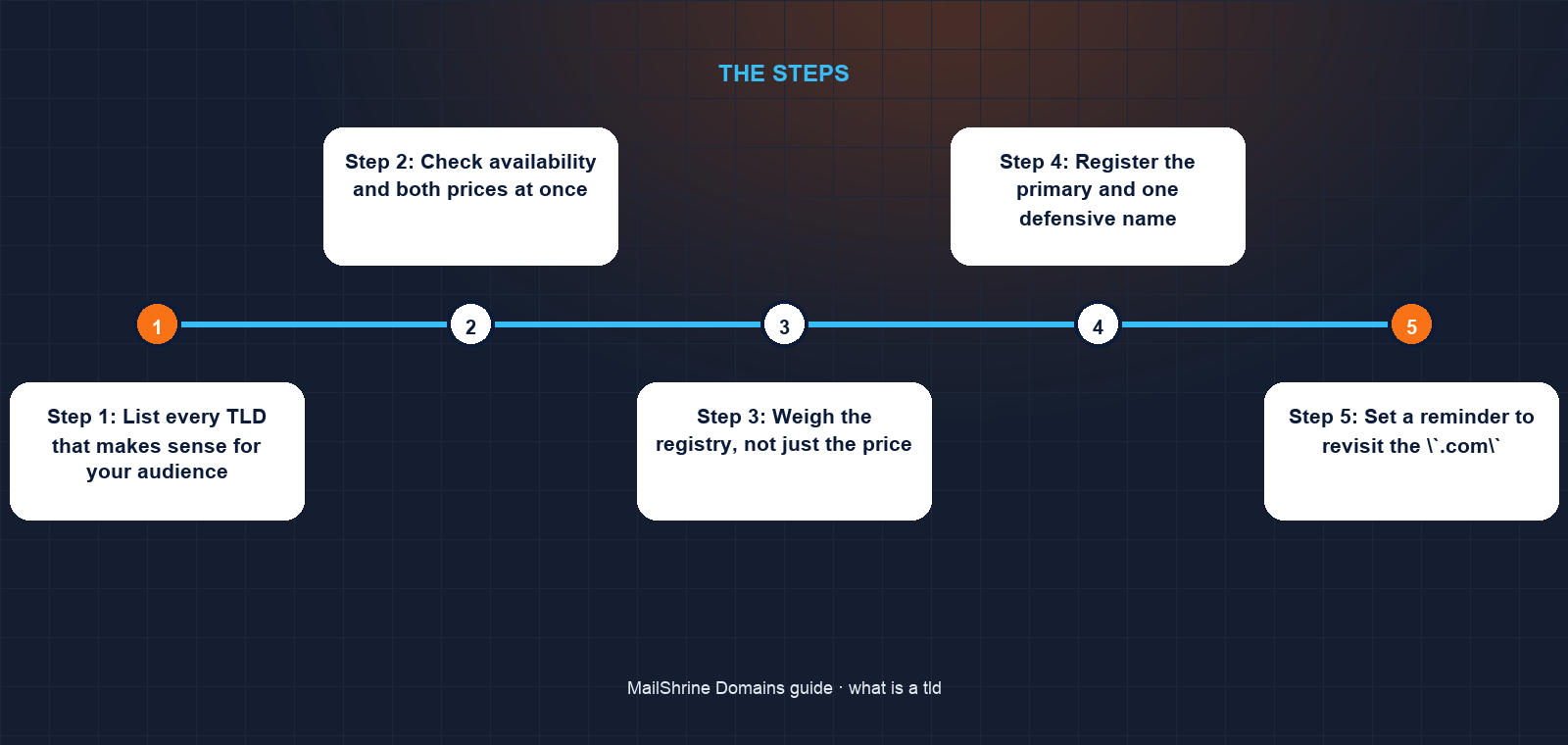
Step 1: List every TLD that makes sense for your audience
Priya writes down .com, .io, .ai, .in and .co. She drops .ai immediately because Ledgerly is not an AI company and .ai carries a two-year minimum term at a high price.
Step 2: Check availability and both prices at once
In the availability checker, ledgerly.io and ledgerly.co are free; ledgerly.in is free; ledgerly.com shows as an aftermarket name with a Buy Now price. She writes each renewal price next to the first-year price.
Step 3: Weigh the registry, not just the price
.io is a ccTLD operated under contract for a territory whose sovereignty is being transferred to Mauritius, and ISO code changes have historically meant TLD retirement. ICANN has signalled a transition process rather than a sudden removal, but Priya decides a ccTLD with that history is not where she wants her brand.
Step 4: Register the primary and one defensive name
She registers ledgerly.co as the primary for three years and ledgerly.in for local credibility with Indian clients. Both get privacy and transfer lock by default, and hello@ledgerly.co is live within minutes.
Step 5: Set a reminder to revisit the `.com`
She saves the aftermarket listing. If revenue justifies it in a year, she will buy it and redirect it to .co.
Priya's checklist
- Learned the difference between generic, new generic and country-code TLDsCompleted
- Found out that
.ioand.aiare country codes, not tech extensionsCompleted - Compared renewal prices across five candidates, not first-year pricesCompleted
- Registered
ledgerly.cofor three years andledgerly.infor oneCompleted - Add
ledgerly.coto the pitch deck and investor updateNot completed - Review the
ledgerly.comaftermarket price in twelve monthsNot completed
Common mistakes
Choosing a ccTLD without reading its rules. .de requires a German administrative contact, .ca requires Canadian presence, and .ai sells in two-year blocks. Discovering this at checkout wastes time; discovering it at renewal can lose the name.
Assuming all TLDs have the same grace periods. ICANN's redemption-period protections apply to generic TLDs. Country codes set their own, and some delete expired names in days.
Buying a cheap first-year extension for a long-term brand. A .xyz at $1 that renews at $14 is fine for a side project and a poor base for a company whose name will be printed on contracts.
Ignoring the local extension in your home market. A Nigerian business on .com that leaves .com.ng free is inviting a competitor or a scammer to take it.
Check your work
Look up the TLD you chose in the IANA root zone database. The entry shows the registry operator, the date it was delegated and a link to the registry's policies. If the operator is a national body or government delegate, you have a ccTLD and should read its expiry and eligibility rules. If the entry lists Verisign, Public Interest Registry, Identity Digital, Google Registry or another ICANN-contracted operator, generic-TLD rules apply.
FAQ
Is `.io` a good domain for a business?
It works well for developer-facing products because that audience is used to it. It is a country code with higher prices than .com and a registry history that has raised questions, so for a non-technical audience .com or your local ccTLD is safer.
Is `.com` always better than everything else?
For a global commercial audience, yes, because visitors type it by default. For a business that sells only in one country, the ccTLD often builds more trust and ranks well in local search.
How many TLDs exist?
About 1,500 are delegated in the root zone, including roughly 1,200 generic extensions and around 300 country codes. MailShrine sells more than 150 of the ones that are open to the public.
Can I make up my own TLD?
Not as an individual. New generic TLDs are created through ICANN application rounds that cost hundreds of thousands of dollars and require operating a registry. The next round opened for applications in 2026.
Why are some extensions so much more expensive than `.com`?
Each registry sets its own wholesale price. .com is price-capped by contract; new gTLDs and many ccTLDs are not, and some registries price short or dictionary words as premium names.
Next steps
- What Is a Domain Name? Plain-English Explanation — how the TLD fits into the rest of the name.
- Premium Domains Explained: Why Some Names Cost Thousands — registry premiums and aftermarket prices like Priya's
.com. - Domain Lifecycle: Active, Grace, Redemption, Pending Delete — the expiry rules that differ between gTLDs and ccTLDs.
Citations & References
- Reference: IANA: Root zone database of all TLDs
- Reference: ICANN: New gTLD Program
- Reference: Verisign: Domain Name Industry Brief
- Reference: ISO 3166 country codes
Written by Isabelle R., domains editor. Isabelle explains how names, DNS and registrars fit together so first-time buyers know exactly what they are paying for.