
A domain name is the human-readable address people type to reach you on the internet. google.com, bbc.co.uk and kigalicoffee.rw are all domain names. Behind each one sits a numeric IP address such as 142.250.74.46 that computers actually use to find a server. The domain name exists so that nobody has to remember the number. The Domain Name System (DNS) is the global phone book that turns the name into the number, millions of times a second.
A domain is also the part of an email address after the @. When you register kigalicoffee.rw you get the right to create orders@kigalicoffee.rw, www.kigalicoffee.rw and anything else in front of it. That is why a domain is the first thing a business registers, before a website, a shop or a mailbox exists.
MailShrine Domains is where you register one. Search a name, see the first-year and renewal price side by side, and pay for one to ten years. The moment it registers we write the DNS records that make email work and give you two free business mailboxes on it, so you@yourname.com exists on day one. You can check whether a name is free in our domain availability checker before you commit.
Real-life example: Grace's coffee roastery
Grace Uwase roasts and sells coffee from a small unit in Kigali. She has an Instagram page and takes orders on WhatsApp, and a wholesale buyer in Berlin has just asked for "a proper email address and a website we can link to". Grace has heard the words domain, hosting and DNS used interchangeably and is not sure which one she is being asked to buy.
Grace's goals this week:
- Understand exactly what a domain name is and what it is not.
- Pick between
kigalicoffee.rw,kigalicoffee.comandkigali.coffeewith a clear reason. - Register the name and have
grace@working before she replies to Berlin.
The anatomy of a domain name
Read a domain from right to left and every part has a job.
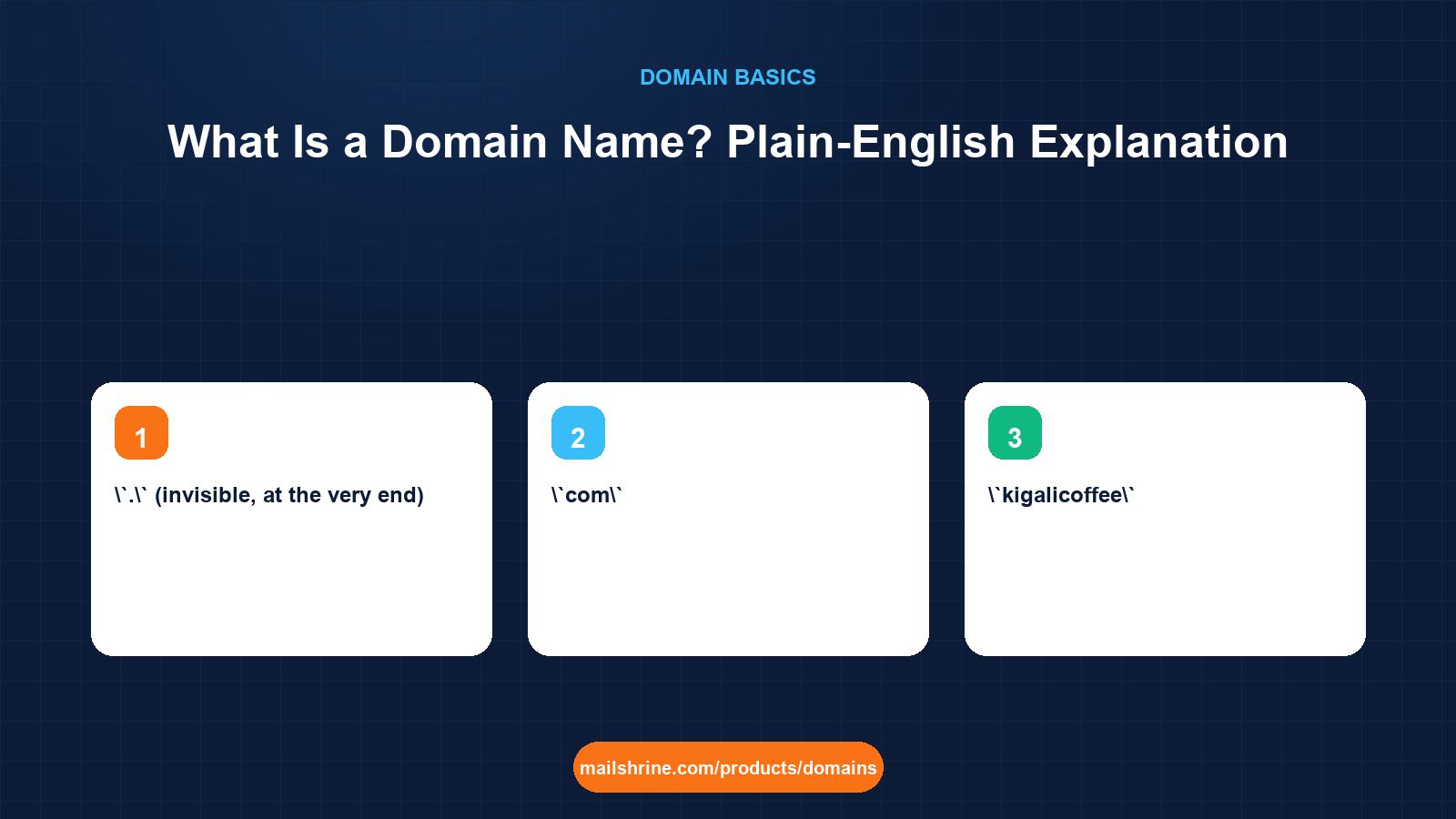
Part of shop.kigalicoffee.com | Name | What it is |
|---|---|---|
. (invisible, at the very end) | Root | The top of the DNS tree, operated by 13 root server systems coordinated by IANA |
com | Top-level domain (TLD) | The extension. Verisign runs .com; RICTA runs .rw |
kigalicoffee | Second-level domain | The part Grace actually chooses and registers |
shop | Subdomain | A free sub-address Grace can create herself once she holds the domain |
The registrable unit is kigalicoffee.com: second-level label plus TLD. That is what appears on the invoice. Everything to the left of it is Grace's to create at no extra cost, and everything to the right belongs to the registry and the root.
What a domain is not
Most confusion comes from three products that are sold near domains but are separate.
| Thing | What it does | Do you need it to have a domain? |
|---|---|---|
| Domain name | The address itself, rented from a registry via a registrar | This is the domain |
| Web hosting | A server that stores a website's files and serves them when the domain is visited | No. A domain works for email with no website |
| Website | The pages themselves, built in WordPress, Shopify, a static generator or code | No. Many domains only carry email |
| Email hosting | Mailboxes that receive mail addressed to the domain | No, but MailShrine includes two mailboxes with every domain |
A domain with no website is normal. Grace can register kigalicoffee.com today, use it for email for a year, and point it at a website later by changing a DNS record. Nothing about the registration has to change.
How a domain gets resolved
When the Berlin buyer types kigalicoffee.com, their laptop does not know where that is. This is what happens in roughly 50 to 200 milliseconds:
- The laptop asks its recursive resolver, usually the ISP's or a public one such as
1.1.1.1or8.8.8.8. - The resolver asks a root server: "who handles
.com?" The root points to Verisign's.comnameservers. - The resolver asks Verisign: "who handles
kigalicoffee.com?" Verisign returns the nameservers Grace's registrar set at registration. - The resolver asks those nameservers for the A record (website) or MX record (email) and receives the IP address or mail server name.
- The answer is cached for the record's TTL, often 300 to 3600 seconds, so the next visitor skips most of these steps.
This is why changing where a domain points is not instant. Caches around the world hold the old answer until the TTL runs out.
Rules every domain name follows
These come from RFC 1035 and the registries, not from any registrar.
- Allowed characters: letters a to z, digits 0 to 9 and hyphens. No spaces, underscores or punctuation. Case does not matter:
KigaliCoffee.comandkigalicoffee.comare the same name. - Hyphens may not start or end a label, and two hyphens in positions three and four (
xn--) are reserved for internationalised names. - Length: each label is 1 to 63 characters; a full name is at most 253 characters. Most registries require at least 2 or 3 characters in the second-level label.
- Non-Latin scripts are supported through Internationalised Domain Names (IDN), stored as
xn--punycode under the hood. - Uniqueness: a name can be registered once per TLD.
kigalicoffee.comandkigalicoffee.rware two different domains that could be held by two different people.
What you need before you start
| You need | Why |
|---|---|
| A shortlist of two or three names | Your first choice may be taken; decide the fallback before you are at checkout |
| A registrant name, address and email | ICANN requires accurate contact data for every registration |
| A decision on the extension | .com for global reach, .rw for a Rwandan audience, both if the brand matters |
| A term in mind | 1 to 10 years. Longer terms stop you forgetting the renewal |
| A card or Paystack account | MailShrine takes USD by card or Naira via Paystack |
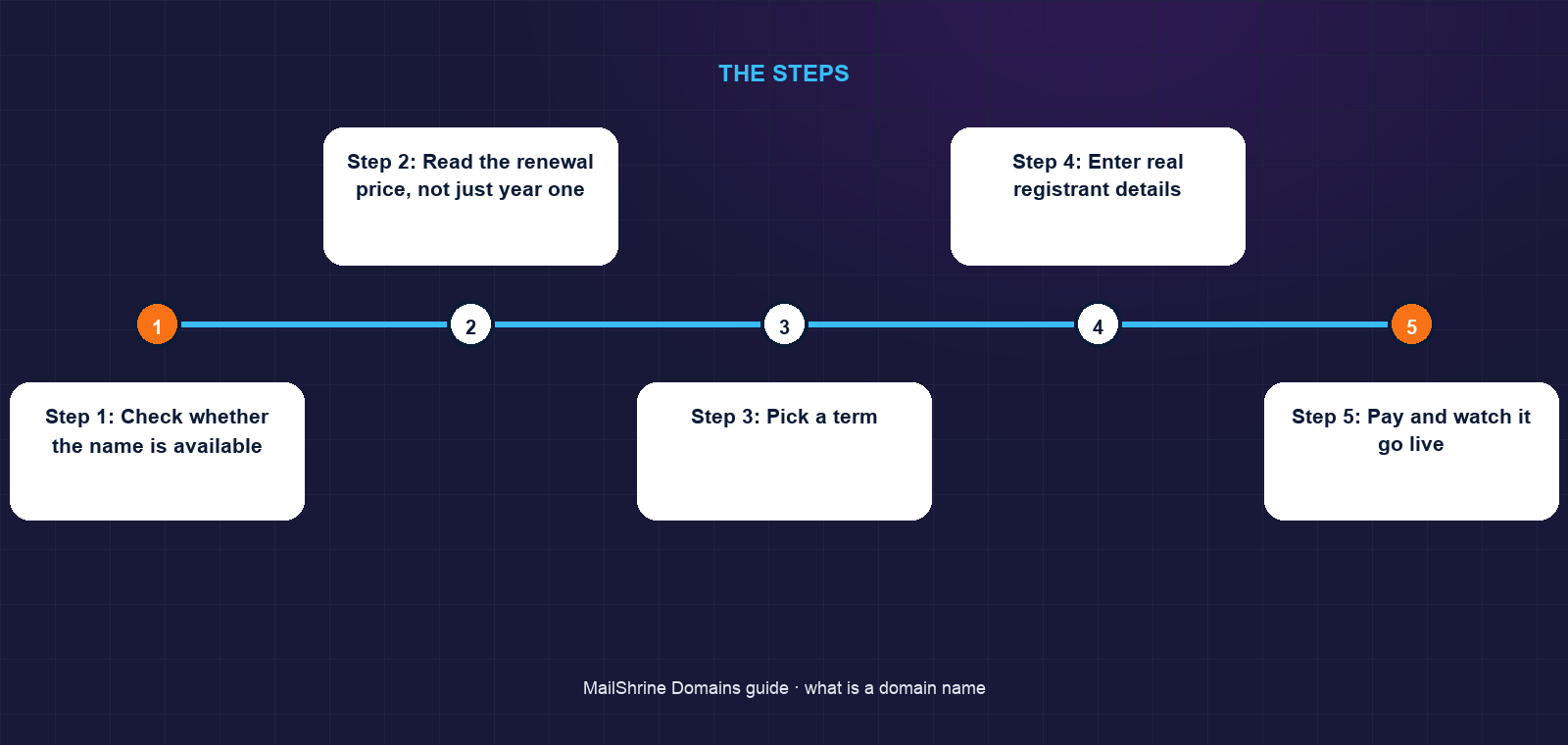
Step 1: Check whether the name is available
Type the name into the availability checker. Results show the status for the extension you asked for plus alternatives across more than 150 extensions. Grace finds kigalicoffee.rw and kigalicoffee.com both free, and kigali.coffee free at a higher price because .coffee is a newer extension with a higher registry fee.
Step 2: Read the renewal price, not just year one
Every result shows the first-year price and the renewal price. A .com on MailShrine is typically $12.99 a year, both years. Some extensions are heavily discounted in year one and renew at three or four times that. Choose knowing both numbers.
Step 3: Pick a term
One year is the minimum; ten is the maximum under ICANN's rules for generic extensions. Grace picks two years so the Berlin buyer's catalogue, which prints her email address, does not outlive the domain.
Step 4: Enter real registrant details
The registrant is the legal holder. Grace enters her own name and the roastery's address, not a friend's. WHOIS privacy is on by default, so these details are not published, but they must be accurate.
Step 5: Pay and watch it go live
After payment the registrar sends a create command to the registry. For .com this takes seconds. MailShrine then writes MX, SPF, DKIM and DMARC records and provisions two mailboxes. Grace renames you@kigalicoffee.com to grace@kigalicoffee.com and replies to Berlin from it.
Grace's checklist
- Learned that the domain is the address, not the website or the serverCompleted
- Chose
kigalicoffee.comfor the global buyer andkigalicoffee.rwfor local customersCompleted - Compared renewal prices before choosing an extensionCompleted
- Registered for two years with privacy and transfer lock left onCompleted
- Put the expiry date in her calendar even though auto-renew is onNot completed
- Added
grace@kigalicoffee.comto her Instagram bio and WhatsApp business profileNot completed
Common mistakes
Believing you must buy hosting to "activate" the domain. A registered domain is active the moment the registry writes it. Hosting is a separate choice you can make years later.
Registering under someone else's name. If a web designer or cousin registers the name for you, they are the legal registrant. Always register in the business owner's name and give others access instead.
Treating uppercase as a brand feature. DNS is case-insensitive. Writing KigaliCoffee.com on a business card is fine for readability, but it is the same name as the lowercase version and cannot be registered separately.
Picking a name you cannot say aloud. If you have to spell it on the phone every time, customers will mistype it. Say the name to three people before you buy.
Check your work
Open a terminal or a free online DNS lookup tool and query your new name. An MX lookup should return MailShrine's mail servers, and a NS lookup should return the nameservers shown in your dashboard. If both answer within an hour of registration, the domain exists in the registry and DNS is serving it. Then send an email from your new address to an old one and reply; a round trip proves the mailbox is live.
FAQ
Is a domain name the same as a URL?
No. A URL is the full address of a specific page, such as https://kigalicoffee.com/wholesale. The domain is the kigalicoffee.com part. One domain can have thousands of URLs.
Is a domain name the same as a website?
No. The domain is the address; the website is the content served when someone visits it. You can have a domain with no website, which is common for businesses that only use it for email.
Can two people own the same domain name?
Not within the same extension. kigalicoffee.com can be held by one registrant at a time. The same word under a different extension, such as kigalicoffee.rw, is a separate domain and could belong to someone else.
How much does a domain name cost?
It depends on the extension. A .com on MailShrine is typically $12.99 per year. Country codes and newer extensions range from a few dollars to over $50. Premium names held in the aftermarket can cost thousands.
Do I need a company to register a domain?
No. Individuals register domains every day. Some country-code extensions have residency or business-registration requirements, but .com, .net, .org and most new extensions are open to anyone.
Next steps
- How Does Domain Registration Work? Registrar vs Registry vs ICANN — who the four parties are and what happens after you pay.
- Domain vs Hosting vs Website: What's the Difference? — the three products people confuse and which you actually need.
- What Is a TLD? .com, .net, .org, .io and Country Codes Explained — how to choose the extension on the right.
Citations & References
- Reference: ICANN: Beginner's guide to domain names
- Reference: IANA: Root zone database
- Reference: RFC 1035: Domain names, implementation and specification
- Reference: Cloudflare Learning: What is DNS?
Written by Isabelle R., domains editor. Isabelle explains how names, DNS and registrars fit together so first-time buyers know exactly what they are paying for.