
No, you cannot buy a domain name permanently. Every domain in every public extension is registered for a fixed term, from one to ten years, and the term must be renewed before it ends or the name eventually returns to the pool. The ten-year maximum is written into ICANN's registry agreements for generic extensions such as .com, .net and .org, and most country-code registries set a similar or shorter cap. There is no "lifetime" option in any registry database, and any company that sells one is selling you a promise to keep renewing on your behalf.
That said, "rented" does not mean "insecure". As long as you renew, nobody can take a domain from you, and you can renew indefinitely. A business that has held the same name since 1995 has simply paid roughly thirty invoices. The practical question is not whether you can own a domain forever but how to make a renewable rental behave like permanent ownership, and this guide covers exactly that.
MailShrine Domains lets you register or renew for any term from one to ten years, shows the renewal price next to the first-year price before you pay, and sends reminders at 30, 7 and 1 day before expiry and again at expiry. Auto-renew is on by default and can be switched off. If a domain does lapse, it can still be renewed during the registry grace period before anyone else can touch it.
Real-life example: Marcus's architecture practice
Marcus Adeyemi runs a five-person architecture practice in Toronto. The firm has used adeyemiarchitects.com for eleven years, and it is printed on every drawing, contract and building permit they have ever issued. A reseller has emailed him offering a "permanent domain registration" for $499. He wants to know whether that is real, and if not, what the closest equivalent is.
Marcus's goals:
- Confirm whether permanent ownership exists anywhere and what the $499 offer actually buys.
- Lock the domain down for as long as the rules allow.
- Build a process so the firm can never lose the name through an expired card or a departed employee.
Why domains are rented and not sold
| Reason | What it means in practice |
|---|---|
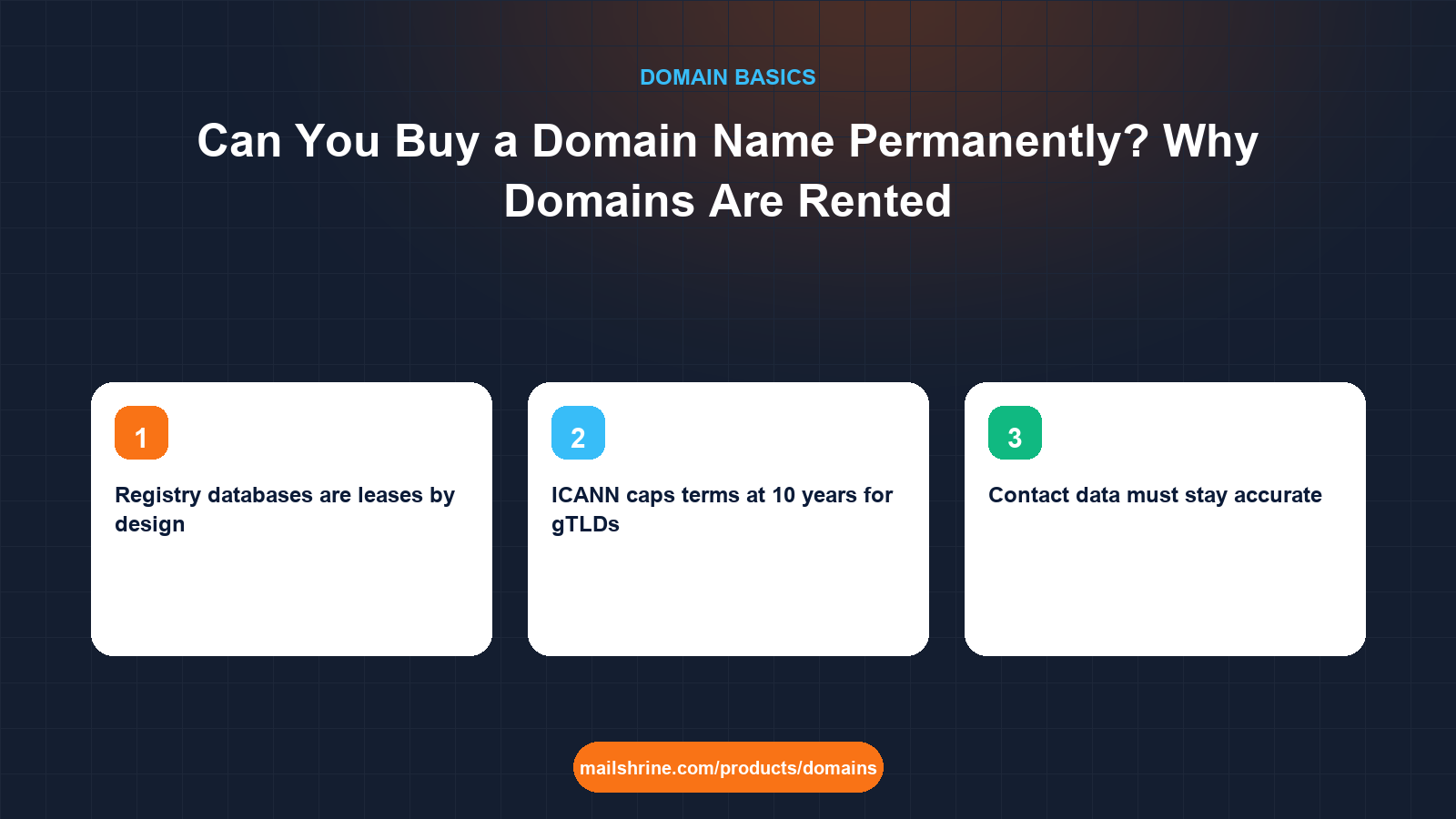
| Registry databases are leases by design | Each entry has an expiry date. A registry's job is to maintain the list, not to transfer title |
| ICANN caps terms at 10 years for gTLDs | A registrar cannot create or renew a .com beyond ten years from today |
| Contact data must stay accurate | Renewal is the moment registrars re-verify that the registrant is still reachable |
| Abandoned names must be recyclable | Without expiry, every name whose owner died or dissolved would be locked forever |
| Registries and ICANN are funded per year | Verisign's fee and ICANN's 18-cent fee are collected per domain-year |
The leasing model is also what gives a lapsed owner protection. Because the registry knows the expiry date, it can apply a grace period and a redemption period before deleting the name. A true one-time sale would have neither.
What "lifetime domain" offers really are
| Offer | What is actually happening | Risk |
|---|---|---|
| "Permanent registration" for a one-off fee | The seller pre-pays or promises renewals from its own account | If the seller closes or stops paying, the domain expires |
| "Free domain for life" with a hosting plan | Domain renews only while you keep paying the hosting plan | Cancel hosting, lose the domain |
| 100-year registration marketed by a few platforms | A registrar collects the fee and promises to renew in ten-year steps | Depends on that company existing for a century |
| Blockchain or alternative "domains" | Names in a separate namespace not in the DNS root | Do not resolve in browsers or email without plugins |
The $499 offer Marcus received is the first row. Whoever holds the registrar account that pays the renewals holds the domain. A reseller that disappears takes the "permanent" registration with it.
How to make a rental behave like ownership
A ten-year term topped up every year is the closest thing to permanence the DNS offers. Here is what that looks like for Marcus.
| Control | Setting | Why |
|---|---|---|
| Term | Renew to the full 10 years | Locks today's price, survives a decade of forgotten emails |
| Auto-renew | On, with a company card, not a personal one | Keeps the term at or near 10 years |
| Registrant | The company, with a role address like domains@ | Survives staff changes |
| Transfer lock | On | Blocks unauthorised moves |
| Reminders | To two people | One inbox going quiet should not be fatal |
| Registrar account 2FA | On for every user | Account takeover is the usual way a domain is lost |
What you need before you start
| You need | Why |
|---|---|
| Your current expiry date | The maximum new expiry is ten years from today, so the top-up amount depends on it |
| A company payment method | Personal cards expire, leave with the employee, or get cancelled |
| A role mailbox for registrant contact | Reminders and transfer approvals go there |
| A second named person with access | Redundancy against illness, holidays and departures |
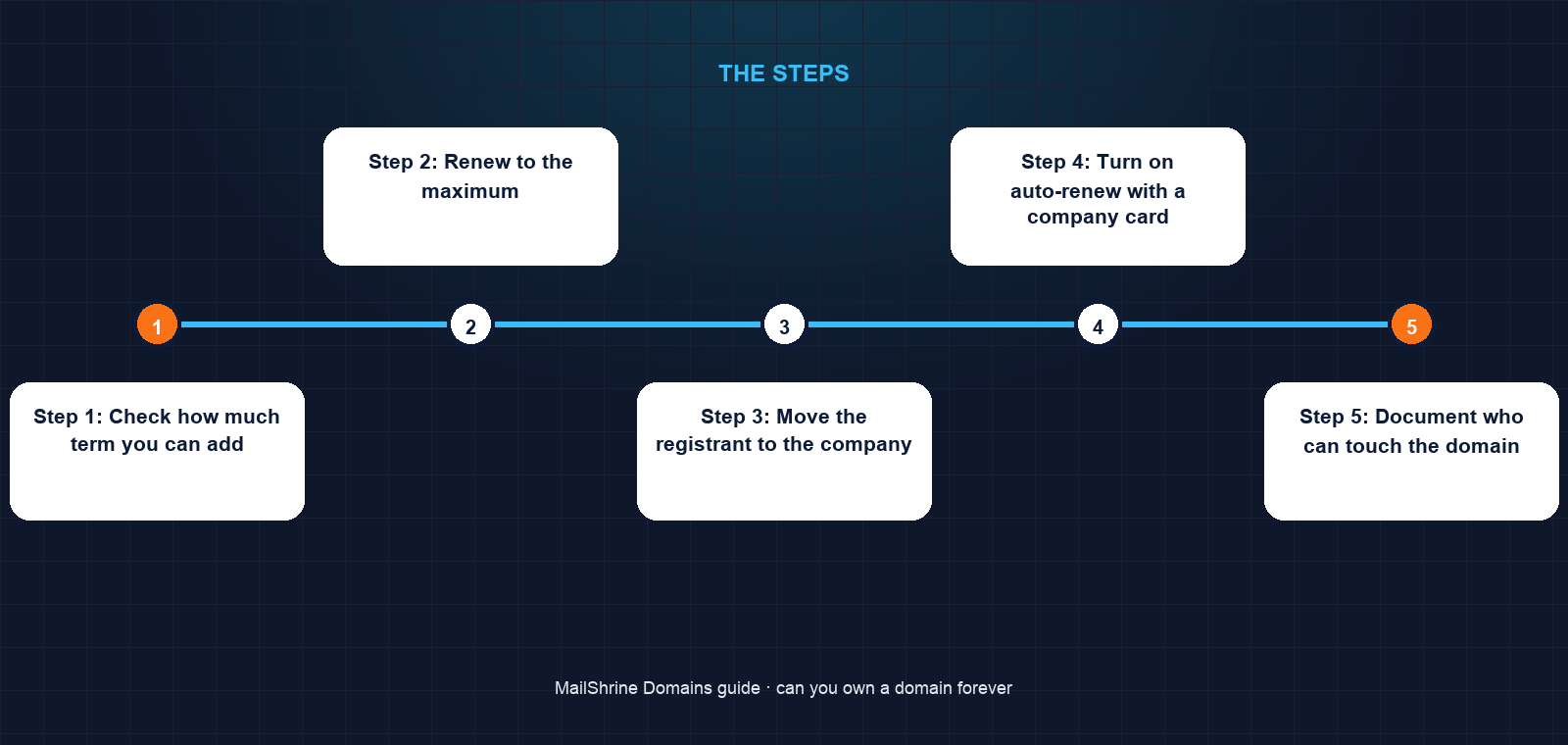
Step 1: Check how much term you can add
ICANN's rule is ten years from the date of the renewal, not ten years on top of your existing expiry. If Marcus's domain expires in 14 months, he can add about 8 years and 10 months. MailShrine's renewal screen shows the maximum term available and the price per year.
Step 2: Renew to the maximum
He renews for the full available term. At $12.99 a year for a .com, that is less than the "permanent" offer and it is an actual registry entry, visible in RDAP, rather than a promise.
Step 3: Move the registrant to the company
If the domain was registered in a founder's personal name, update the registrant to the company with its registered address and a role email. ICANN's change-of-registrant rules may apply a 60-day transfer lock after a material change, which is harmless if the domain is staying put.
Step 4: Turn on auto-renew with a company card
Auto-renew runs each year, topping the term back towards ten. Marcus adds the firm's card and sets a yearly reminder to confirm the card is still valid.
Step 5: Document who can touch the domain
A one-page note in the firm's shared drive: registrar, login owner, 2FA holder, expiry date, renewal card. Two partners have access. When someone leaves, their access is removed the same day.
Marcus's checklist
- Understood that the $499 "permanent" offer is a reseller promise, not a registry recordCompleted
- Renewed
adeyemiarchitects.comto the maximum ten-year termCompleted - Changed the registrant to the company with
domains@adeyemiarchitects.comCompleted - Left transfer lock and WHOIS privacy onCompleted
- Add a second partner as a user on the MailShrine account with 2FANot completed
- Put a yearly card-check reminder in the practice calendarNot completed
Common mistakes
Paying a reseller for "lifetime" ownership. You are buying their promise to renew. Spend the same money on a ten-year renewal at an accredited registrar and the registry itself holds the record.
Registering in a personal name "for now". Founders leave, divorce, die. A domain registered to a person belongs to that person's estate, not to the business.
Trusting auto-renew with an expiring card. Auto-renew fails silently when the card is declined. The 30, 7 and 1 day reminders exist for that case; make sure they go somewhere someone reads.
Treating a trademark as ownership of the domain. A trademark gives you a route to dispute a bad-faith registration through UDRP, but it does not stop your own domain expiring or make it yours without renewal.
Check your work
Look up your domain in an RDAP or WHOIS tool. The expiry date should read close to ten years from today, the registrant organisation should be your company, and the status should include clientTransferProhibited. Then open the registrar dashboard and confirm auto-renew is on and the payment method expires after the next renewal. If all four are true, you have the most permanent domain the system allows.
FAQ
What is the longest I can register a domain for?
Ten years for generic extensions such as .com, .net and .org, set by ICANN's registry agreements. Country codes vary: some allow ten years, some cap at five or less, and .ai requires two-year blocks.
Can a registry or registrar take my domain if I keep renewing?
Only in narrow cases: a court order, a successful UDRP trademark dispute, false registrant data that is not corrected, or a breach of the registry's policy. Normal use with accurate details and timely renewals is never interrupted.
Does a trademark make my domain permanent?
No. A trademark helps you recover a domain someone else registered in bad faith. It does not exempt your own registration from expiry or renewal.
Why does ICANN cap registrations at ten years?
To keep contact data verifiable, to let abandoned names recycle, and to keep registry and ICANN funding tied to active use. The cap is a rolling window, so you can always top back up to ten years.
What happens if I forget to renew after a ten-year term?
The same as any expiry: a grace period during which you renew at the normal price, then a redemption period at a higher fee, then deletion. MailShrine sends reminders at 30, 7 and 1 day before expiry and at expiry, and auto-renew prevents the problem entirely.
Next steps
- Domain Lifecycle: Active, Grace, Redemption, Pending Delete — the stages a lapsed domain passes through and how long each lasts.
- Who Owns a Domain? Registrant, Admin and Tech Contacts Explained — putting the company, not a person, on the record.
- How Does Domain Registration Work? Registrar vs Registry vs ICANN — why the registry holds the record and the registrar holds the relationship.
Citations & References
- Reference: ICANN: Registrant rights and responsibilities
- Reference: ICANN: Expired Registration Recovery Policy
- Reference: ICANN: Transfer Policy, including change of registrant
- Reference: Verisign: .com registry agreement
Written by Isabelle R., domains editor. Isabelle explains how names, DNS and registrars fit together so first-time buyers know exactly what they are paying for.