
A subdomain is a name you create underneath a domain you already hold. If you own northstarfit.com, then shop.northstarfit.com, app.northstarfit.com and blog.northstarfit.com are subdomains. They cost nothing, need no registration, and exist the moment you add a DNS record for them. A domain, by contrast, is the registrable unit you pay a registry for, one line in the .com database.
The decision between the two comes up every time a business adds a second thing: a store, a help centre, a staging server, a product with its own brand. Pick a subdomain and you keep one renewal, one DNS zone and one brand. Pick a new domain and you get a clean identity at the cost of a second registration to protect and a second zone to manage. Neither is "better for SEO" in the way forum posts claim, and this guide explains what Google has actually said.
MailShrine Domains gives every domain a full DNS record editor on Anycast nameservers, so adding shop or app is one A or CNAME record away. If you decide a second domain is the right call, it is a search and a checkout, with email DNS written automatically and two mailboxes included on each name.
Real-life example: Jordan's fitness studio
Jordan Blake owns a fitness studio in Austin with a booking app, a small shop selling branded gear, and a weekly newsletter. Everything lives on northstarfit.com. The shop runs on Shopify, the app on a hosting platform, the newsletter from MailShrine. A marketing consultant has suggested buying northstargear.com for the shop "so it ranks on its own".
Jordan's goals:
- Decide whether the shop should be a subdomain or a separate domain, with a reason that holds up.
- Keep email deliverability from the main domain untouched, whatever the decision.
- Set up the chosen structure in DNS without downtime.
Subdomain and domain side by side
Subdomain (shop.northstarfit.com) | New domain (northstargear.com) | |
|---|---|---|
| Cost | Free, unlimited | Yearly registration, typically $12.99 for a .com |
| How it is created | One DNS record in the parent zone | Registration with a registrar, then its own zone |
| Who controls it | Whoever controls the parent domain's DNS | Whoever is the registrant of the new name |
| Brand | Clearly part of the parent | Independent; must be built from zero |
| Can have its own MX records, but inherits reputation signals from the parent | Starts with no reputation; needs its own SPF, DKIM, DMARC and warm-up | |
| Risk if forgotten | None; it disappears when you delete the record | Expires if not renewed; a stranger can register it |
| Typical use | Shop, app, docs, staging, regional sites | New product line, separate business, acquired brand |
How a subdomain works in DNS
Jordan's zone for northstarfit.com is a list of records. A subdomain is simply a record whose name has an extra label in front.
| Record name | Type | Value | What it does |
|---|---|---|---|
@ | A | 76.76.21.21 | Main website |
www | CNAME | northstarfit.com | Alias of the main site |
shop | CNAME | shops.myshopify.com | Sends the shop subdomain to Shopify |
app | A | 104.21.8.9 | Points the app subdomain at the app server |
@ | MX | MailShrine mail servers | Email for jordan@northstarfit.com |
Technically www is a subdomain too, which is why guides that say "subdomains hurt SEO" contradict the most common website setup on earth. Each label can also have its own records: shop.northstarfit.com could carry its own MX if Jordan wanted support@shop.northstarfit.com, although most businesses keep mail on the parent.
A subdomain can even be delegated: an NS record for app hands that whole branch to another provider's nameservers while the parent stays at MailShrine. This is how large companies let an engineering team run DNS for app. without touching the marketing site.
What Google actually says
Google has said repeatedly, most recently through its Search Central documentation and John Mueller's public answers, that subdomains and subdirectories are both fine and that its systems work out how a site is organised either way. In practice:
- A subdomain is treated as closely related to its parent, but not identical. Links to
blog.northstarfit.comhelp the blog most directly. - A separate domain starts with zero history. Every link, every review, every citation has to be earned again.
- A subdirectory (
northstarfit.com/shop) keeps everything in one place, but most third-party platforms such as Shopify cannot be served from a subdirectory of your own domain, which is why the subdomain exists.
The honest answer for Jordan's shop: a subdomain inherits the studio's existing trust, costs nothing, and is the only option Shopify supports anyway.
When a separate domain is the right call
| Situation | Why a new domain wins |
|---|---|
| The product will be sold or spun out | Buyers want the brand and its domain in one clean package |
| The audience must not associate the two | A discount sub-brand under a premium parent, or a consumer product under a B2B company |
| A different country with a ccTLD | northstarfit.ca for Canadian customers, with local pricing and currency |
| Legal separation | A separate company with its own registrant, invoices and liability |
| Protecting a name | Registering northstargear.com so nobody else does, then redirecting it |
If none of these apply, the subdomain is almost always the right answer.
What you need before you start
| You need | Why |
|---|---|
| Access to the parent domain's DNS editor | The subdomain is created there |
| The target from the platform you are connecting | An IP for an A record or a hostname for a CNAME |
| A decision on email for the subdomain | Usually none; keep mail on the parent |
| For a new domain, registrant details and a term | 1 to 10 years, privacy and lock on by default |
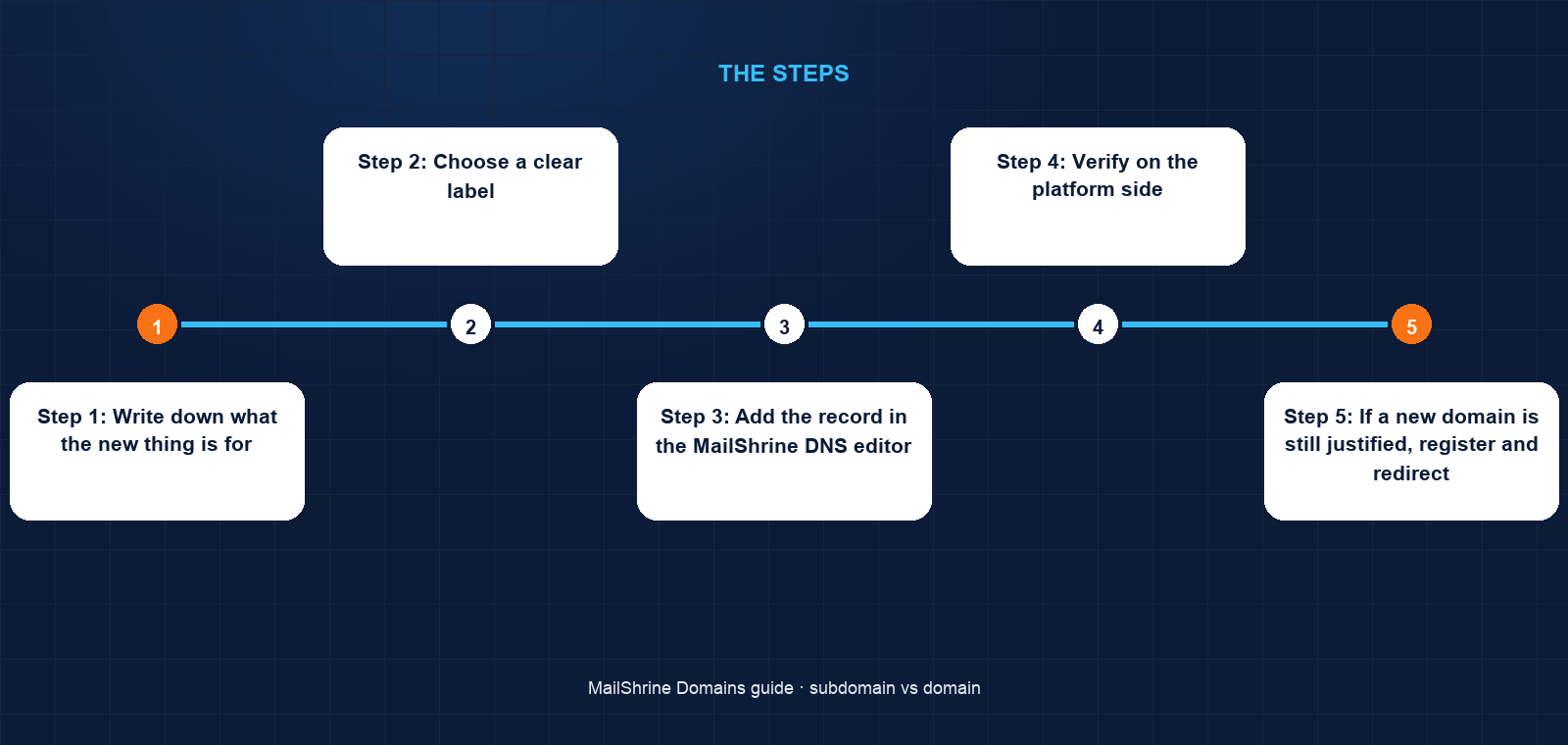
Step 1: Write down what the new thing is for
Jordan lists the shop's purpose: sell gear to existing members. Same brand, same audience, no plan to sell the shop as a business. That points to a subdomain.
Step 2: Choose a clear label
Short, obvious, lowercase. shop beats store-online. Avoid labels that collide with common services: mail, autodiscover and _dmarc have conventional meanings in DNS.
Step 3: Add the record in the MailShrine DNS editor
Jordan adds a CNAME record named shop with the value Shopify provides. He leaves the TTL at the default. The record is live on MailShrine's Anycast nameservers within seconds and reaches resolvers worldwide as their caches expire.
Step 4: Verify on the platform side
Shopify checks the DNS record and issues its certificate for shop.northstarfit.com. Nothing about the parent domain's A, MX or TXT records changed, so the main site and jordan@northstarfit.com keep working.
Step 5: If a new domain is still justified, register and redirect
Jordan also registers northstargear.com for one year, purely so a competitor cannot. He sets it to redirect to shop.northstarfit.com. If the shop ever becomes its own business, the name is already his.
Jordan's checklist
- Decided the shop is a subdomain because it shares brand, audience and ownershipCompleted
- Added
shopas aCNAMEwithout touching MX or SPF recordsCompleted - Confirmed the Shopify certificate issued for the subdomainCompleted
- Registered
northstargear.comdefensively and redirected itCompleted - Add the shop link to the newsletter footerNot completed
- Set a calendar note to review whether the defensive domain is still worth renewingNot completed
Common mistakes
Buying a new domain for every project. Each one is a renewal to remember, a zone to secure and a brand to build. Three subdomains on one strong domain beat four weak domains.
Changing nameservers to the platform instead of adding a record. Moving the whole zone to Shopify or a host to connect one subdomain also moves your email records. Add the single record instead.
Using a subdomain for email you send at scale without its own authentication. A news. subdomain for newsletters is good practice, but it needs its own SPF, DKIM and DMARC alignment. Set those up before the first campaign.
Forgetting that a subdomain is only as safe as the parent's DNS. Anyone with access to the parent zone can repoint every subdomain. Keep 2FA on the registrar account.
Check your work
Query the new subdomain with a DNS lookup. For a CNAME, the answer should show the platform hostname; for an A record, the IP you entered. Then query the parent domain's MX and TXT records and confirm they are unchanged. If the subdomain resolves and the parent's mail records are intact, the structure is correct. A lookup that returns nothing after an hour usually means a typo in the label or a record added to the wrong zone.
FAQ
Do I have to pay for a subdomain?
No. Subdomains are created in the DNS zone of a domain you already hold and cost nothing. You can create as many as you need.
Do subdomains hurt SEO?
Google treats subdomains and subdirectories as valid ways to organise a site. A subdomain is closely associated with its parent but builds some signals independently, so give it its own internal links and sitemap.
Can a subdomain have its own email?
Yes. Add MX, SPF and DKIM records under the subdomain label. Most small businesses keep all mail on the parent domain and reserve subdomain mail for bulk sending such as newsletters.
Can I move a subdomain to a different host without affecting the main site?
Yes. Change only that subdomain's record. The parent's records, including email, are untouched. This is the main operational advantage over a monolithic site.
Is `www` a subdomain?
Yes. www.example.com is a subdomain of example.com, usually a CNAME or A record pointing at the same site. That alone shows subdomains are not harmful.
Next steps
- What Is a Domain Name? Plain-English Explanation — the labels in a name from root to subdomain.
- Domain vs Hosting vs Website: What's the Difference? — how DNS records connect a name to a platform.
- Who Owns a Domain? Registrant, Admin and Tech Contacts Explained — who controls the parent, and therefore every subdomain.
Citations & References
- Reference: RFC 1034: Domain names, concepts and facilities
- Reference: Google Search Central: SEO Starter Guide, site organisation
- Reference: Cloudflare Learning: What is a subdomain?
- Reference: RFC 7489: DMARC and subdomain policy
Written by Marcus T., DNS and deliverability editor. Marcus writes about the records behind a domain and how to change them without breaking email.