
Domain registration is a rental, not a purchase. When you register adadesigns.com, nobody hands you a file called a domain. A registrar writes your name next to adadesigns in a database that Verisign runs for every .com on earth, and promises the world's DNS that this entry belongs to you for the years you paid for. Keep renewing and it stays yours. Stop, and after a grace period the registry erases the line and anyone can take it.
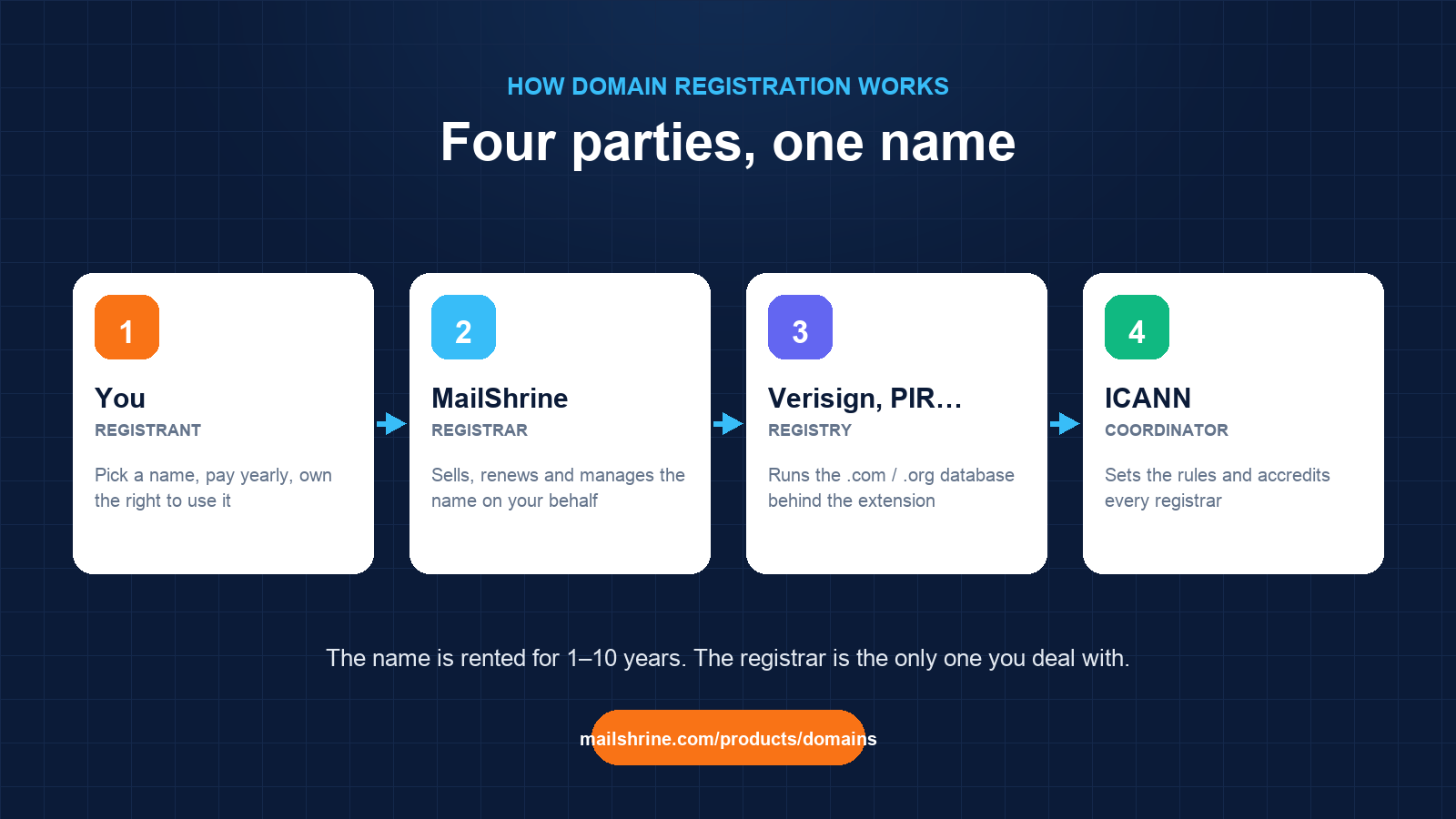
Four parties touch that one line: you (the registrant), the registrar you buy from, the registry that runs the extension, and ICANN, the non-profit that writes the rules both of them follow. Once you can tell those four apart, every confusing thing about domains, from WHOIS privacy to transfer locks to "why did my renewal cost more", becomes obvious.
MailShrine Domains is a registrar. We sell the name, write your email DNS the moment it registers, switch on WHOIS privacy and transfer lock for free, and give you two business mailboxes on it. The registry and ICANN stay invisible to you, which is how it should be.
Real-life example: Ada's studio
Ada Okafor runs a two-person design studio in Enugu. She has been sending quotes from a Gmail address for three years and finally wants ada@adadesigns.com. She searches on MailShrine, sees the name is free at $12.99, and pauses on one question: who actually owns this after I pay, and what am I paying for every year?
Ada's goal this week:
- Understand who the four parties are so she knows who to call if something breaks.
- Know what the yearly fee covers and why the renewal price can differ from year one.
- Register the name with privacy on and email working the same afternoon.
The four parties, in plain English
| Party | Who it is for Ada | What they do | Does Ada ever talk to them? |
|---|---|---|---|
| Registrant | Ada herself | Holds the right to use the name for the paid term | She is this party |
| Registrar | MailShrine | Sells, renews, locks, transfers and manages DNS for the name | Yes, this is the only one |
| Registry | Verisign (runs .com) | Keeps the master list of every .com and who holds it | Never directly |
| ICANN | Internet Corporation for Assigned Names and Numbers | Accredits registrars, contracts registries, sets the rules | Never, but its rules protect her |
Think of it as a supply chain. The registry is the wholesaler that owns the shelf. The registrar is the shop. ICANN is the trade body that licenses the shops and audits the wholesaler. You buy from the shop.
What happens in the thirty seconds after you pay
The part most guides skip is the mechanics. Here is what happens inside MailShrine when Ada clicks Pay.
- Payment is captured. Stripe or Paystack confirms the charge. Nothing has been registered yet, so if a card fails nothing is half done.
- Availability is checked again. A second lookup makes sure nobody grabbed
adadesigns.comin the two minutes she spent at checkout. - The registrar sends a create command to the registry. This travels over a protocol called EPP. It carries the name, the term in years, and a contact handle that points at Ada's registrant details.
- The registry answers. If the name is still free, Verisign writes the line. From this second the name is Ada's, and the registry will refuse any other create for it.
- Nameservers and DNS go live. The registrar publishes the nameservers, then writes the DNS zone. MailShrine writes the mail records at this step, so MX, SPF, DKIM and DMARC exist before Ada ever opens a dashboard.
- Mailboxes are provisioned. A few minutes later
hello@adadesigns.comandada@adadesigns.comcan send and receive.
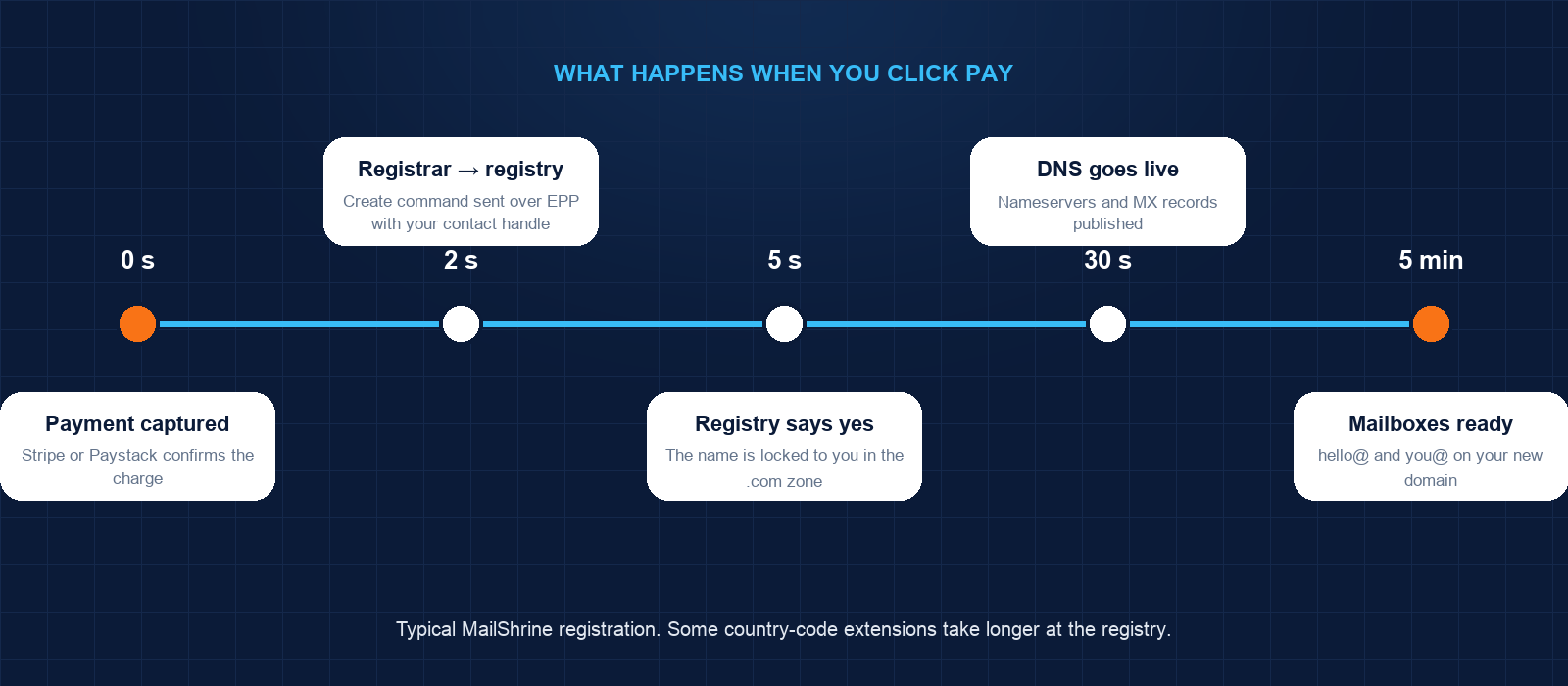
Most of that is invisible. Ada sees "Registering…" turn into "Active" and an email saying her mailboxes are ready.
What you need before you register
| You need | Why the registry asks for it |
|---|---|
| A real registrant name and address | ICANN requires accurate contact data for every registration. Fake details can get a domain suspended. |
| A working email address | Registrars must be able to reach the registrant. On MailShrine this can be your new mailbox after the first day. |
| A decision on the term | 1 to 10 years. Longer terms lock in the renewal price and stop reminders for the whole term. |
| A decision on privacy | WHOIS privacy hides your details from public lookups. MailShrine turns it on for free. |
Where the money goes
Ada's $12.99 is not profit for the registrar. For a .com the registry fee alone is over $10, and every registration carries an 18-cent ICANN fee. The registrar's wholesale account pays those, then adds its own margin.
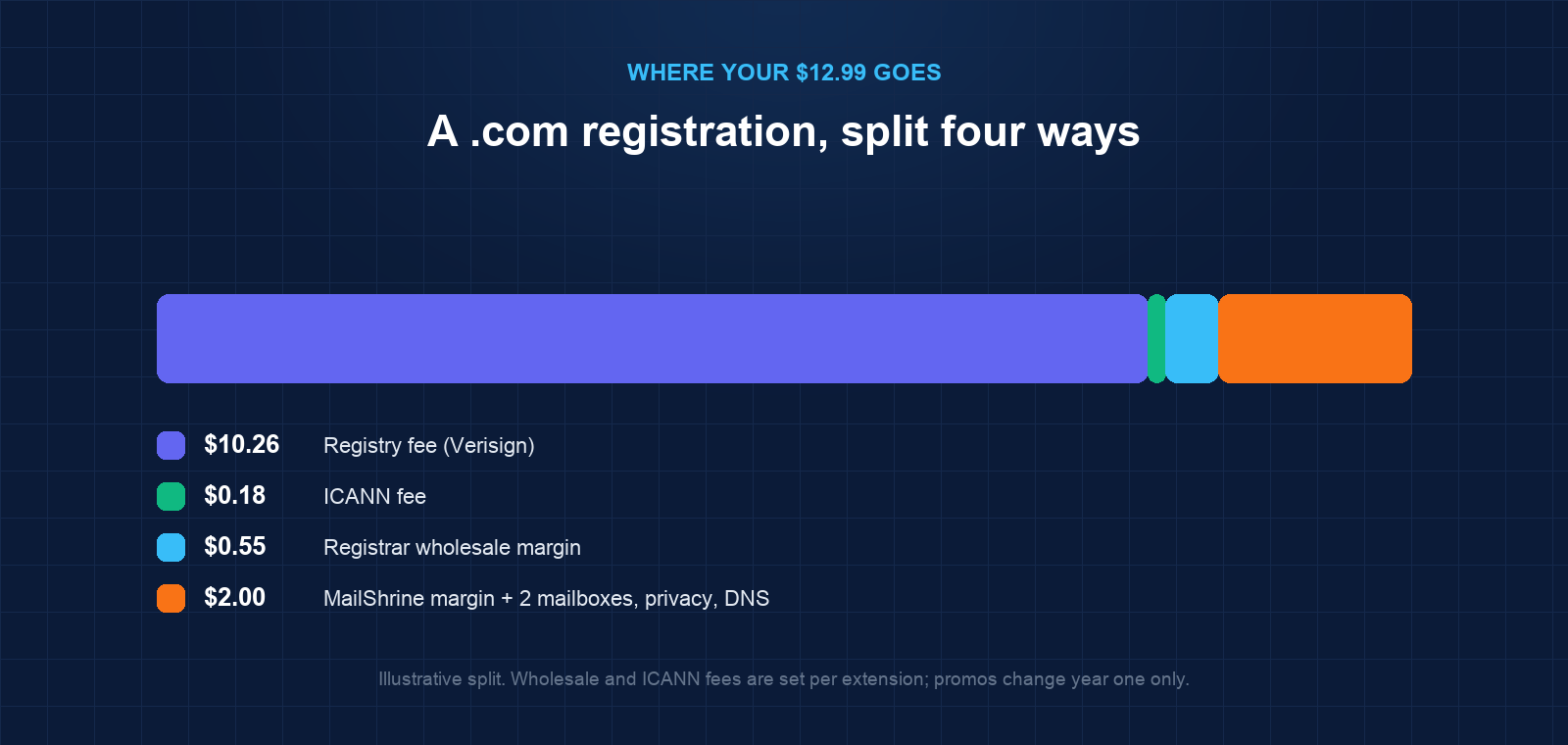
This is also why first-year promotions exist. Registries sometimes discount year one to get names moving, and registrars pass that on. The renewal price is the real price. A registrar that hides it is counting on you not noticing in twelve months. MailShrine shows both on every search result.
Why "the registrar" matters more than the registry
Ada never deals with Verisign. Everything she does, from changing nameservers to turning privacy off before a sale, goes through her registrar. That means the registrar decides:
- How renewals are priced and whether the price is shown up front.
- Whether privacy and transfer lock cost extra. At many registrars they are upsells. At MailShrine they are included.
- How DNS is managed. Some registrars give you a bare DNS panel. MailShrine writes the email records for you and lets you add your own next to them.
- How hard it is to leave. ICANN says you may transfer after 60 days, but a registrar controls how quickly it releases the auth code.
Picking a registrar is picking a landlord. The building is the same. The experience is not.
Ada's checklist
- Confirmed MailShrine is the registrar and Verisign the registry for .comCompleted
- Typed real registrant details, not the studio's old PO boxCompleted
- Chose a 2-year term so the renewal price is lockedCompleted
- Left WHOIS privacy and transfer lock onCompleted
- Renamed
you@toada@in Business EmailNot completed - Added the new address to her quote templateNot completed
Common mistakes
Thinking you bought the name outright. You rented it. Put the renewal date in your calendar even if auto-renew is on, and keep the card on file current.
Registering with a free email you will abandon. Renewal reminders and transfer approvals go to the registrant email. If that inbox dies, so can the domain.
Buying from the cheapest first-year price. Compare renewal prices. A $0.99 first year that renews at $24 costs more over three years than $12.99 that renews at $12.99.
Turning off transfer lock "to be safe". Lock is what stops a stranger from moving your domain away with a stolen auth code. Leave it on until the day you actually transfer.
Check your work
Open your domain in the MailShrine dashboard. You should see four things: status Active, an expiry date in the year you paid up to, privacy and lock on, and email setup complete. If any of those is missing an hour after payment, the registration did not finish and support can see exactly which step stalled.
FAQ
Do I own my domain after I register it?
You hold the exclusive right to use it for the paid term and to renew it indefinitely. The registry keeps the record. If you stop renewing, the right lapses after the grace period.
Can I buy directly from the registry and skip the registrar?
No. Registries sell only through ICANN-accredited registrars and their resellers. Even the largest companies buy through a registrar.
What is the difference between a registrar and a reseller?
A registrar holds ICANN accreditation and talks to the registry directly. A reseller sells through a registrar's wholesale platform. Both are fine for buyers; the reseller's registrar is listed in WHOIS.
Why does the renewal cost more than the first year?
Registries and registrars discount year one to attract registrations. The renewal is the standard price. MailShrine shows the renewal price next to every first-year price before you buy.
How long does registration take?
Most generic extensions such as .com, .net and .org register in seconds. Some country-code extensions ask the registry to review documents and can take a day or more.
Next steps
- What Is a TLD? — the extensions each registry runs and what they signal.
- What Is an EPP / Auth Code? — the password you need when you move a domain.
- Domain Lifecycle Explained — what happens if you forget to renew.
Citations & References
- Reference: ICANN: Registrant rights and responsibilities
- Reference: ICANN: Registrar Accreditation Agreement
- Reference: Verisign: .com registry
- Video: The difference between a domain name registrar, DNS, and hosting
Written by Isabelle R., domains editor. Isabelle explains how names, DNS and registrars fit together so first-time buyers know exactly what they are paying for.