
A premium domain is a name priced far above the standard registration fee for its extension. The term covers two very different things that happen to share a label. A registry premium is a name the registry itself has never released at the normal price: short, generic or dictionary words such as shop.store or cars.xyz that the registry lists at a higher wholesale fee, often with a higher renewal to match. An aftermarket premium is a name someone already registered, usually at the normal price years ago, and is now offering for sale through a marketplace at whatever the market will bear.
Both appear in a search as "premium" with a price that makes a first-time buyer stop. The difference matters: a registry premium renews at its premium price every year, while an aftermarket name is a one-time purchase after which it renews at the standard fee. Knowing which one you are looking at changes whether a $2,000 name is a bargain or a liability.
MailShrine Domains shows both kinds clearly. Registry premiums display the first-year price and the renewal price together, so a $400 name that renews at $400 is never mistaken for one that renews at $12.99. Aftermarket names that are for sale appear with a Buy Now price up to a cap, and once the purchase completes the name sits in your account like any other, with email DNS written and two mailboxes included.
Real-life example: Lukas's furniture brand
Lukas Brandt is launching a direct-to-consumer furniture brand in Berlin called Oak & Linen. oakandlinen.com is free at $12.99. oaklinen.com is an aftermarket listing at $3,900. oak.furniture is a registry premium at $650 a year. A designer friend insists the shorter name is worth the money; his accountant wants to know what the renewal will be in year three.
Lukas's goals:
- Understand why three similar names have three completely different prices.
- Know what he is actually paying for with each premium, and what it renews at.
- Decide whether a premium is worth it for a brand nobody has heard of yet.
Registry premium vs aftermarket premium
| Registry premium | Aftermarket premium | |
|---|---|---|
| Who sets the price | The registry, in tiers | The current registrant or a broker |
| Why it is expensive | Short, generic, dictionary word, or a high-value category in that extension | Someone else wants it too, or the seller believes they will |
| Renewal price | Usually the same premium every year, set by the registry | Standard renewal for the extension after purchase, typically $12.99 for a .com |
| Where you see it | Mostly in newer extensions: .xyz, .store, .furniture, .app, .io | Mostly in .com, .net, .org and strong country codes |
| How you buy | Normal checkout at a registrar | Buy Now, make an offer, or a broker-negotiated sale, often through escrow |
| Can the price change | Registries can move names between tiers at renewal in some extensions | Fixed once you own it |
oak.furniture is the first column. Lukas would pay $650 this year and $650 every year he keeps it. oaklinen.com is the second: $3,900 once, then around $12.99 a year.
What drives the price of an aftermarket name
| Factor | Effect on price | Example |
|---|---|---|
| Length | Shorter is worth more; 3 and 4 letter .com names almost always sell for four figures or more | oak.com vs oakandlinen.com |
| Dictionary words | A real word or two-word phrase commands a premium | linen.com |
| Extension | .com leads; .net, .org, .io, .ai, .de, .co.uk follow | The same word in .info may be nearly free |
| Commercial category | Finance, insurance, travel and software names sell high | loans.com sold for millions |
| Type-in and search traffic | Existing visitors add value | A name that already receives visits |
| Comparable sales | Brokers price off public sales records | NameBio lists reported sales |
| Brandability | Pronounceable, spellable, no hyphens | oaklinen scores well |
Hyphens, numbers, misspellings and more than two words all push value down sharply.
How registry premiums are tiered
Registries that sell new extensions typically sort their dictionary into tiers at launch. A name's tier is set by the registry, applied through every registrar, and visible as a higher price in the search result.
| Tier (illustrative) | Typical yearly price | Examples in a .furniture-style extension |
|---|---|---|
| Standard | $20 to $50 | brandtworkshop.furniture |
| Premium low | $100 to $300 | berlin.furniture |
| Premium mid | $500 to $1,500 | oak.furniture |
| Premium high | $5,000 and up | modern.furniture |
Some registries also hold back reserved names that are not for sale at any price through registrars and are released only in auctions.
What you need before you start
| You need | Why |
|---|---|
| A budget for both purchase and renewal | A premium that renews at the premium price costs its tag every year |
| The exact renewal price | MailShrine shows it beside the first-year price; check it before anything else |
| Comparable sales for an aftermarket name | Public sales records stop you paying $3,900 for a name that sells for $800 |
| A trademark search on the name | Buying a name that infringes a mark buys you a dispute |
| A fallback standard name | Negotiations and auctions fail; have the $12.99 option in hand |
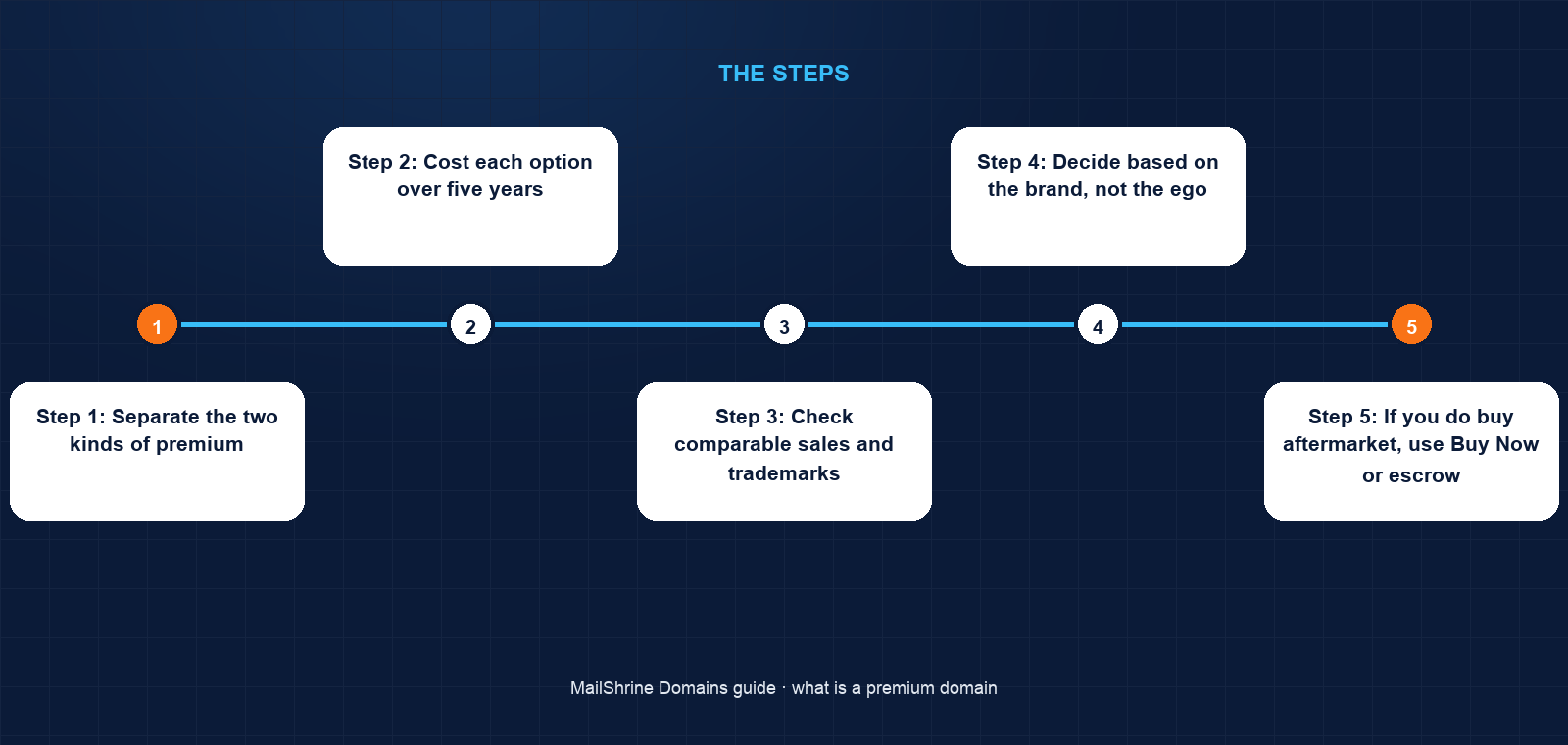
Step 1: Separate the two kinds of premium
Lukas searches all three in the availability checker. oak.furniture shows $650 first year and $650 renewal, a registry premium. oaklinen.com shows a Buy Now of $3,900, an aftermarket listing, with the standard .com renewal. oakandlinen.com is a standard $12.99.
Step 2: Cost each option over five years
Registry premium: $650 times 5 is $3,250, and it never stops. Aftermarket: $3,900 plus about $52 in renewals is roughly $3,952, then $12.99 a year forever. Standard: about $65. He writes the three numbers on one page.
Step 3: Check comparable sales and trademarks
Public sales records show two-word .com names in his category selling between $1,500 and $5,000, so $3,900 is within range but not cheap. A trademark search on "Oak Linen" shows no registered mark in his classes.
Step 4: Decide based on the brand, not the ego
Oak & Linen has no customers yet. Lukas registers oakandlinen.com for three years today so email and the shop can launch. He bookmarks the oaklinen.com listing and sets a rule: if first-year revenue clears a threshold, the shorter name is a marketing expense he can justify and redirect to the main site.
Step 5: If you do buy aftermarket, use Buy Now or escrow
A Buy Now purchase on MailShrine completes through the marketplace and the name lands in his account. For a negotiated sale off-platform, payment should go through an escrow service that releases funds only when the transfer completes.
Lukas's checklist
- Learned that registry premiums renew at the premium price and aftermarket names do notCompleted
- Compared five-year costs for all three names on one pageCompleted
- Checked comparable sales and ran a trademark searchCompleted
- Registered
oakandlinen.comfor three years with privacy and lock onCompleted - Revisit the
oaklinen.comlisting after the first year's revenueNot completed - Never pay a seller directly without escrow or a marketplace in betweenNot completed
Common mistakes
Reading the first-year price of a registry premium as the price. $650 is $650 every year. MailShrine shows the renewal next to it; always read both.
Paying aftermarket money for a name you could register in a different extension. If .com is the only extension your customers will type, pay for it. If they will search for you and click, a standard name in a sensible extension does the same job.
Buying before the trademark search. A premium name that matches someone's registered mark can be taken from you through UDRP, and the money is gone.
Wiring money to a seller found by email. Scammers list names they do not hold. Use a marketplace with Buy Now or an escrow service; never pay first.
Check your work
Before paying for any premium, open the domain in the MailShrine search result and confirm two numbers: the price today and the renewal price. For an aftermarket name, run an RDAP lookup and check the current registrar and expiry; a name expiring in two weeks may drop and be available at the standard price. After purchase, confirm the domain appears in your account with status ok or clientTransferProhibited, your details as registrant, and the expected renewal on the renewal screen.
FAQ
What makes a domain premium?
Either the registry priced it above standard because it is short or generic, or a current holder is selling it on the aftermarket for more than the registration fee. The word "premium" alone does not tell you which; the renewal price does.
Do premium domains have higher renewal fees?
Registry premiums usually do: the premium price recurs every year. Aftermarket premiums do not: after the one-off purchase they renew at the standard price for the extension.
Are premium domains worth it?
For an established brand that loses customers to a shorter or more obvious name, often yes. For a new business with no revenue, a standard name launches today and the premium can be bought later if the brand earns it.
Can a premium domain be negotiated?
Aftermarket names often can; Buy Now prices are a ceiling and many sellers accept offers. Registry premiums are fixed by tier and cannot be negotiated through a registrar.
Can I sell a domain I own as a premium later?
Yes. Any registered domain can be listed on a marketplace. Value depends on length, words, extension and demand, and most names never sell, so buy domains for use rather than as investments.
Next steps
- What Is a TLD? .com, .net, .org, .io and Country Codes Explained — why the same word costs a dollar in one extension and thousands in another.
- Can You Buy a Domain Name Permanently? Why Domains Are Rented — what you actually acquire when you pay thousands for a name.
- Domain Lifecycle: Active, Grace, Redemption, Pending Delete — how aftermarket names sometimes drop and become available at the standard price.
Citations & References
- Reference: ICANN: Uniform Domain-Name Dispute-Resolution Policy
- Reference: Verisign: Domain Name Industry Brief
- Reference: NameBio: Domain name sales history
- Reference: WIPO: Domain name dispute resolution
Written by Samira K., small-business editor. Samira writes for owners who need a working address and inbox this week, not a technology lecture.