
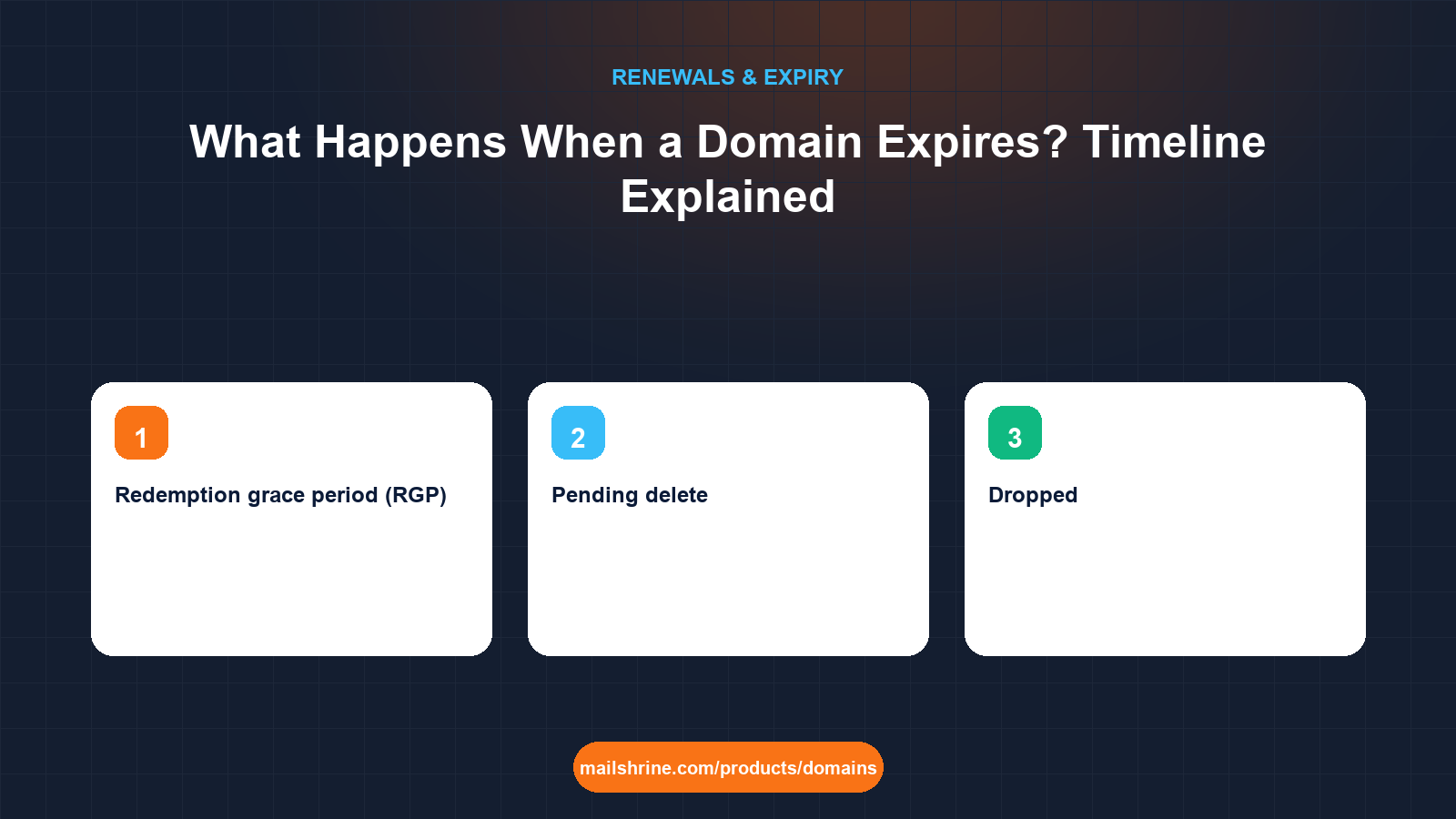
A domain expiry is not a single event. It is the start of a countdown that runs for roughly 75 to 80 days on a .com, and the price of getting your name back climbs at each stage. On the expiry date itself nothing is deleted. Your registration simply stops being paid for, and the registry starts a sequence that ICANN and the registry operator have defined down to the day: a grace period where renewal costs the normal price, a redemption period where it costs several times more, a five-day pending-delete window where nobody can touch it, and then the drop, when the name becomes available to anyone.
Most people who lose a domain lose it in the first stage, not the last. The site goes dark, email bounces, and they assume the name is gone when they usually still have a month to renew at the standard fee.
MailShrine Domains sends renewal reminders at 30, 7 and 1 day before expiry and again on the day itself, and lets you renew an expired domain for as long as the registry grace period lasts. Because your Business Email mailboxes run on the same name, an expiry on MailShrine is also an email outage, which is one more reason the reminders matter.
Real-life example: Kwame's print shop
Kwame Mensah runs Mensah Print, a six-person print and signage shop in Accra. He registered mensahprint.com four years ago through a friend, paid cash for the first two years, and never saw a renewal notice because they went to the friend's inbox. On a Monday morning in March, customer emails start bouncing and the website shows a parking page full of adverts.
Kwame's goals this week:
- Find out exactly which stage of expiry the domain is in and how many days he has left.
- Learn what it will cost to recover it at each stage so he can decide fast.
- Move the domain to an account he controls so this never happens again.
The expiry timeline for a .com, day by day
| Stage | When (days after expiry) | Who can renew | Typical cost | What the public sees |
|---|---|---|---|---|
| Expired, auto-renew grace period | Day 0 to about day 30 to 45 | Registrant, through the current registrar | Normal renewal price | Site and email usually stop within days; parking page common |
| Redemption grace period (RGP) | About day 45 to day 75 | Registrant only, through the current registrar | Renewal plus a restore fee, often $80 to $200 | Domain shows status redemptionPeriod; nothing resolves |
| Pending delete | Last 5 days | Nobody | Cannot be renewed | Status pendingDelete; name is locked |
| Dropped | About day 80 onward | Anyone, first come first served | New registration price, or auction price if caught | Available in any availability checker |
The exact length of the first stage is set by the registrar, not the registry. Verisign allows registrars up to 45 days of auto-renew grace on .com and .net, but many registrars shorten it to 30 days or less and begin auctioning the name to third parties before the redemption period starts. Country-code extensions run their own clocks: some .ng and .ke registrations drop in a fraction of the time, and a few have no redemption period at all.
What ICANN forces every registrar to do
Expiry is one of the few areas where ICANN has written consumer-protection rules directly into registrar contracts. The Expired Registration Recovery Policy (ERRP), in force since 2013, requires every accredited registrar to:
| Rule | What it means for you |
|---|---|
| Send at least two reminders before expiry | Roughly one month and one week before the date, to the registrant email on file |
| Send one notice after expiry | Within five days of the domain expiring |
| Interrupt DNS resolution after expiry | At least once in the eight days following expiry, so you notice the site or email has stopped |
| Publish renewal and restore fees | The price to recover a domain in redemption must be on the registrar's site, not quoted on request |
| Allow renewal during redemption | Registrars cannot refuse to restore a domain that is still in RGP |
The parking page Kwame saw is the ERRP working as intended: a dark site gets attention that a reminder in an abandoned inbox never will.
What you need before you start
| You need | Why it matters |
|---|---|
| The exact expiry date and current status | An RDAP lookup at lookup.icann.org shows both; the status line tells you which stage you are in |
| Access to the registrar account | Only the account holder can renew during grace or redemption; a new registrar cannot help until the name drops |
| Access to the registrant email | Password resets and restore confirmations go there; recover that mailbox first if it is lost |
| A card or bank method ready | Redemption restores are often paid by wire or card on file and the clock does not pause while you arrange it |
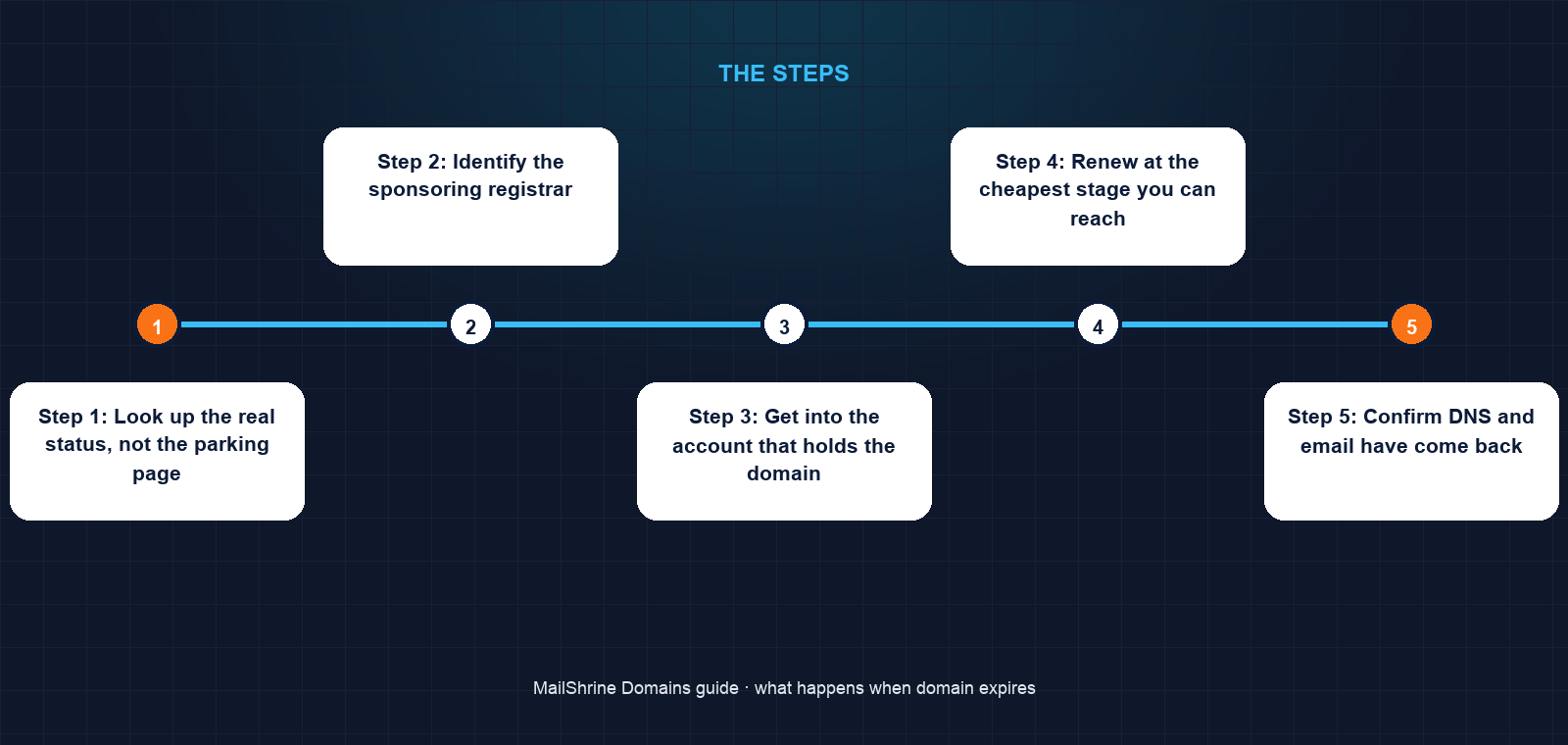
Step 1: Look up the real status, not the parking page
Run an RDAP lookup on the name. RDAP replaced WHOIS as the authoritative lookup protocol in 2025 and returns the same fields in a structured form. You are looking for two things: the expiration date and the status codes. clientHold or autoRenewPeriod means you are in the grace period. redemptionPeriod means stage two. pendingDelete means the five-day countdown has started and renewal is impossible.
Step 2: Identify the sponsoring registrar
The RDAP record names the registrar and gives its abuse and support contacts. If the domain was bought through a reseller, the registrar listed is still the company that holds the EPP record and the only one that can process a renewal or restore.
Step 3: Get into the account that holds the domain
Kwame's friend had the login. If the person who registered the name is reachable, have them renew immediately or push the domain to an account you control. If they are not reachable, most registrars will move a domain to a new account holder after identity and business verification, but the process takes days you may not have. Start it the same hour.
Step 4: Renew at the cheapest stage you can reach
In the grace period a renewal costs the standard price, about $12.99 for a .com at MailShrine. In redemption it costs that plus the restore fee the registrar publishes. If you are three days from the end of grace, do not spend those days negotiating; renew first and sort out ownership afterwards. Renewal never changes who the registrant is.
Step 5: Confirm DNS and email have come back
Renewal removes the hold status, but DNS caches still carry the parking records for as long as their TTL, often one to 24 hours. Mail servers that received bounces will retry on their own. Send yourself a test message from an outside address and check the website from a phone on mobile data, not the office Wi-Fi.
Step 6: Fix the cause
Move the domain to an account with a current card, your own mailbox as the registrant email, and auto-renew on. If the registrar made this hard, transfer it after the dust settles. MailShrine's transfer-in refunds the full fee if the losing registrar rejects the transfer.
Kwame's checklist
- Ran an RDAP lookup and found status
autoRenewPeriod, 19 days left in graceCompleted - Reached the friend, who renewed for one year at the standard price the same afternoonCompleted
- Confirmed email was flowing again by the next morningCompleted
- Transfer
mensahprint.cominto his own MailShrine account once the renewal settlesNot completed - Set the registrant email to
kwame@mensahprint.comand turn auto-renew onNot completed - Put the new expiry date in the shop calendar as a backupNot completed
Common mistakes
Assuming a parking page means the name is gone. A parking page is the registrar's required DNS interruption. It appears within days of expiry, typically with at least three weeks of grace still to run.
Trying to re-register the name at a different registrar. Until the name actually drops, availability checkers will show it as taken. No other registrar can touch a domain in grace or redemption.
Waiting for the redemption fee to come down. It does not. The restore fee is fixed and the pending-delete stage that follows cannot be interrupted by anyone, including the registry.
Renewing and then stopping. The person who renewed is still the registrant. If that is an ex-contractor or an old agency, you have bought a year of time, not ownership. Use it.
Treating country-code domains like .com. Many ccTLD registries have shorter grace periods, no redemption, or require paperwork to restore. Look up the rules for the specific extension the week you notice the problem.
Check your work
After renewal, the RDAP record should show a new expiration date one or more years ahead, no hold or redemptionPeriod status, and your own name in the registrant field if you also changed ownership. In the MailShrine dashboard the domain should read Active, show the new expiry date, and show renewal reminders scheduled for 30, 7 and 1 day before it. If the status still shows a hold a day after payment, the renewal did not reach the registry and support can trace the EPP command.
FAQ
Does my website go down the moment the domain expires?
Not at the exact second, but usually within a few days. ICANN requires registrars to interrupt DNS resolution at least once in the eight days after expiry, and most do it immediately by replacing your nameservers with a parking page.
How long do I have to renew after a domain expires?
For most generic extensions you have the registrar's auto-renew grace period, up to 45 days, at the normal price, followed by a 30-day redemption period at a higher price. Country-code extensions set their own, often shorter, windows.
Can someone else buy my domain the day after it expires?
No. During grace and redemption the name is locked to you. Someone else can only register it after pending delete ends, about 75 to 80 days after expiry on a .com, unless your registrar auctions it during grace and you fail to renew before the auction closes.
Does an expired domain lose its SEO rankings?
Search engines notice the parking page quickly and may drop the pages from results within a couple of weeks. Rankings generally recover once the original site is back, but the longer the outage, the slower the recovery.
What happens to my email during expiry?
Your MX records stop resolving as soon as DNS is interrupted, so senders get bounce messages. Mail is not queued for you. Once renewed, new messages arrive normally, but anything sent during the outage is lost unless the sender resends it.
Next steps
- How to Renew a Domain Name — the renewal steps, terms and prices before you reach the grace period.
- Redemption Period: Recovering a Domain After It Expires — what the restore fee covers and how to get a domain back in stage two.
- Domain Expired: When Can Someone Else Buy It? — the exact moment a lapsed name becomes available to others.
Citations & References
- Reference: ICANN: Expired Registration Recovery Policy
- Reference: ICANN: Life cycle of a typical gTLD domain name
- Reference: IETF RFC 3915: Domain Registry Grace Period Mapping for EPP
- Reference: ICANN Lookup (RDAP)
Written by Isabelle R., domains editor. Isabelle explains how names, DNS and registrars fit together so first-time buyers know exactly what they are paying for.