
Renewing a domain means paying the registry, through your registrar, to extend the expiry date on your registration by one or more years. It is the simplest transaction in the domain world and also the one that goes wrong most often, because it happens once a year, in an account you rarely open, with a card that may have expired since you last paid. The mechanics are short: log in, pick a term, pay, confirm the new date. The judgement is in how many years to add, whether to renew early, and how to make sure the price you are quoted is the renewal price and not a first-year promotion that no longer applies to you.
A renewal never changes who holds the name, which nameservers it uses, or any DNS record. It only moves the expiry date. That is why you can renew a domain you bought years ago at a registrar you have since stopped using, and why renewing is always safer than letting a name lapse and trying to get it back.
MailShrine Domains shows the renewal price next to the first-year price before you buy, so the number you see at renewal is the one you were told at registration. Reminders arrive 30, 7 and 1 day before expiry and on the day itself, you can renew for any term from 1 to 10 years in total, and you can pay in US dollars by card or in Naira through Paystack. Your Business Email mailboxes on the domain continue without interruption as long as the name is renewed.
Real-life example: Priya's tutoring agency
Priya Raman runs Bright Minds Tutoring in Toronto, matching twelve part-time tutors with families across the city. Her domain brightmindstutoring.ca was registered two years ago on a one-year term and renewed once by a web developer who has since moved on. The 30-day reminder has just landed in her inbox. She has a card ready and ten minutes between lessons, and she wants to make sure she never thinks about this again.
Priya's goals this week:
- Renew the domain before the date on the reminder with no gap in email or website.
- Decide whether to pay for one year or several, and understand what each option really costs.
- Set the account up so future renewals happen without a developer in the loop.
Renewal terms and what they cost over time
| Term chosen now | Price today for a .com at $12.99/yr | Reminders before next expiry | Best for |
|---|---|---|---|
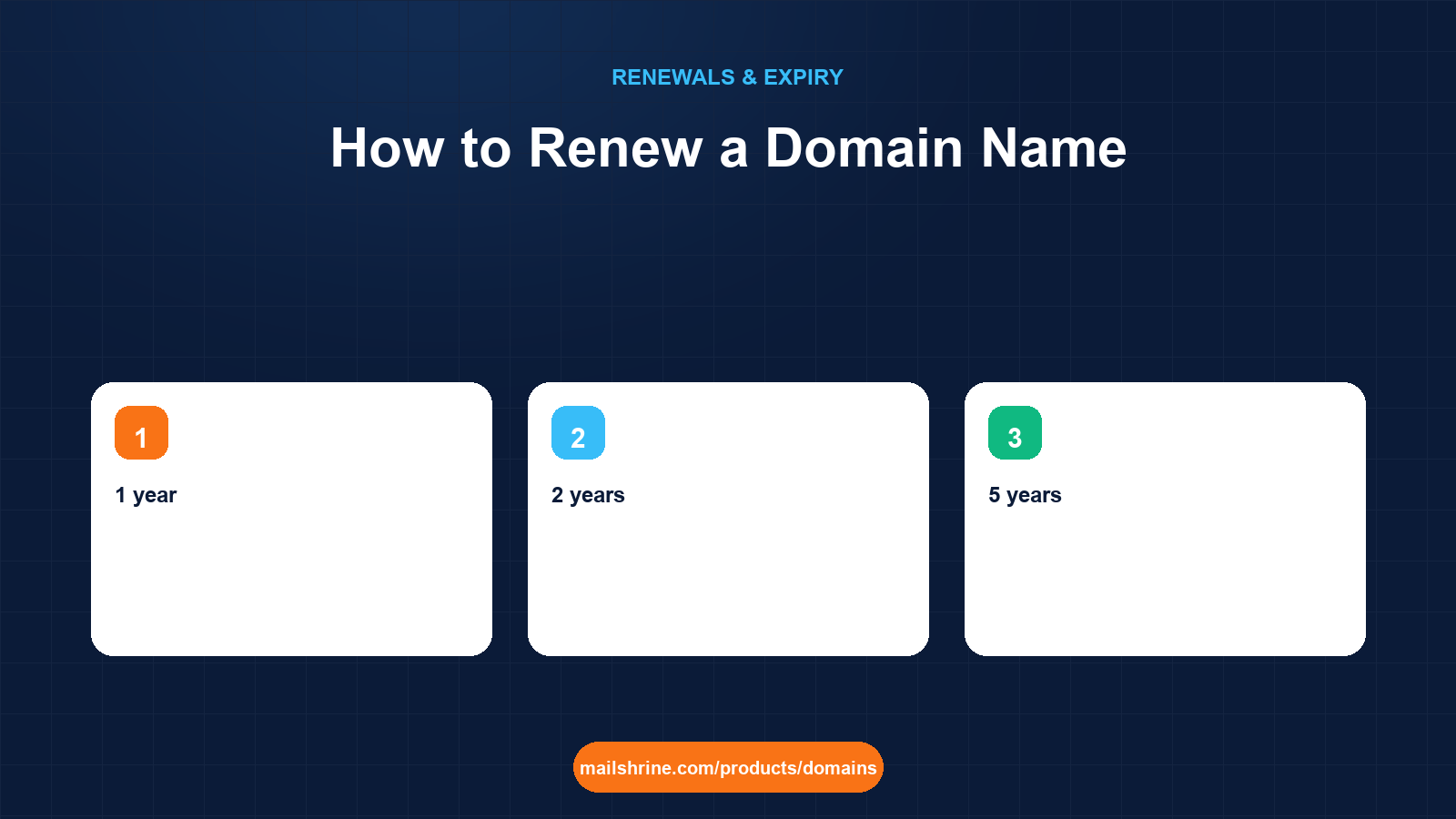
| 1 year | $12.99 | 4 emails over the next 12 months | Names you are not sure you will keep |
| 2 years | $25.98 | 4 emails over the next 24 months | Most small businesses |
| 5 years | $64.95 | 4 emails over the next 5 years | A trading name you will never drop |
| Up to 10 years total | Up to $129.90 | Almost none for a decade | Brand names, founder surnames, flagship products |
The registry caps every generic domain at 10 years of total registration. If a name already has three years left, the most you can add is seven. Renewal prices are per year and do not get cheaper with longer terms; the benefit of a multi-year renewal is protection against price increases and the removal of an annual failure point, not a bulk discount.
Early renewal versus renewal at expiry
Renewing early does not waste time. If Priya's domain expires on 14 November and she renews for two years on 20 October, the new expiry is 14 November two years later, not 20 October. The registry adds the years to the current expiry date, so there is no penalty for being prompt. The only situation where early renewal costs anything is on the handful of country-code extensions that reset the date to the renewal day, which is why MailShrine shows the resulting expiry date on the confirmation screen before you pay.
| Timing | What happens to the expiry date | Risk |
|---|---|---|
| Any time before expiry | Years added to the existing date | None |
| 0 to 30/45 days after expiry (grace) | Years added from the original expiry date | Site and email may be interrupted while expired |
| 30/45 to 75 days after expiry (redemption) | Same, but a restore fee is added | High cost, several days to process |
| After pending delete | Cannot renew; name has dropped | May be registered by someone else |
What you need before you start
| You need | Why it matters |
|---|---|
| Login to the registrar account that holds the domain | Renewals can only be processed by the sponsoring registrar; the name shows in RDAP |
| A valid payment method | An expired card is the number one cause of failed auto-renewals |
| The current expiry date | Decide how many years to add without hitting the ten-year ceiling |
| Access to the registrant email | Receipts and the renewal confirmation go there; fix this address if it belongs to a former contractor |
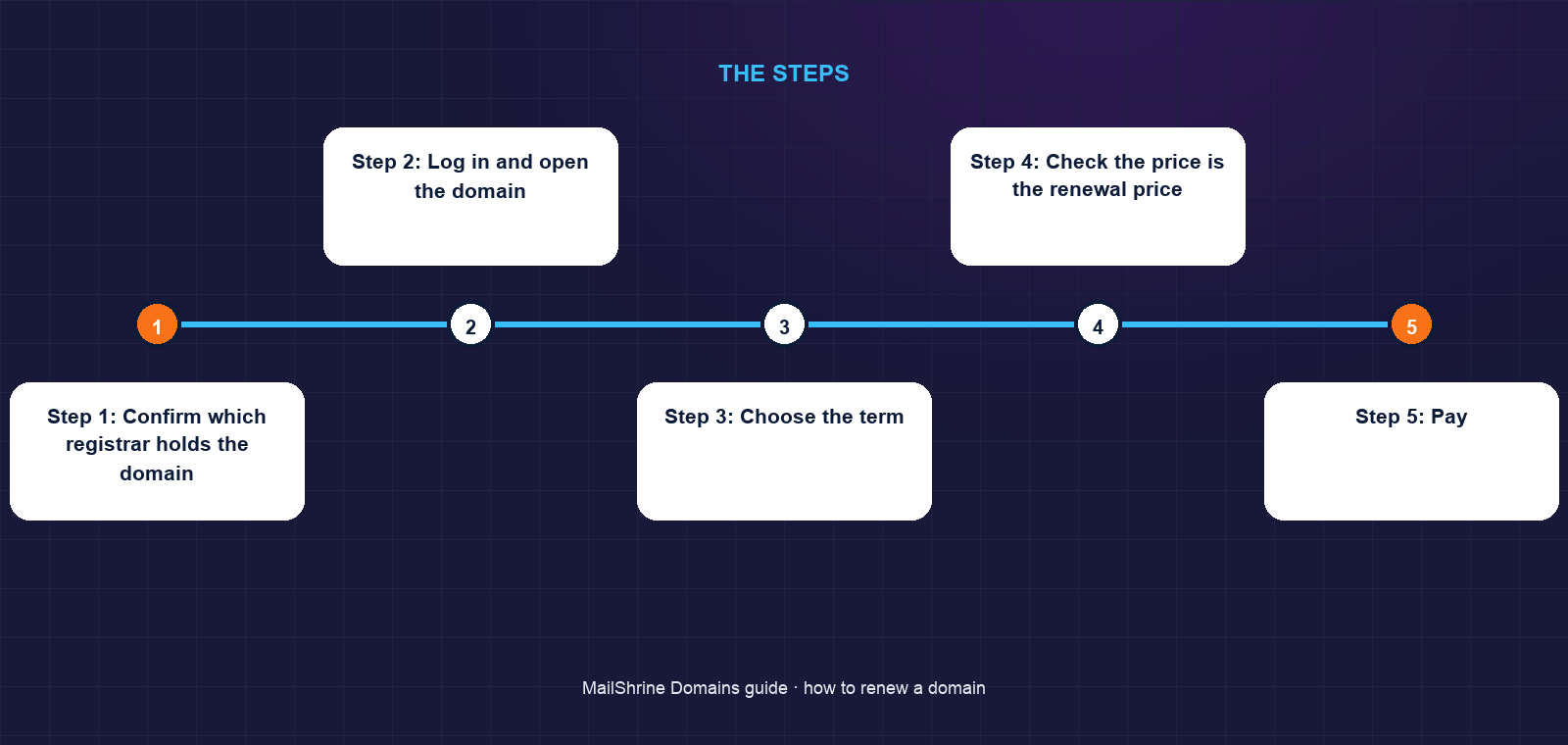
Step 1: Confirm which registrar holds the domain
If you are not sure where the name lives, run an RDAP lookup at lookup.icann.org. The record names the registrar. Priya's shows the registrar her developer used, which is where she must renew this time even if she plans to move the name later.
Step 2: Log in and open the domain
Inside the dashboard, find the domain and check the expiry date against the reminder. On MailShrine the domain card shows the expiry date, whether auto-renew is on, and the renewal price per year.
Step 3: Choose the term
Pick the number of years to add. The confirmation screen should show the new expiry date. If it does not, calculate it yourself: current expiry plus the years chosen, capped at ten years from today.
Step 4: Check the price is the renewal price
Compare the per-year figure with what you were shown at registration. First-year promotions do not apply to renewals, and some registrars charge more for renewal than they advertise. On MailShrine the renewal price was displayed at purchase and is the same figure here.
Step 5: Pay
Pay by card in USD or, for Nigerian customers, in Naira through Paystack. The charge is captured before the renew command goes to the registry, so a declined card leaves the domain exactly as it was rather than half-renewed.
Step 6: Verify the new expiry date
Within a few minutes the dashboard and the RDAP record should both show the new date. Save the receipt. Then open the domain settings and decide on auto-renew for next time.
Priya's checklist
- Found the sponsoring registrar through RDAP and recovered the login from the old developerCompleted
- Renewed for two years so the next decision is in 24 monthsCompleted
- Saw the new expiry date on the confirmation screen before payingCompleted
- Changed the registrant email to her own
priya@brightmindstutoring.caCompleted - Transfer the domain to MailShrine after the renewal settles so email and domain live in one accountNot completed
- Add a calendar note one month before the new expiry as a backup to the remindersNot completed
Common mistakes
Renewing at the wrong company. Hosting, website and email providers all send invoices, and many people pay a hosting bill believing it covers the domain. Only the registrar shown in RDAP can renew the name.
Letting a card expire in the account. Reminders tell you a renewal is due; they do not fix a declined payment. Update the card whenever you get a new one.
Choosing one year every year for a name you will keep forever. Each renewal is a chance to forget. A five-year renewal on a trading name costs nothing extra per year and removes four failure points.
Reading a first-year promotion as the renewal price. A $0.99 or $4.99 headline price applies to new registrations. The renewal figure is what you will pay every year after that, and MailShrine shows both before purchase for this reason.
Trying to transfer instead of renewing when the date is close. A transfer adds a year but can take up to five days to complete and can be rejected. If expiry is within two weeks, renew first and transfer afterwards.
Check your work
Three things should agree after a renewal: the registrar dashboard, the RDAP record, and your receipt. All three should show the same new expiry date, and the dashboard should show status Active with no hold. If the RDAP record still shows the old date an hour later, the renew command did not reach the registry and support can check the EPP response. Finally, send a test email to an address on the domain to confirm nothing changed in DNS, because a renewal should be invisible to everything except the expiry date.
FAQ
Can I renew a domain early?
Yes, at any time. The years you buy are added to the current expiry date, so renewing early does not cost you time. The only limit is that total registration cannot exceed ten years from today.
How much does it cost to renew a domain?
The renewal price is set per extension and per registrar. A .com typically renews at about $12.99 per year on MailShrine; other extensions differ. The renewal price is usually higher than a first-year promotional price, and it is the figure you should compare between registrars.
Does renewing change my DNS or email settings?
No. A renewal only extends the expiry date. Nameservers, DNS records, WHOIS privacy and transfer lock all stay exactly as they were.
Can I renew a domain I did not register myself?
Only if you have access to the registrar account that holds it. If a former employee or agency registered it, you will need to recover that account or have the registrar move the domain to you after identity verification.
What if I miss the expiry date?
Most extensions give you a grace period of up to 45 days where renewal costs the normal price, then a 30-day redemption period with an added restore fee. After that the name drops and anyone can register it.
Next steps
- Auto-Renew for Domains: Pros, Cons and How It Works — whether to let the registrar renew for you and what can still go wrong.
- Should You Register a Domain for 10 Years? — when a long term is worth paying up front.
- What Happens When a Domain Expires? Timeline Explained — the stages that follow if the renewal does not happen.
Citations & References
- Reference: ICANN: Expired Registration Recovery Policy
- Reference: ICANN: Registrant rights and responsibilities
- Reference: Verisign: .com registry
- Reference: ICANN Lookup (RDAP)
Written by Samira K., small-business editor. Samira writes for owners who run the shop, the books and the website at the same time and need domain decisions to take ten minutes, not a weekend.