
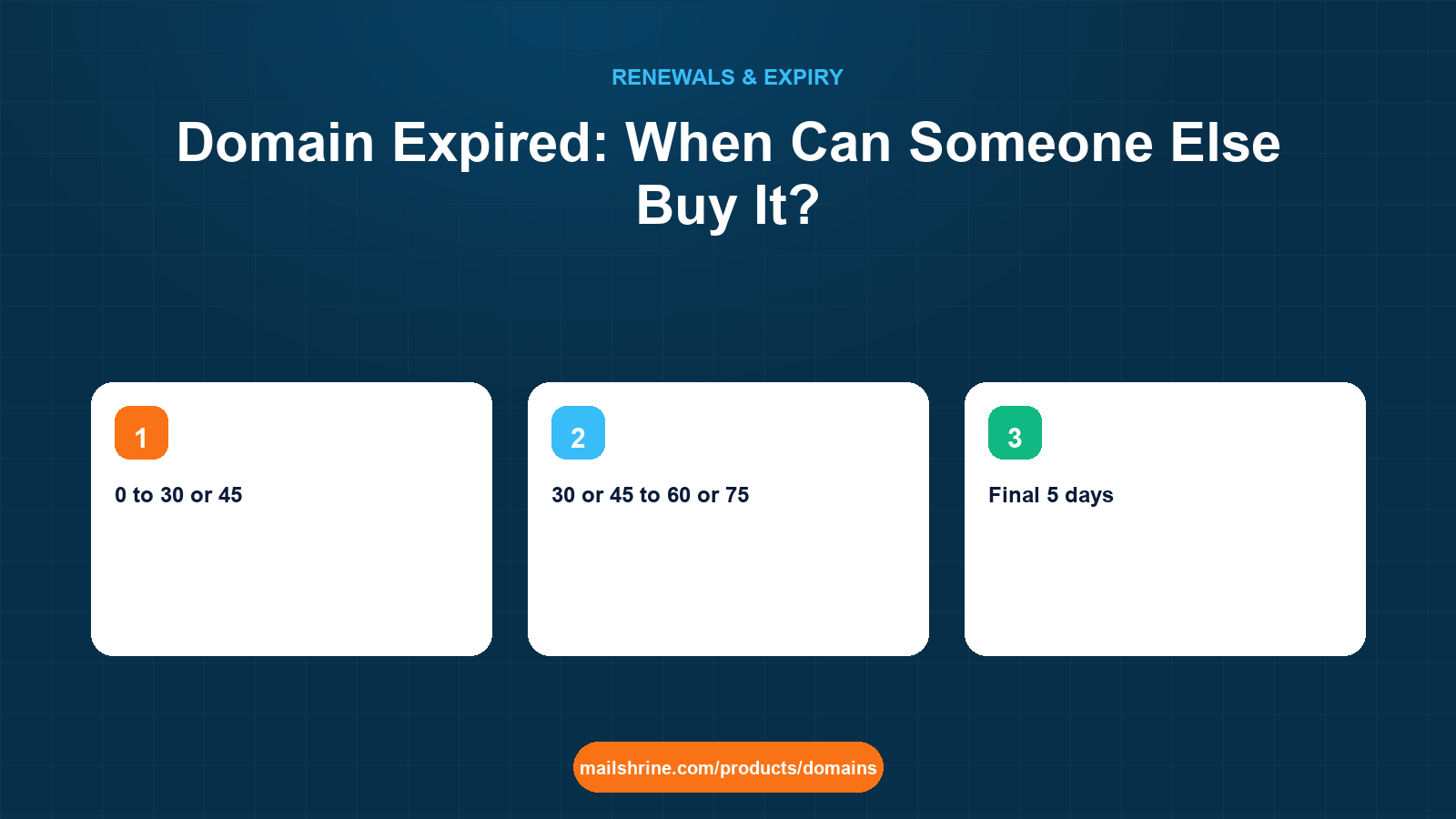
An expired domain is not an available domain. When you check a name you want and the lookup shows an expiry date in the past, the registration has lapsed, but the name is still held for its current registrant through a sequence of protected stages that lasts roughly 75 to 80 days on a .com. Only when the registry deletes the name at the end of that sequence can you, or anyone, register it. The exact moment is predictable to within a few hours once you know which stage the name is in, and whether the current registrar intends to auction it before letting it drop.
The confusion comes from the word "expired". A lapsed domain shows as expired in RDAP from day one, but the registrant can renew it at the normal price for a month or more, then pay a restore fee for another month. The name you are watching may come back to life at any point in that window. Treating the expiry date as a release date is how people wait weeks for a name that was never going to drop.
MailShrine Domains availability checks tell you whether a name can be registered right now. For a lapsed name, the honest answer is "not yet", and this guide explains how to read the status codes that tell you when "yet" arrives. If the current holder renews, you can look for alternatives with the availability checker, and if the name drops you can register it the same day with privacy and Business Email included.
Real-life example: Fatou's fashion label
Fatou Diallo is launching a ready-to-wear label in Dakar and wants fatoudiallo.com. The name was registered years ago by someone with the same name in another country and the site has been a blank page since 2022. An RDAP lookup shows the expiry date passed three weeks ago and the status is clientHold. Fatou is being told by one friend that she can buy it now, by another that it is gone forever, and by a drop-catching service that she should pay them to grab it. She wants the real answer and a date to put in her diary.
Fatou's goals this week:
- Read the status codes and work out exactly which stage the domain is in.
- Know the earliest date it could become available and the latest.
- Decide whether to wait, backorder, or register an alternative today.
When a lapsed .com actually becomes available
| Days after expiry | Stage | RDAP status you will see | Can you register it? |
|---|---|---|---|
| 0 to 30 or 45 | Auto-renew grace period | clientHold, autoRenewPeriod | No. The registrant can renew at the normal price |
| 30 or 45 to 60 or 75 | Redemption grace period | redemptionPeriod | No. The registrant can restore for a fee |
| Final 5 days | Pending delete | pendingDelete | No. Nobody can act; the date is now fixed |
| About 75 to 80 | Deleted | Name absent from RDAP | Yes, from the moment the registry drops it |
Two things make the timeline shorter or longer than this. First, the registrar chooses how much of the 45-day auto-renew grace to allow before handing the name to redemption; some use the full 45, some 30, and a few move names on in under two weeks. Second, many large registrars run expired-domain auctions during the grace period. If a bidder wins, the registrar renews the domain and transfers it to the winner, and the name never drops at all.
The three ways a lapsed domain changes hands
| Route | When it happens | Who gets the name | What it costs |
|---|---|---|---|
| Registrant renews or restores | Any time in grace or redemption | The original holder keeps it | Renewal, plus restore fee in redemption |
| Registrar expired auction | During the grace period, before redemption | Highest bidder at that registrar's auction partner | Opening bids often around $10 to $20, rising with demand |
| The drop | After pending delete ends | First registrar to submit a successful create command | Standard registration price, or a drop-catch service fee if you used one |
For .com and .net, Verisign processes deletions in a daily batch that begins at about 14:00 US Eastern time (18:00 or 19:00 UTC depending on daylight saving). Names in their fifth day of pendingDelete drop during that batch. Drop-catching services send thousands of create commands per second at that moment, which is why a desirable name is rarely available to a human typing into a search box; it is gone within milliseconds.
What you need before you start
| You need | Why it matters |
|---|---|
| The current RDAP record | Status codes and the last-updated date tell you the stage and the likely drop date |
| The sponsoring registrar's expiry policy | Tells you whether the name will be auctioned and how long their grace period is |
| A backup name you would be happy with | Most watched names never drop; you need a plan B you can register today |
| A decision on budget | A drop-catch backorder, an auction bid and a plain registration cost very different amounts |
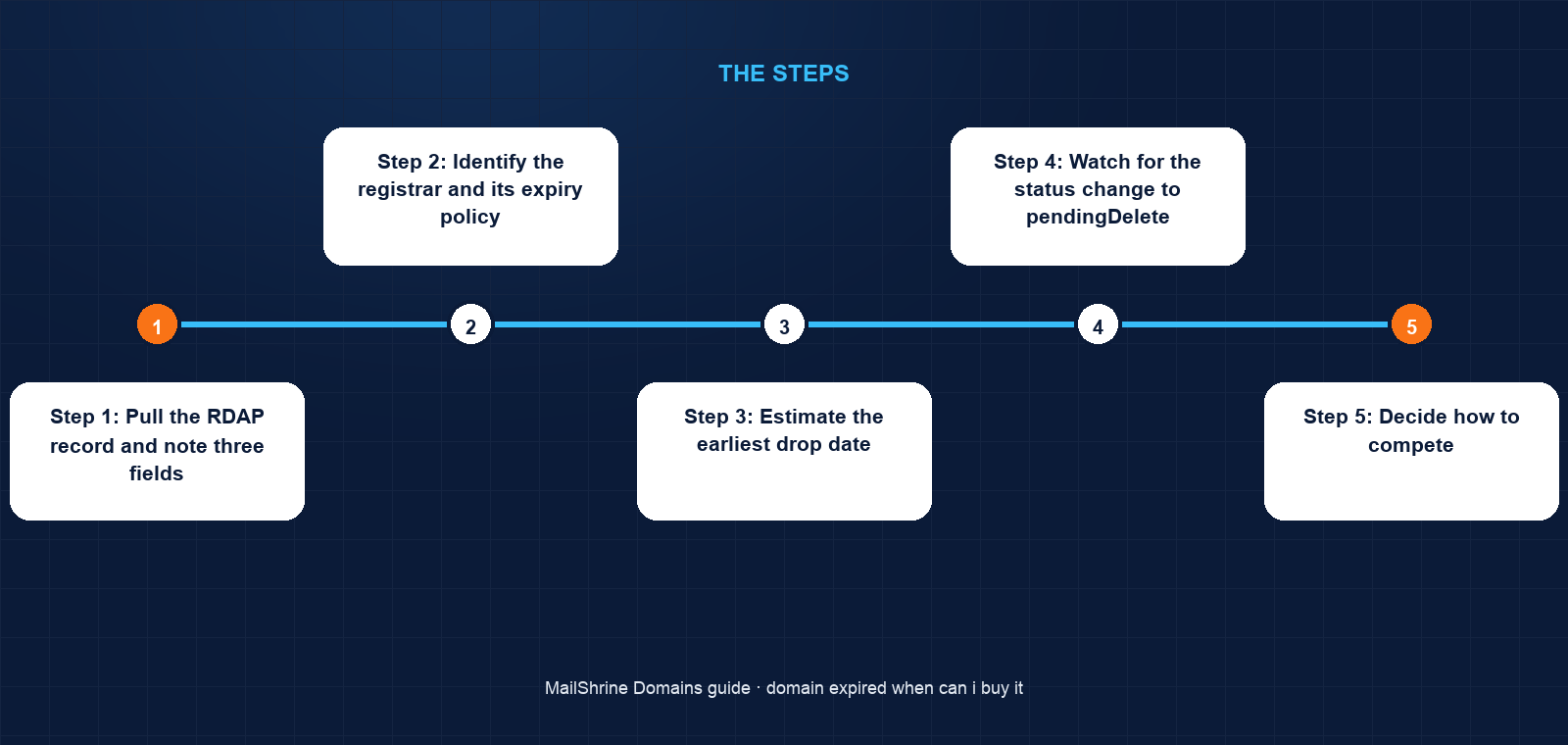
Step 1: Pull the RDAP record and note three fields
Expiration date, status codes and last-updated date. Fatou's record shows expiry 21 days ago, status clientHold, last updated 20 days ago. She is in the auto-renew grace period, and the registrant can still renew at any moment.
Step 2: Identify the registrar and its expiry policy
RDAP names the registrar. Search that registrar's help pages for "expired domain" to learn two things: how many days of grace they allow and whether they auction expiring names. If they auction, the name may appear on their auction partner's listing within days.
Step 3: Estimate the earliest drop date
Add the registrar's grace period, then 30 days of redemption, then 5 days of pending delete to the expiry date. For Fatou's name at a registrar with a 30-day grace period, that is expiry plus 65 days, roughly six weeks from today. If the registrar auctions, add the possibility that the name never drops.
Step 4: Watch for the status change to pendingDelete
Check RDAP every few days. When the status changes to pendingDelete, the drop will happen on the fifth day in that status during the registry's daily deletion batch. This is the only point at which the date is certain.
Step 5: Decide how to compete
If the name is valuable to others, place a backorder with a drop-catching service before the drop; they compete for you at the registry. If it is obscure, be ready to register it on MailShrine within an hour of the drop batch. If a registrar auction appears, decide whether the name is worth bidding on.
Step 6: Register the moment it clears
When the RDAP lookup returns no record, the name is deleted. Search it on MailShrine and register immediately. Privacy and transfer lock are on by default, and the email DNS is written at registration, so the label's mail can be live the same afternoon.
Fatou's checklist
- Confirmed the domain is in auto-renew grace with status
clientHoldCompleted - Found the registrar's policy: 30-day grace, expired names listed for auction at day 26Completed
- Calculated an earliest drop date of 65 days after expiry if nobody bidsCompleted
- Registered
fatoudiallo.sntoday as the working domain for the launchCompleted - Check the auction listing on day 26 and set a maximum bidNot completed
- Watch RDAP for
pendingDeleteand place a backorder if the name reaches itNot completed
Common mistakes
Treating the expiry date as the release date. The registrant has at least a month, usually two, to get the name back. The earliest possible availability is well after the date you see in RDAP.
Contacting the registrar to "reserve" the name. Registrars cannot promise a dropping domain to anyone. The registry allocates it to whichever create command arrives first.
Ignoring the auction route. Many desirable names at large registrars never drop; they are sold at auction during grace. If you only watch for the drop, you may miss the only chance to get it.
Paying for several backorders at once. Backorder services compete against each other at the drop, so paying three of them does not triple your odds much; it mostly triples your cost. Pick the one with the strongest record for the extension.
Waiting with no alternative. The name may renew tomorrow. Register a workable alternative now and treat the watched name as a possible upgrade, not a dependency.
Check your work
You should be able to state, for the name you want, the stage it is in today, the registrar sponsoring it, whether that registrar auctions expiring names, and the earliest and latest dates it could drop. If the status is pendingDelete, you should know the exact drop day. And you should already hold a domain you can trade under in case the one you are watching is renewed, which is what happens to most of them.
FAQ
Can I buy a domain the day after it expires?
No. For at least 30 days, and often 45, the original registrant can renew it at the normal price, and during the following 30-day redemption period they can restore it for a fee. Only after a further five days of pending delete does the name become available.
How do I know exactly when a domain will drop?
Once RDAP shows pendingDelete, the name will be deleted on its fifth day in that status, during the registry's daily deletion batch. For .com and .net that batch starts at about 14:00 US Eastern time.
What is a backorder?
A paid request to a drop-catching service to attempt registration of a name the instant it is deleted. Services compete at the registry with high-volume create commands, and if more than one customer wants the same name they usually settle it with a private auction.
Why do some expired domains never become available?
Because the registrant renews them, or because the registrar auctions them during the grace period and transfers them to the winning bidder, which keeps the registration continuous.
Can I contact the current owner to buy it instead of waiting?
Yes, and for a name in grace it is often the fastest route. WHOIS privacy usually hides direct details, but RDAP records include a registrar contact form or abuse address through which a purchase enquiry can be relayed.
Next steps
- How to Buy an Expired Domain (Backorders, Drops, Auctions) — how to compete for the name once you know when it drops.
- What Happens When a Domain Expires? Timeline Explained — the same timeline from the current owner's side.
- Redemption Period: Recovering a Domain After It Expires — the stage where the holder can still restore a name you are waiting for.
Citations & References
- Reference: ICANN: Life cycle of a typical gTLD domain name
- Reference: ICANN: EPP status codes
- Reference: ICANN: Expired Registration Recovery Policy
- Reference: ICANN Lookup (RDAP)
Written by Isabelle R., domains editor. Isabelle explains how names, DNS and registrars fit together so first-time buyers know exactly what they are paying for.