
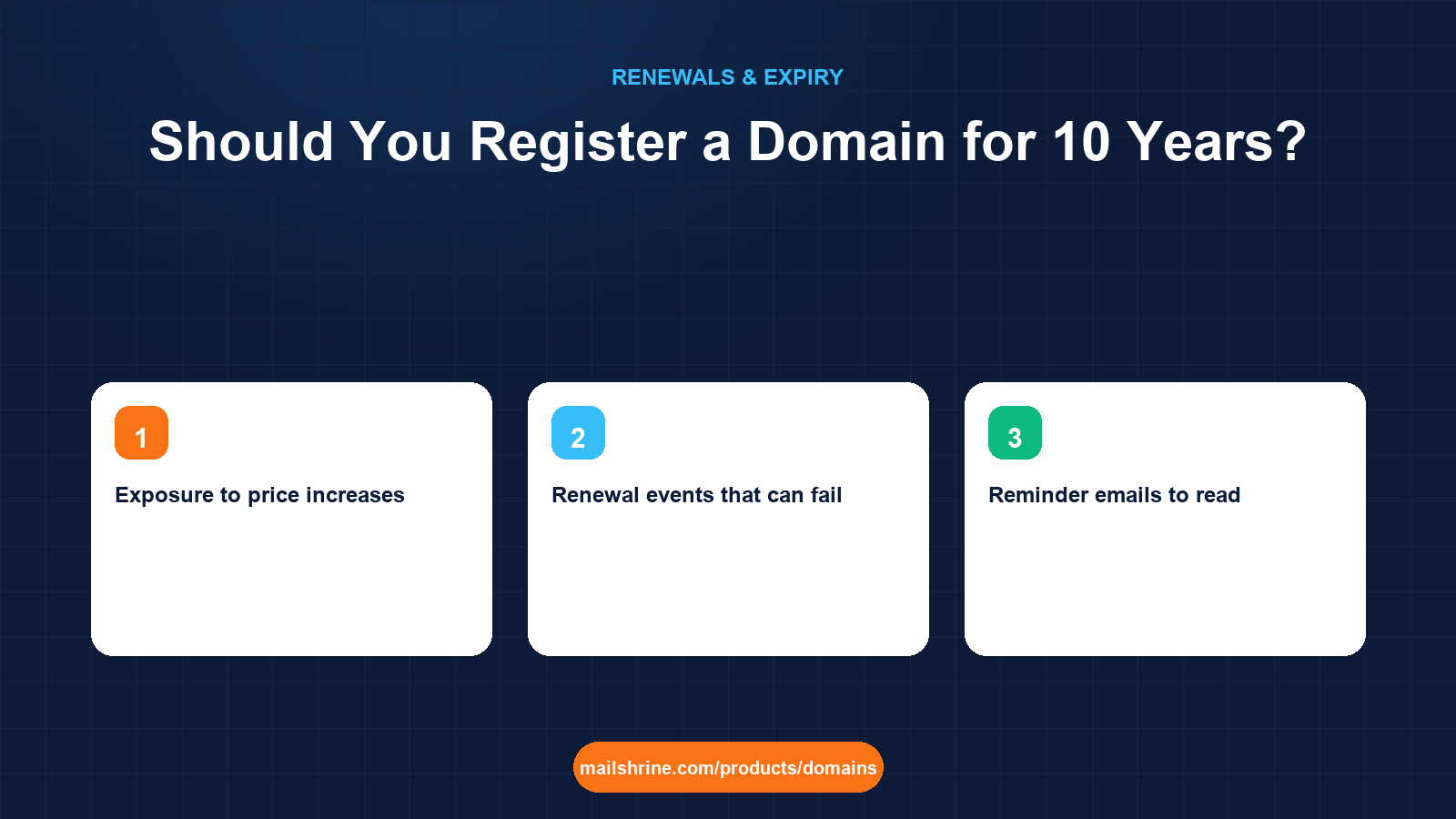
A 10-year domain registration is the longest term the registries allow for generic extensions such as .com, .net and .org. You pay ten years of renewal fees up front, the expiry date moves a decade into the future, and for the whole of that time there is no annual charge to fail, no reminder to miss and no price increase that applies to you. The registry rule is simple: a domain can never be registered more than ten years ahead of today, so you can also top up a shorter registration to that ceiling at any time.
Whether that is worth doing depends on one question: are you more likely to regret paying for years you did not use, or to regret the renewal that did not happen? For a trading name, a founder's surname or a product customers type into a browser, the second regret costs more than the first by a wide margin. For a side project, a campaign or a name you chose last Tuesday, ten years is money spent on certainty you do not yet have.
MailShrine Domains offers every term from 1 to 10 years at checkout and shows the renewal price per year before you pay, so the arithmetic for a long term is visible rather than inferred. Reminders at 30, 7 and 1 day before expiry still run for whatever term you choose, and your two free Business Email mailboxes are tied to the domain for as long as it is registered, which for a 10-year term is a very long time.
Real-life example: Grace's bakery chain
Grace Uwase owns three bakeries in Kigali trading as Inzozi Bakery, with a fourth opening next year. Her domain inzozibakery.rw and its .com twin are on one-year terms, renewed each December by whoever remembers. Two years ago the .com lapsed for nine days and the card-payment provider's emails bounced for a week. Grace has the brand printed on packaging, vans and a billboard. She is deciding whether to pay for ten years at once or keep paying every December.
Grace's goals this week:
- Work out the real cost of ten years versus ten single years, including likely price rises.
- Understand what a long term protects against and what it does not.
- Choose a term for each of the two domains and set them up so renewals need nobody's memory.
Ten years up front versus one year at a time
| 10 one-year renewals | One 10-year registration | |
|---|---|---|
| Cost at today's $12.99/yr | $129.90 spread over a decade | $129.90 paid now |
| Exposure to price increases | Full; each renewal is at that year's price | None; the ten years are paid at today's price |
| Renewal events that can fail | 10 | 0 within the term, then 1 |
| Reminder emails to read | About 40 | About 4, at the very end |
| Refund if you stop needing the name | None, but you stop paying | None; unused years are not refunded |
| Transfer to another registrar | Allowed; transfer adds a year up to the 10-year cap | Allowed, but a transfer cannot add a year if you are already at the cap |
The .com wholesale price has risen several times since 2021 under Verisign's agreement with ICANN, which permits increases of up to 7 percent in six of every ten years. A ten-year payment at today's price insulates you from every one of those steps. On a $12.99 name the saving is modest in dollars; the point is that the cost is capped and the failure mode is removed.
What a long term does and does not protect
| Risk | Does a 10-year term help? |
|---|---|
| Forgetting to renew | Yes, completely, for ten years |
| Card expiring or failing | Yes; there is no charge to fail |
| Registrar price increases | Yes; the term is prepaid |
| Domain theft via a compromised account | No; keep 2FA and transfer lock on |
| Outdated registrant contact details | No; ICANN still requires accurate contacts, and you still get the annual data-accuracy reminder |
| Losing access to the registrant email | No; recovery still depends on that mailbox |
| Business closing or rebranding | No; the years are sunk cost |
A ten-year term fixes the renewal problem and only the renewal problem. Grace's lapse two years ago was a renewal problem, so it fits. If her risk were a disgruntled former manager with the registrar login, a long term would do nothing.
What you need before you start
| You need | Why it matters |
|---|---|
| A clear view of how long the brand will last | Ten years for a trading name is easy; ten years for a campaign slogan is waste |
| The budget for the full term now | The whole amount is charged today |
| The current expiry date of each domain | You can only add years up to a total of ten from today |
| Knowledge of the extension's rules | Some ccTLDs cap terms at 1, 2 or 5 years and cannot be registered for ten |
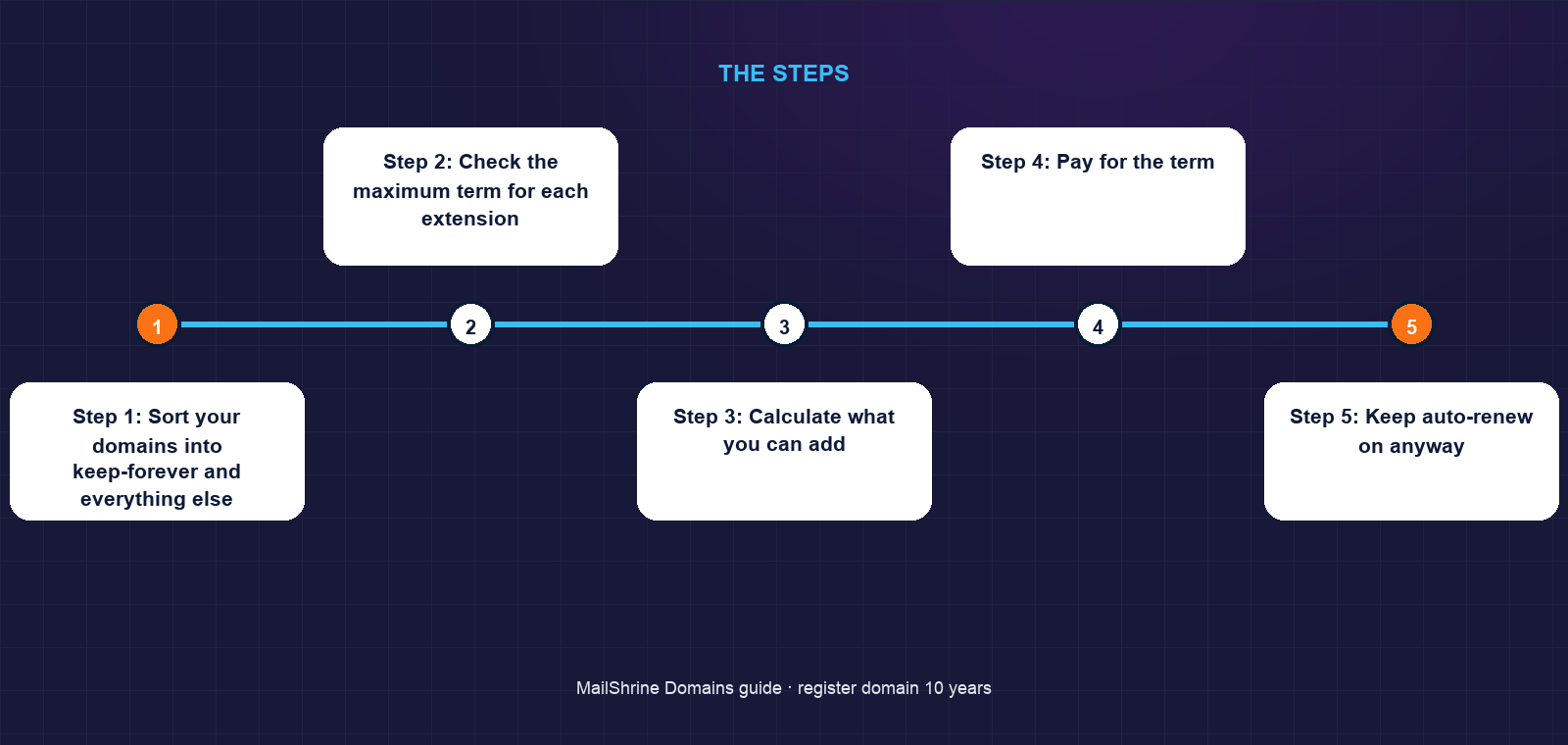
Step 1: Sort your domains into keep-forever and everything else
Grace's .com and .rw are both the brand. A campaign domain she used for a Christmas promotion is not. Only the first group is a candidate for a long term.
Step 2: Check the maximum term for each extension
.com allows ten years. .rw and many other country-code extensions allow shorter maximum terms set by their registries. MailShrine's checkout only offers the terms the registry permits, so the dropdown tells you the ceiling.
Step 3: Calculate what you can add
A domain with 11 months left can take nine more years to reach the cap. One registered yesterday for a year can take nine. If a transfer is planned, remember a transfer adds one year and will fail to add it if you are already at ten.
Step 4: Pay for the term
Choose the term at checkout and confirm the resulting expiry date on the summary screen. Pay by card in USD or in Naira via Paystack. The receipt should show the number of years and the new expiry date.
Step 5: Keep auto-renew on anyway
Ten years ends. Auto-renew on a long-term domain means that when the final year arrives, the renewal still does not depend on anyone remembering a date from a decade earlier. The reminders at 30, 7 and 1 day will still go out.
Step 6: Record the date somewhere that outlives your current systems
A ten-year expiry outlasts phones, laptops and most staff. Put it in the company's permanent records alongside the registration certificate and the registrar account details.
Grace's checklist
inzozibakery.com: topped up to the 10-year cap at $12.99 per yearCompletedinzozibakery.rw: renewed to the maximum the registry allowsCompleted- Confirmed the new expiry dates on the receiptsCompleted
- Auto-renew left on for both, registrant email set to a shared bakery mailboxCompleted
- Add the expiry dates and registrar login location to the company's permanent recordsNot completed
- Let the Christmas campaign domain expire with auto-renew offNot completed
Common mistakes
Paying ten years for a name you chose last week. Businesses pivot and rebrand. Register new ideas for a year or two and extend once the name has proved itself.
Expecting a bulk discount. Renewal pricing is per year. Ten years costs ten times one year; the benefit is a capped price and no renewal events, not a cheaper rate.
Hitting the cap and then trying to transfer. A transfer normally adds a year; if the domain is already at ten years, some registries reject the transfer or add nothing. Transfer first, then top up.
Thinking a long term means you can ignore the account. Contact details must stay accurate, 2FA must stay on, and the registrant email must stay alive. Ten years is a long time for a mailbox to survive.
Assuming every extension allows ten years. Many ccTLDs do not. The checkout dropdown shows the real limit for each extension.
Check your work
Open each domain in your dashboard and confirm the expiry date is where you intended, the term on the receipt matches, and auto-renew is on. Run an RDAP lookup and check the expiration field agrees. Then ask one question of each name: if nobody in the business logs into this account for nine years, is it still safe? For the brand domains the answer should be yes.
FAQ
Is 10 years the maximum I can register a domain for?
Yes, for generic extensions such as .com, .net and .org. The registry will not allow an expiry date more than ten years from today. Many country-code extensions have lower maximums.
Is registering for 10 years cheaper per year?
No. Registrars charge the per-year renewal price multiplied by the term. The saving comes from locking today's price against future increases, not from a discount.
Does a 10-year registration help SEO?
Google has said registration length is not a ranking factor. Register for ten years for business reasons, not for search.
Can I transfer a domain registered for 10 years?
Yes, after the standard 60-day lock. A transfer normally adds a year, so if you are at the ten-year cap the transfer may add nothing or be rejected by the registry. Transfer first and extend afterwards.
What if I close the business after three years?
The remaining years are not refunded. You can sell or transfer the domain to someone else with the remaining term intact, which can make the name slightly more attractive to a buyer.
Next steps
- How to Renew a Domain Name — topping an existing registration up to the ten-year cap.
- Auto-Renew for Domains: Pros, Cons and How It Works — the second layer of protection for the end of a long term.
- Letting a Domain Expire Safely: Checklist Before You Drop It — what to do with the names that do not deserve ten years.
Citations & References
- Reference: Verisign: .com registry
- Reference: ICANN: .com Registry Agreement
- Reference: ICANN: Registrant rights and responsibilities
- Reference: ICANN: Transfer Policy
Written by Samira K., small-business editor. Samira writes for owners who run the shop, the books and the website at the same time and need domain decisions to take ten minutes, not a weekend.