
A domain name costs between $10 and $20 a year for most ordinary extensions, and the price is set by three layers stacked on top of each other: the fee the registry charges for the extension, an 18-cent ICANN fee on every year of every generic TLD, and the margin the registrar adds. A .com sits near the bottom of that range. A .io or .ai sits far above it, not because the name is better but because the registry behind it charges more. Anything advertised below the registry's own wholesale price is a first-year promotion, and it will renew at the real price.
The number that matters is not the first-year price. It is the renewal price multiplied by the years you will hold the name. A $1.99 first year that renews at $19.99 costs $61.96 over three years. A flat $12.99 costs $38.97 over the same three years.
MailShrine Domains sells 150+ extensions and prints the first-year promo price and the renewal price side by side on every search result, so you can do that three-year sum before you pay. A .com is typically $12.99 a year, WHOIS privacy and transfer lock are included, and two mailboxes from Business Email come with the name.
Real-life example: Kwame's roastery
Kwame Mensah runs Ridge Roasters, a small coffee roastery in Accra that sells beans to cafés and ships subscriptions. He has shortlisted ridgeroasters.com, ridgeroasters.coffee and ridgeroasters.com.gh, and the prices he sees range from "free with hosting" to $45 a year. He wants to understand why.
Kwame's goals this week:
- Know what each of his three candidates will cost in year one and in every year after.
- Understand which parts of the price are fixed by the registry and which are the registrar's choice.
- Decide whether to buy one name or all three, with a budget he can defend to his business partner.
Typical annual prices by extension
These are typical retail ranges you will see across registrars. MailShrine's own price is on the search result, with the renewal shown next to it.
| Extension | Registry operator | Typical first-year retail | Typical renewal | Why it costs what it does |
|---|---|---|---|---|
| .com | Verisign | $1–$13 (promos common) | $12–$22 | Wholesale $10.26 since September 2024, frozen through 2026 |
| .net | Verisign | $10–$15 | $14–$22 | Verisign may raise it 10% a year |
| .org | Public Interest Registry | $8–$13 | $13–$20 | Non-profit registry, modest yearly rises |
| .co | .CO Internet (GoDaddy Registry) | $8–$30 | $25–$35 | Marketed as a .com alternative, priced above it |
| .io | Identity Digital | $30–$45 | $40–$60 | Popular with startups, registry raised fees in 2024 |
| .ai | Government of Anguilla | $70–$100 | $70–$100 | Two-year minimum term at registration |
| .coffee, .shop, .store | Various new-gTLD registries | $3–$10 promos | $25–$45 | Registry sets its own price; first-year discounts are steep |
| .com.gh, .com.ng, .co.ke | National ccTLD registries | $10–$40 | $10–$40 | Priced locally, often no first-year discount at all |
Two patterns jump out. First, the extensions with the biggest first-year discounts have the biggest gap to renewal. Second, country extensions tend to be flat: the price you pay in year one is the price you pay in year six.
Where a $12.99 .com actually goes
| Layer | Amount for one year of .com | Who sets it |
|---|---|---|
| Registry fee | $10.26 | Verisign, under its agreement with ICANN |
| ICANN fee | $0.18 | ICANN, the same for every gTLD year |
| Registrar margin | $2.55 | The registrar, covering payment fees, support, DNS and profit |
| Retail price | $12.99 | What you see at checkout |
That $2.55 is why registrars behave so differently. One registrar uses it to include privacy and lock. Another charges $9.99 for privacy on top. A third sells the first year below cost to win the customer and recovers it on a $21.99 renewal. The registry gets the same $10.26 in all three cases.
Country-code extensions do not pay the ICANN fee and are not bound by ICANN's price rules, which is why their pricing looks nothing like the gTLD table.
What you need before you start
| You need | Why it matters for the price |
|---|---|
| A shortlist of two or three names | Prices differ by extension more than by registrar, so compare extensions first |
| The number of years you expect to hold the name | Multiply the renewal by this number, not the first-year price |
| A view on privacy and lock | If a registrar charges extra for them, add that to every year |
| Your payment currency | Card prices are in USD; paying in Naira through Paystack is converted at checkout |
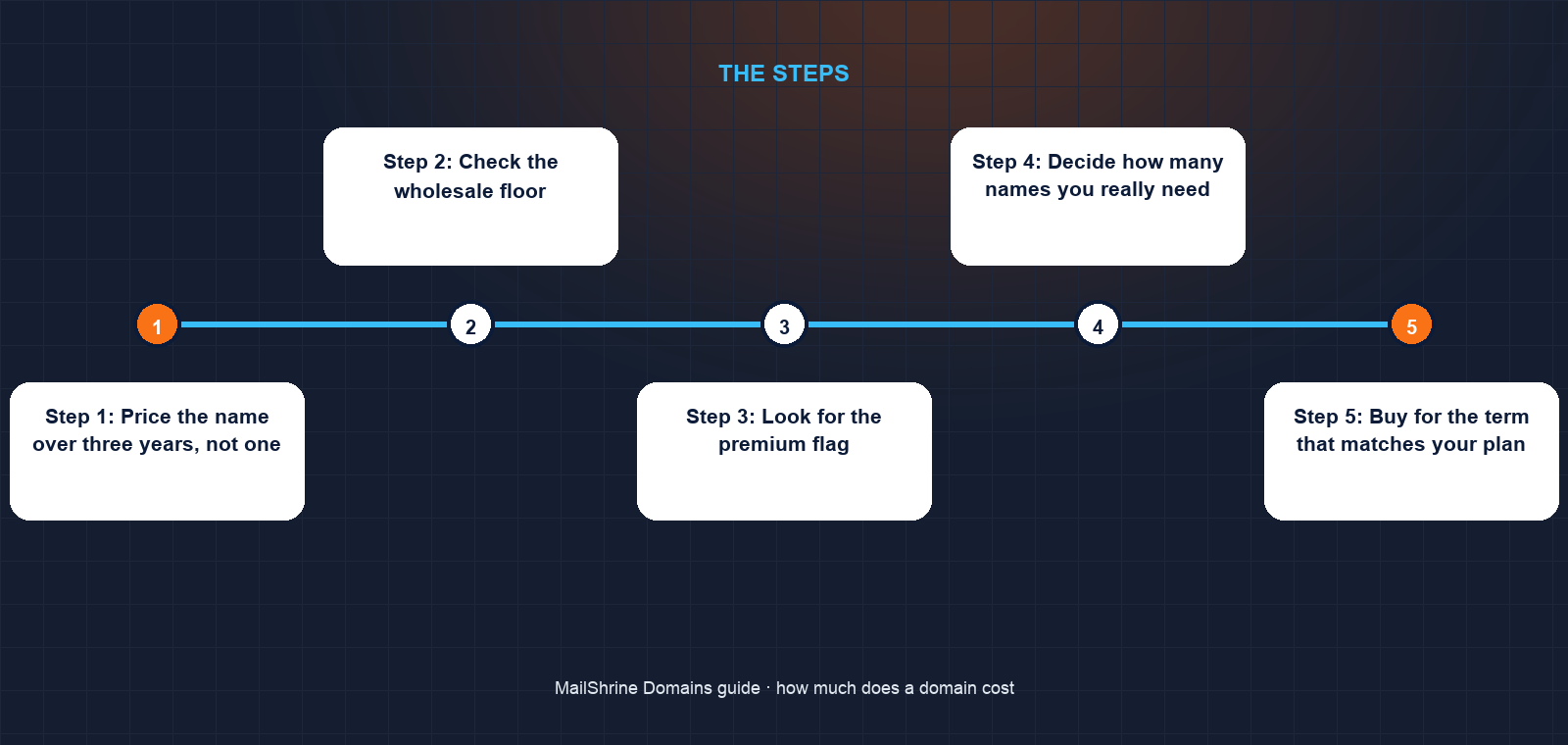
Step 1: Price the name over three years, not one
Take the renewal price and multiply by three. Add any yearly privacy fee. For Kwame's .com at a registrar with a $0.99 promo, $21.99 renewal and $9.99 privacy, three years cost $0.99 + $21.99 + $21.99 + 3 × $9.99 = $74.94. At $12.99 flat with privacy included, three years cost $38.97. The cheap first year was the expensive option.
Step 2: Check the wholesale floor
For .com the floor is $10.26 plus $0.18. Any registrar selling a renewal below $10.44 is losing money on it and will make it back somewhere. For new gTLDs, the floor is whatever the registry charges, which is why a .coffee cannot renew for $5 no matter who sells it.
Step 3: Look for the premium flag
Some names are registry premium: the registry itself has priced coffee.shop or roast.io at hundreds or thousands per year, every year. A registrar must show this before checkout. If a name on your shortlist is premium, the renewal is premium too; it does not drop to the standard price later.
Step 4: Decide how many names you really need
Kwame's three names at typical renewals: .com $12.99, .coffee around $35, .com.gh around $25. All three for five years is roughly $365. The .com alone is $65. Buy the one you will put on the bags and in your email address. Add others only when a competitor or a market makes them necessary.
Step 5: Buy for the term that matches your plan
If the business will exist in three years, register for three. The renewal price is locked for the term you pay, which protects you against registry increases, and nothing expires while you are busy.
Kwame's checklist
- Priced each name at renewal × 3, not at the promo priceCompleted
- Confirmed none of the three is flagged registry premiumCompleted
- Chose
ridgeroasters.comfor the bags and the email addressCompleted - Left privacy and transfer lock on at no extra costCompleted
- Decided whether to add
.com.ghwhen the Accra wholesale shop opensNot completed - Set up
orders@ridgeroasters.comin Business EmailNot completed
Common mistakes
Comparing first-year prices across registrars. They are marketing. Compare renewals, because you will pay the renewal five or ten times and the first-year price once.
Assuming a cheaper extension is a worse name. A .org or .net is cheaper than .io because of registry pricing, not quality. Choose the extension your customers expect, then look at the price.
Forgetting privacy fees. A $9.99 privacy add-on nearly doubles the yearly cost of a .com. Check whether it is included before you compare.
Treating a premium name as a one-off cost. Registry premiums renew at the premium price. A $300 name is $300 every year.
Buying every extension "just in case". Five extensions at $30 each is $150 a year protecting a brand that does not exist yet. Buy the main name, trade when you have revenue.
Check your work
Before you pay, you should be able to write down three numbers for the name: the first-year price, the renewal price, and the total for the term you chose. On MailShrine all three are on the checkout screen. If a registrar's checkout shows you only the first number, open its pricing page and find the renewal before you continue.
FAQ
Why is a .com so much cheaper than a .io?
Verisign charges registrars $10.26 a year for a .com under an ICANN-regulated agreement with capped increases. The .io registry has no such cap and prices the extension for its startup audience, so registrars pay several times more and pass it on.
Does the price include email?
At most registrars, no; email is a separate subscription. MailShrine includes two business mailboxes with every domain and writes the MX, SPF, DKIM and DMARC records at registration, so the price on the search result is the full price of having email on the name.
Is a $0.99 domain real?
Yes, for twelve months. The registrar is selling the first year below the $10.44 wholesale floor to win you as a customer. The renewal will be the real price, often $18 to $22, so check it before you buy.
Do prices change after I register?
Not during the term you paid for. If a registry raises its fee, the increase applies at your next renewal. Registering for several years locks the current price for the whole term.
Are prices the same in every country?
The registry fee is the same worldwide, but registrars price in their own currency and some add local taxes. Country-code extensions are priced by the national registry and often do not run first-year promotions.
Next steps
- Why Is the Renewal Price Higher Than the First Year? — the economics behind the promo-to-renewal jump.
- What Is a Registrar Markup and Why Prices Differ — the registrar's slice and what it buys you.
- How Many Years Should You Register a Domain For? — locking the price with a longer term.
Citations & References
- Reference: Verisign: .com Registry Agreement pricing (ICANN)
- Reference: ICANN: Registrar fees and the per-transaction fee
- Reference: Verisign: Domain Name Industry Brief
- Reference: IANA: Root zone database of TLDs and their operators
Written by Isabelle R., domains editor. Isabelle explains how names, DNS and registrars fit together so first-time buyers know exactly what they are paying for.