
The renewal price is higher because the first-year price was a discount, not the other way round. A registrar pays the registry a fixed wholesale fee every year a domain exists: $10.26 plus an 18-cent ICANN fee for a .com. It cannot buy year one cheaper than year five. When you see a .com for $1.99, the registrar is paying $10.44 and absorbing the $8.45 loss as a customer-acquisition cost. The renewal at $19.99 or $21.99 is where that loss, and the profit, comes back.
The practice is legal and disclosed, but the disclosure is often a small line under the big price. The result is a yearly surprise that arrives twelve months later, when switching registrars feels like too much work for a $10 difference. Multiply that by millions of domains and you have the business model.
MailShrine Domains prints the renewal price next to the first-year price on every search result and on the checkout screen, so there is nothing to discover a year later. A .com is typically $12.99 both years, privacy and lock are included, and renewal reminders go out at 30, 7 and 1 day so the renewal itself is never a shock either.
Real-life example: Priya's tutoring centre
Priya Nair runs Nair Maths Lab, a tutoring centre in Mumbai with four teachers and about 120 students. Two years ago she registered nairmathslab.com for ₹99 on a promotion. Last month the renewal invoice came in at ₹1,899, plus ₹899 for "privacy protection" she did not remember buying. She wants to know whether she was cheated, whether it is worth moving, and how to stop it happening with the .in she is about to register.
Priya's goals this week:
- Understand exactly which parts of the ₹2,798 invoice are the registry's fee and which are the registrar's choice.
- Decide whether to renew where she is or transfer before the expiry date.
- Register the new
.insomewhere the price she sees is the price she keeps paying.
The two prices, side by side
| First-year price | Renewal price | |
|---|---|---|
| What the registrar pays the registry | $10.26 + $0.18 | $10.26 + $0.18 |
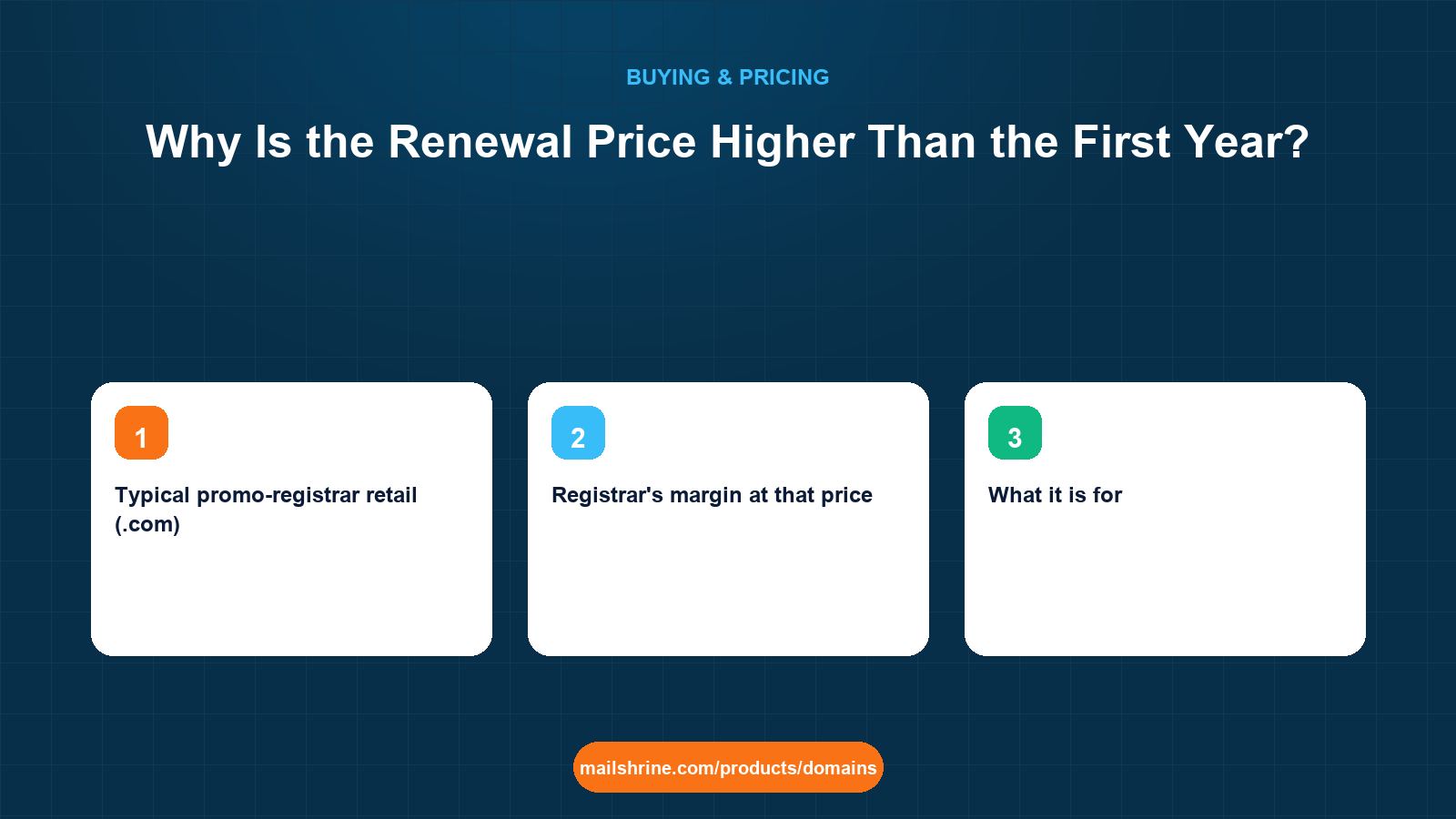
| Typical promo-registrar retail (.com) | $0.99–$5.99 | $18.99–$22.99 |
| Registrar's margin at that price | Negative, a loss of $5–$10 | $8–$12 |
| What it is for | Winning the customer | Keeping the lights on and recovering year one |
| Is it shown clearly? | In large type | In a footnote, if at all |
The right-hand column is the real price of the domain. The left-hand column is advertising spend that the registrar has chosen to give to you instead of to a search engine.
Three reasons renewals climb, and only one is the registry
1. The first year was a loss leader. Already covered: the registrar sold below wholesale and prices the renewal to recover it. This is the biggest factor and entirely the registrar's choice.
2. Add-ons that were free in year one start charging. WHOIS privacy, "domain protection", premium DNS and parked-page removal are often bundled free for twelve months, then billed at $5 to $15 each. Priya's ₹899 privacy line is this. At MailShrine privacy and transfer lock have no price at all, in any year.
3. The registry raised its wholesale fee. This is the only increase the registrar did not choose. Verisign raised .com from $7.85 to $10.26 across four 7% steps between 2021 and 2024. Those increases flow through at renewal time, but they are small: 7% of $10.26 is 72 cents, not the $15 gap in the table above.
A fair registrar passes on the third and has no reason for the first two. When your renewal jumps by more than a dollar or two, you are looking at reasons one and two.
What you need before you start
| You need | Why |
|---|---|
| Your current renewal invoice, itemised | To separate the domain line from the add-ons |
| Your expiry date | Transfers take up to five days; start at least two weeks before expiry |
| Access to the registrant email | The transfer approval and the auth code go there |
| The registrar's published renewal price for your extension | Compare it to the invoice; registrars sometimes bill above their own list price |
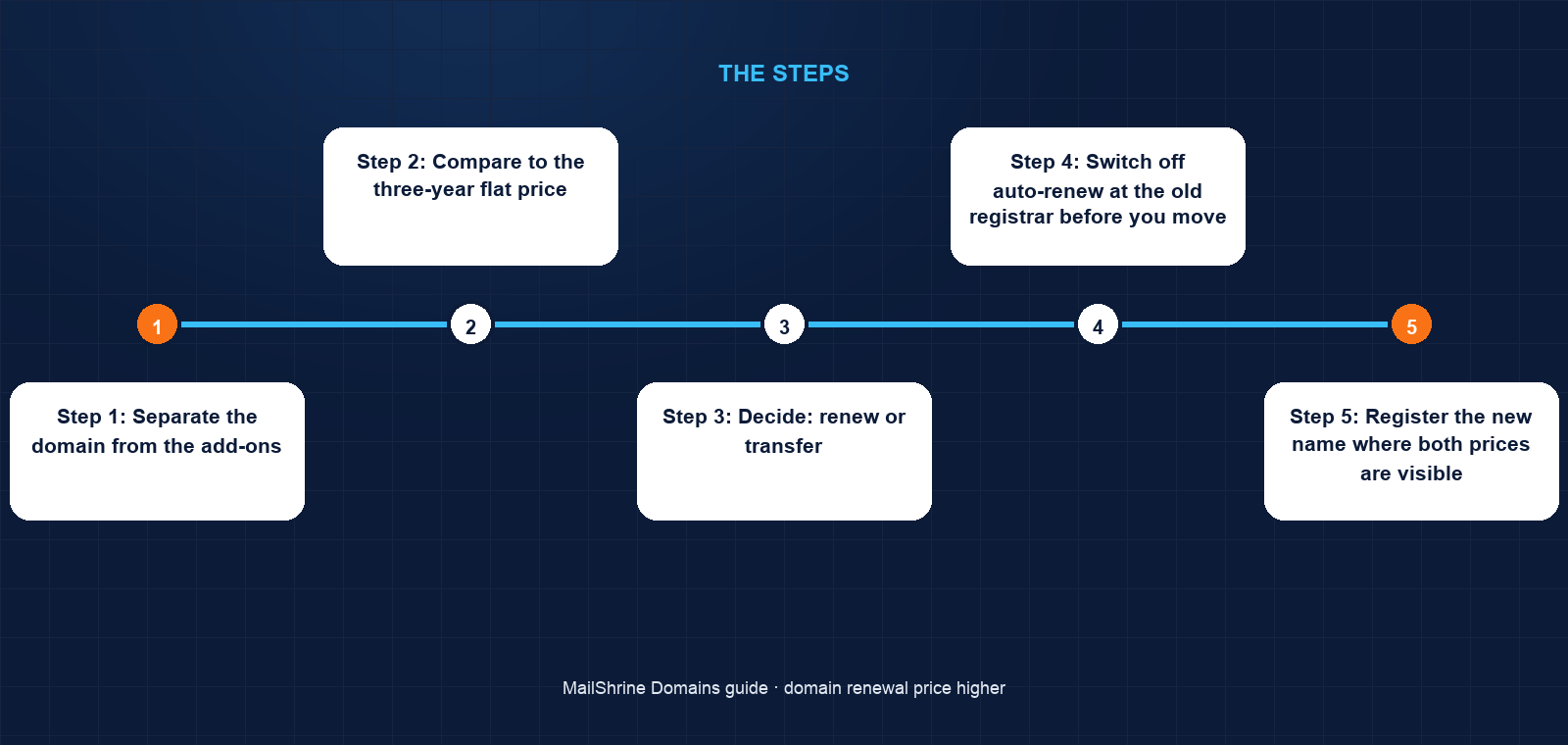
Step 1: Separate the domain from the add-ons
Priya's ₹2,798 invoice splits into ₹1,899 for the .com renewal and ₹899 for privacy. At current rates ₹1,899 is about $22, roughly double the $10.44 the registrar pays. The privacy fee is pure margin: the registrar's cost of substituting its own details in the public record is close to zero.
Step 2: Compare to the three-year flat price
At $12.99 flat with privacy included, three years cost $38.97. At Priya's registrar, three renewals cost around $66 plus $32 of privacy, about $98. The difference is $59 over three years on one domain. For a school with one domain that is lunch for the teachers. For an agency with 40 client domains it is $2,360.
Step 3: Decide: renew or transfer
If the expiry date is more than two weeks away and the domain is older than 60 days, transfer. A transfer costs about one year's renewal at the new registrar and adds a year to the term, so you are not paying twice. If expiry is less than a week away, renew for one year where you are first and transfer later; a domain that expires mid-transfer causes problems.
Step 4: Switch off auto-renew at the old registrar before you move
Auto-renew at the losing registrar can fire during the transfer window and bill you anyway. Turn it off once the transfer is approved. Refund policies for an unwanted auto-renew vary and are rarely generous.
Step 5: Register the new name where both prices are visible
For nairmathslab.in, Priya searches on MailShrine and sees the first-year price and the renewal on the result card. She chooses a two-year term so the price she sees is locked until the renewal she has already seen.
Priya's checklist
- Itemised the invoice: ₹1,899 domain, ₹899 privacyCompleted
- Checked the domain is older than 60 days and expires in 26 daysCompleted
- Unlocked the domain and requested the auth code at the old registrarCompleted
- Started the transfer into MailShrine with privacy includedCompleted
- Switch off auto-renew at the old registrar once the transfer is approvedNot completed
- Register
nairmathslab.infor two years with the renewal price visibleNot completed
Common mistakes
Renewing out of inertia. The renewal email arrives, the card is on file, the price seems "about what domains cost". Open the invoice and compare to a flat-price registrar once; it takes five minutes.
Transferring in the last three days before expiry. Some registrars refuse transfers inside a few days of expiry, and a domain that expires mid-transfer can land in the grace period with the old registrar. Give yourself two weeks.
Assuming the add-ons are mandatory. Privacy, protection plans and premium DNS are optional at every registrar. Decline them at renewal if you do not want them, or move somewhere they are included.
Blaming the registry. Verisign's increases are capped and small. If your renewal rose by $10, the registrar chose that.
Forgetting that promo pricing exists at the new registrar too. When comparing, always look at the second price. If you cannot find it, that is the answer.
Check your work
Write down two numbers for every domain you own: what you paid last time, and what the registrar's public pricing page says a renewal costs. If they differ, ask why. Then compare the renewal to the $10.44 wholesale floor for .com. A renewal between $12 and $16 is a normal margin. Above $20, you are paying for a promotion you may not even have received.
FAQ
Is a higher renewal price a scam?
No, it is legal as long as it is disclosed, and it usually is, in smaller type. It is a pricing strategy, not fraud. The problem is that most buyers never see the second price until the renewal invoice arrives.
Can I lock the first-year price for longer?
Not the promotional price. Promos are almost always for one year only; longer terms at the same registrar are charged at the renewal rate from year two. Registering for several years at a flat-price registrar locks that flat price for the whole term.
Does the renewal price change if I transfer?
Yes. After a transfer, the domain renews at the new registrar's price, and the transfer itself adds a year to your term at that price. Transfers are the normal way to escape a high renewal.
Why do registries discount the first year at all?
Some registries, mostly for newer extensions, offer registrars a lower first-year wholesale fee to get names registered. Verisign does not do this for .com, so any .com promotion is entirely funded by the registrar.
How do I know a registrar will not raise my renewal later?
You cannot know with certainty, but a registrar that publishes renewal prices and shows them at checkout has little room to hide an increase. Registering for a multi-year term also fixes the price for that term.
Next steps
- How Much Does a Domain Name Cost? — the full price table by extension.
- What Is a Registrar Markup and Why Prices Differ — what the registrar's slice pays for.
- Domain Pricing Compared: Namecheap vs GoDaddy vs MailShrine — the renewal gap at the big names.
Citations & References
- Reference: ICANN: Expired Registration Recovery Policy
- Reference: ICANN: Transfer Policy
- Reference: Verisign: .com Registry Agreement (ICANN)
- Reference: ICANN: Registrar fees
Written by Samira K., small-business editor. Samira writes for owners who run the business and the IT, and wants the yearly bills to be as boring as possible.