
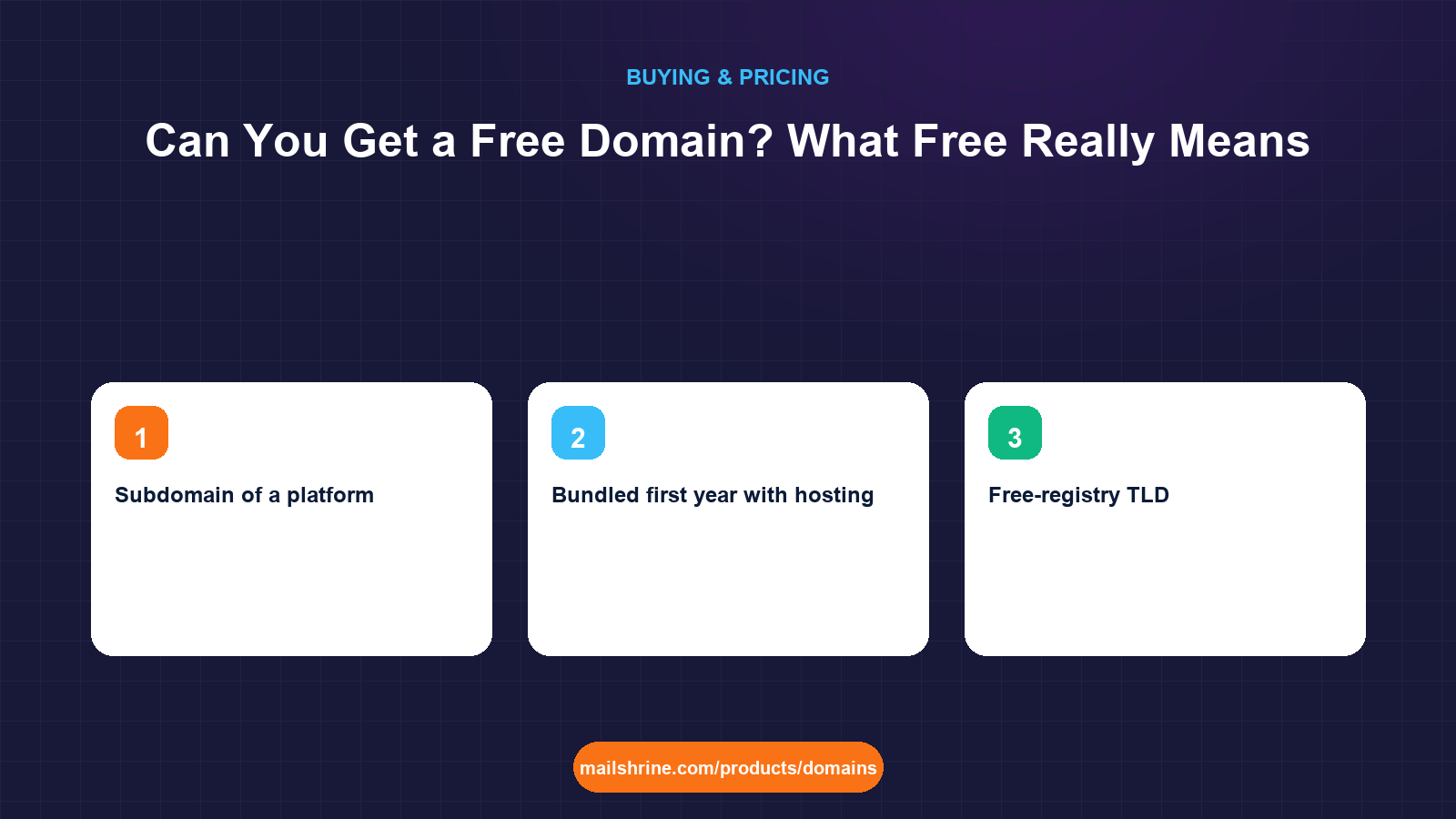
A free domain is one of four things: a subdomain of someone else's name, a first year bundled into a hosting contract, an extension whose registry gives names away and whose reputation reflects it, or a trial that converts to a paid renewal. None of them is a .com that is yours for nothing, because every .com costs the registrar $10.26 plus $0.18 every year, and nobody absorbs that for free without getting it back somewhere.
That does not make every free option bad. A subdomain is a fine place to test an idea. A bundled first year is fine if you read the renewal and the registrant record. But a business email address, a brand or anything you will print on a card needs a name you control, and that costs roughly the price of two coffees a year.
MailShrine Domains does not offer free domains. It sells 150+ extensions with the first-year price and the renewal shown together, includes WHOIS privacy and transfer lock, and gives you two Business Email mailboxes with the name. A .com is typically $12.99 a year. What is free is everything the registrars with "free" in the headline charge extra for.
Real-life example: Wanjiru's bakery
Wanjiru Kamau runs Kamau Bakes in Kilimani, Nairobi, taking cake orders on Instagram. A web-builder ad offered her a free website with a free domain, and a cousin says he got a .tk domain for nothing years ago. She wants kamaubakes.co.ke or kamaubakes.com, an email address that is not @gmail.com, and she wants to know what free would actually cost her.
Wanjiru's goals this week:
- Understand what each kind of "free domain" gives up.
- Decide whether any free option is good enough for order emails and a printed menu.
- If not, get a real domain with email for the least money over three years.
The four kinds of free, compared
| Kind of free | Example | Who holds the name | Email on it? | What it costs later |
|---|---|---|---|---|
| Subdomain of a platform | kamaubakes.wixsite.com, kamaubakes.github.io | The platform | No, not as you@ | Nothing, but you can never move it or brand it |
| Bundled first year with hosting | "Free domain with annual hosting" | Often the host, sometimes you | Usually extra | The host's renewal price, and a hosting contract |
| Free-registry TLD | .tk, .ml, .ga, .cf, .gq via Freenom | The registry, revocably | Technically, but heavily filtered as spam | New registrations stopped in 2023; existing names unreliable |
| Trial or coupon | "$0 first year" codes | You | Depends on registrar | The full renewal, often $18–$22 for .com |
The only row where you hold a real, transferable domain from day one is the last one, and it is just a discount with a renewal attached.
Why the free TLDs failed, and why that matters for email
Freenom gave away .tk, .ml, .ga, .cf and .gq for years, funding it by taking back names that got traffic and parking ads on them. Because registration was free and anonymous, the extensions became the most abused on the internet; .tk was for years the most common TLD in phishing reports after .com. Spam filters learned that, and mail from those extensions was treated as suspicious before anyone read it.
In 2023 Meta sued Freenom over phishing domains, Freenom stopped new registrations, and several of the governments involved began reclaiming their extensions. A business that had built on a free name lost it with no recourse, because the terms always said the registry could take it back.
The lesson for a bakery is simple. Email deliverability depends partly on the reputation of your extension and partly on the SPF, DKIM and DMARC records your registrar writes. A free TLD starts with a bad reputation and often cannot carry proper mail records at all. An order confirmation that lands in spam is an order you lose.
What you need before you start
| You need | Why |
|---|---|
| A realistic three-year budget | Around $39 for a .com; compare every free option against that |
| A list of what the name must do | Email, a menu page, Instagram link, printed cards |
| The registrant check | Whoever is listed as registrant holds the name; it must be you |
| The renewal price of any bundle | Printed somewhere in the offer; find it before you accept |
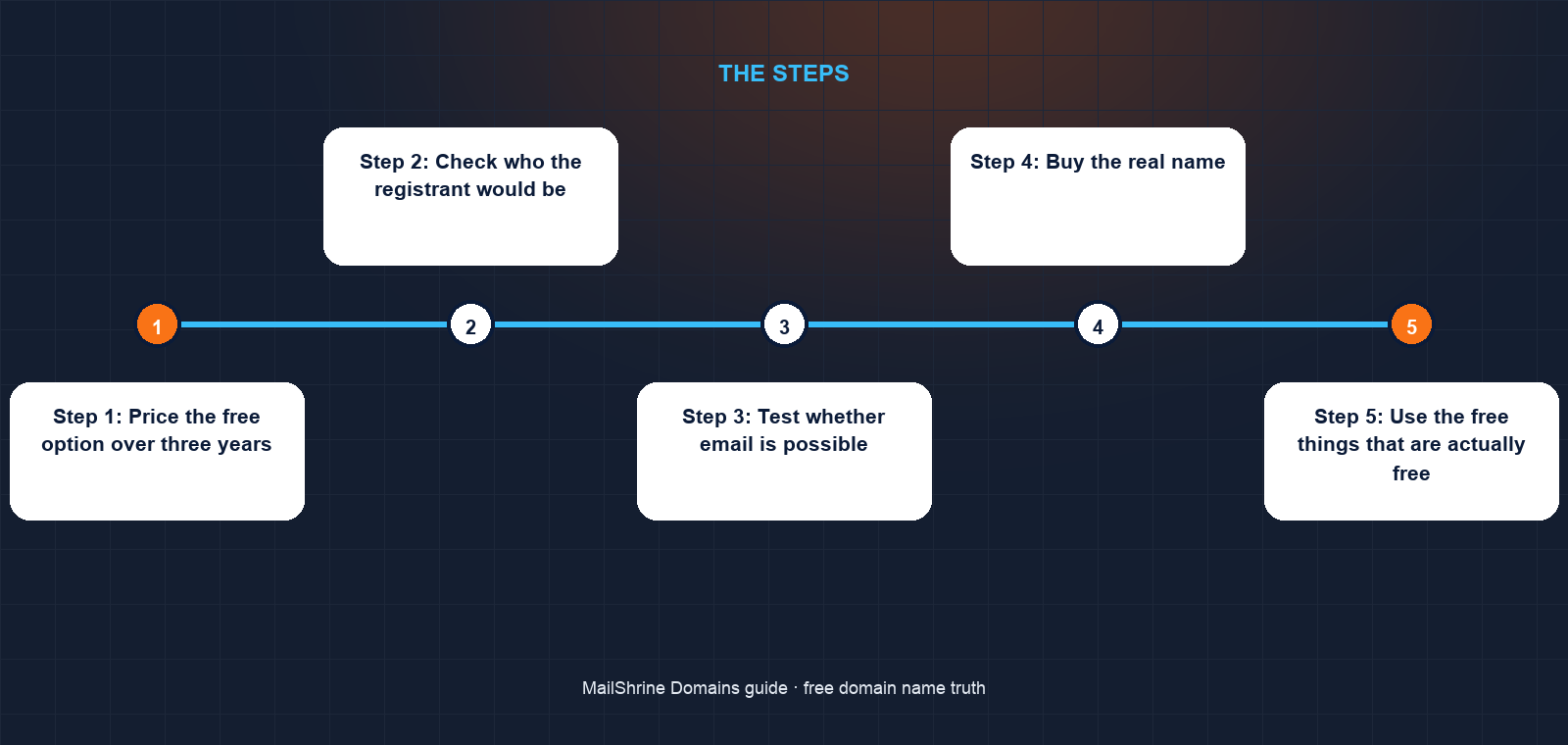
Step 1: Price the free option over three years
The web builder's free plan gives Wanjiru kamaubakes.wixsite.com forever and a free .com for one year only if she upgrades to a paid plan at about $17 a month. Three years: $612, and the domain renews at the builder's own price in year two. The real domain alone: $38.97.
Step 2: Check who the registrant would be
In bundled offers, open the terms and find the registrant clause. If the host or builder is the registrant, you do not hold the name and leaving means negotiating for it. If you are the registrant, confirm you can get the auth code from the dashboard without a support ticket.
Step 3: Test whether email is possible
A subdomain of a platform cannot carry you@ email at all; MX records belong to the parent domain. A free TLD can, in theory, but check whether the registrar lets you edit MX, SPF, DKIM and DMARC. If it does not, order emails will not authenticate.
Step 4: Buy the real name
Wanjiru searches kamaubakes on the availability checker. The .co.ke is free at a flat price with no promo and the .com is $12.99. She buys the .com for two years and leaves the .co.ke for later.
Step 5: Use the free things that are actually free
Privacy and transfer lock are included. The two mailboxes with webmail, calendar, drive and two-factor are included. The DNS editor is included. Wanjiru creates orders@kamaubakes.com, keeps her free Instagram page as the storefront, and points the domain at a one-page menu whenever she wants one.
Wanjiru's checklist
- Priced the builder bundle at three years: $612 versus $39 for the domainCompleted
- Confirmed she would be the registrant on the real domainCompleted
- Rejected the
.tkidea after checking it cannot be registered anywayCompleted - Bought
kamaubakes.comfor two years with privacy and lock onCompleted - Create
orders@and put it on the Instagram bio and the printed menuNot completed - Decide in a year whether
.co.keis worth adding for local searchNot completed
Common mistakes
Building a brand on a platform subdomain. Every printed card, every search result and every customer's bookmark points at the platform's name. Moving later means starting over.
Accepting a free domain without reading the registrant clause. This is the single most common way small businesses lose their name: the host held it, and the business left.
Using a free TLD for email. Even where it works, deliverability is poor and the registry can revoke the name. A domain you can lose is not a business asset.
Treating "free first year" as free. It is a discount, and the renewal is the price. Read the second number.
Paying for things that should be free. Privacy, lock and basic DNS cost registrars almost nothing. If a "cheap" registrar charges for them, the headline price is not the price.
Check your work
Ask three questions about any free offer and write the answers down. Who is the registrant? What does it renew at in year two? Can I set MX, SPF, DKIM and DMARC records on it? If any answer is "not me", "unclear" or "no", the free option will cost you later. For the paid domain, the dashboard should show Active, privacy and lock on, and email setup complete within the hour.
FAQ
Is there any legitimately free domain?
Subdomains of platforms are legitimately free and useful for personal projects and prototypes. A full domain under your own name is never free in the long run, because registries charge for every year it exists.
What happened to .tk domains?
Freenom, which gave them away, stopped new registrations in 2023 after a lawsuit from Meta over phishing abuse. Existing names are unreliable, and the extensions' reputation with spam filters remains poor.
Is a free domain with hosting a bad deal?
Not always, but check two things: that you are the registrant and that the renewal price is reasonable. If both are fine, the bundle is simply a discount. If the host holds the name, keep the domain separate.
Can I get email on a free subdomain?
No. Mail routing for kamaubakes.wixsite.com is controlled by the owner of wixsite.com. You need your own domain to have you@ addresses.
What is the cheapest real domain?
Among mainstream extensions, .com, .net and .org renew for roughly $12 to $20 depending on the registrar, and some country codes are similar. Compare renewals rather than first-year prices, and check that privacy is included.
Next steps
- Can You Buy a Domain Without Hosting? — keep the domain separate from any bundle.
- How Much Does a Domain Name Cost? — real prices by extension.
- What Is a Registrar Markup and Why Prices Differ — why no registrar can give a .com away.
Citations & References
- Reference: ICANN: Registrant rights and responsibilities
- Reference: IANA: .tk delegation record
- Reference: Google Workspace Admin: Email sender guidelines (SPF, DKIM, DMARC)
- Reference: KeNIC: .ke registry
Written by Daniel O., security editor. Daniel covers the ways people lose domains and mailboxes, and the settings that stop it happening.