
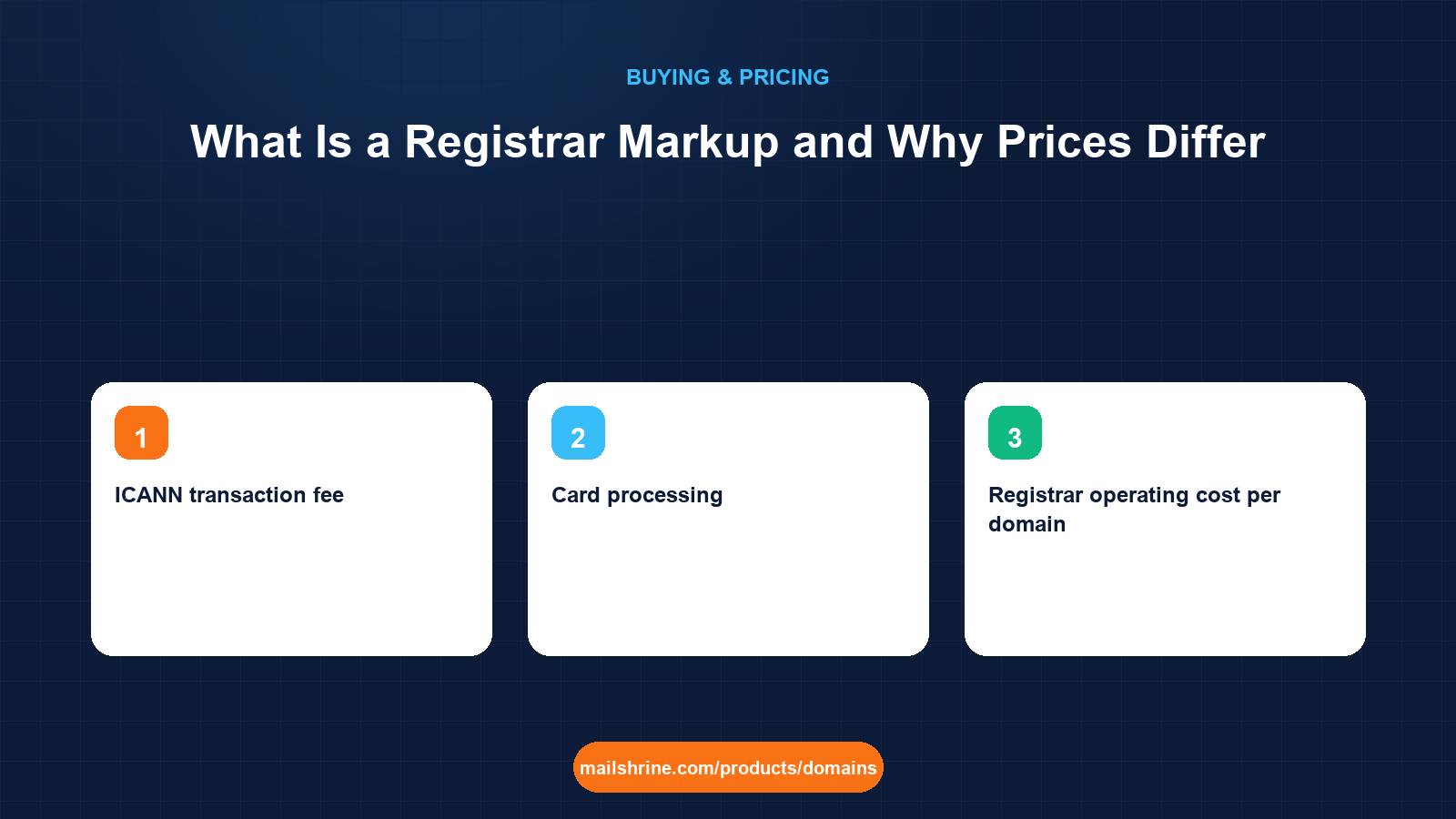
A registrar markup is the difference between what the registry charges for a domain and what you pay. For a .com the registry side is fixed: Verisign charges every accredited registrar the same $10.26 a year, and ICANN adds $0.18. There are no volume discounts on .com; the registrar selling a million names pays the same per name as the one selling a thousand. Everything above $10.44 is the registrar's markup, and the markup is where every pricing difference between registrars comes from.
Two things make markups vary. First, what the registrar has to pay for out of it: card fees, support, DNS infrastructure, abuse handling, ICANN accreditation. Second, how the registrar chooses to shape it over time: flat, or a loss in year one recovered later. Once you can see the markup, "why is this registrar cheaper?" always has a concrete answer.
MailShrine Domains is a flat-markup registrar: a .com is typically $12.99 in year one and at renewal, and the markup pays for Anycast DNS with a full record editor, free WHOIS privacy and transfer lock, email DNS written at registration, and two Business Email mailboxes. Both prices are on every search result.
Real-life example: Aminata's freight company
Aminata Diallo runs Diallo Freight, a customs brokerage and trucking company in Dakar with eleven staff. She manages six domains: diallofreight.com, .sn, .net, and three for a subsidiary. They are spread across three registrars, and the renewal invoices range from $9.99 to $24.99 for what she knows is the same .com. She wants to consolidate and to understand what she is paying for at each price point.
Aminata's goals this week:
- Understand what a registrar's markup actually covers, so she can judge whether $24.99 buys anything $12.99 does not.
- Work out why one registrar can sell a
.comat $9.99, below the registry fee. - Consolidate six domains at one registrar whose markup is transparent.
Anatomy of a .com price
| Layer | Amount | Fixed or variable? | Who sets it |
|---|---|---|---|
| Verisign registry fee | $10.26 | Fixed for every registrar | Verisign, within ICANN's agreement |
| ICANN transaction fee | $0.18 | Fixed per domain-year | ICANN |
| Card processing | About $0.30 + 3% of the sale | Variable with the price | Payment processor |
| Registrar operating cost per domain | $0.50–$3 | Variable with scale and service level | The registrar's business |
| Profit, or promo loss | Whatever is left | The registrar's choice | The registrar |
At $12.99 the card fee is about $0.69, leaving $1.86 for operations and profit. At $24.99 it is about $1.05, leaving $13.55. At $9.99 the registrar is $0.45 below the registry fee before the card fee is paid, so it loses around $1.20 on the sale and must recover it elsewhere.
What the markup has to pay for
| Cost | What it is | Why it varies between registrars |
|---|---|---|
| ICANN accreditation | A $4,000 annual fee plus variable fees per registrar | Spread over more domains at larger registrars |
| Registry connections | EPP connections, deposits and credit lines with each registry | A registrar on 150 extensions pays less than one on 1,500 |
| DNS hosting | Nameservers answering queries for every domain | Anycast networks cost more than a pair of servers |
| Abuse and compliance | Handling phishing reports, WHOIS accuracy, RDAP service, UDRP notices | Mandatory, scales with domain count |
| Support | Humans answering transfer, DNS and billing questions | The biggest variable; some registrars have almost none |
| Fraud and chargebacks | Stolen cards buying domains for phishing | Higher at registrars with deep promos, which attract fraud |
| Included services | Privacy, lock, mailboxes, DNSSEC | Zero at some registrars, included at others |
Two registrars with the same $12.99 price can be paying for very different things. One includes privacy, mailboxes and an Anycast DNS network. The other includes a bare DNS panel and a ticket queue. The markup is the same; what it buys is not.
Three markup shapes
Flat. The same price every year. The registrar earns a modest margin from day one and keeps you by being good rather than by being hard to leave. Renewal reminders are a service, not a risk.
Loss leader. Year one below cost, often $0.99 to $5.99, recovered by a renewal of $18 to $25. The business model relies on most customers not transferring at the first renewal. It also attracts card fraud, which pushes operating costs up and renewals higher still.
Bundled. The domain is cheap or free, and the margin lives in hosting, email or "protection" plans attached at checkout. The domain is bait; the renewal of the attached services is the catch.
Aminata's $9.99 registrar is a loss leader; its renewal is $21.99. Her $24.99 registrar is a bundled model that charges separately for privacy and DNS. Her $12.99 registrar is flat.
What you need before you start
| You need | Why |
|---|---|
| Each domain's renewal price and extras | To calculate the markup you are actually paying |
| A list of what you use at each registrar | DNS records, mailboxes, privacy, so nothing is lost in consolidation |
| Expiry dates and ages | Transfers need the domain to be older than 60 days and should start two weeks before expiry |
| Auth codes | Requested from each losing registrar's dashboard |
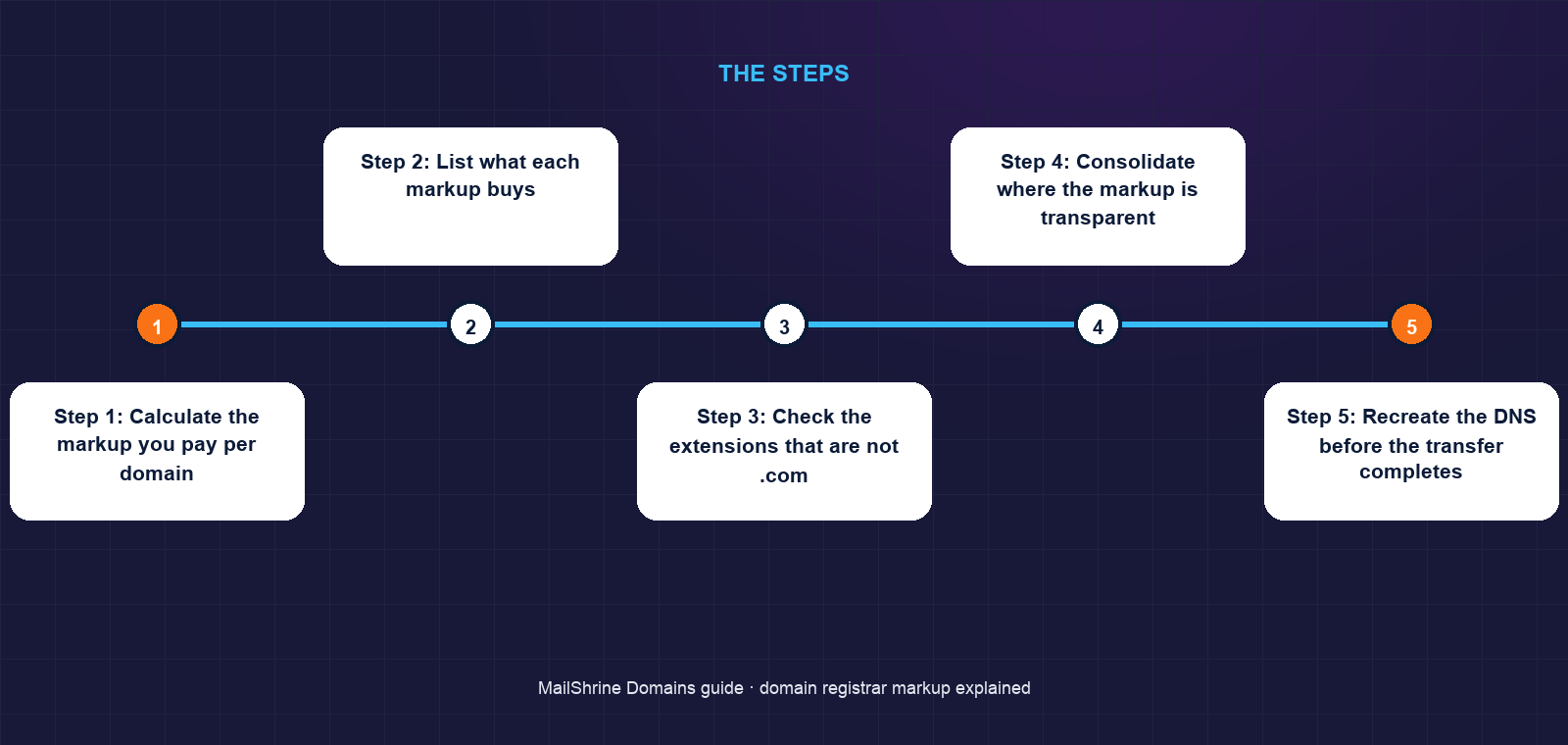
Step 1: Calculate the markup you pay per domain
Subtract $10.44 from each renewal and add any yearly privacy or DNS fee. Aminata's three registrars give markups of $11.55 (the $9.99 promo at its $21.99 renewal), $14.55 plus $9.99 privacy (the bundled one), and $2.55 (the flat one).
Step 2: List what each markup buys
Against each figure, write what you receive: privacy, lock, DNS quality, mailboxes, support, DNSSEC. Aminata finds the $24.54 markup buys her a parking page and a paid DNS tier she does not use. The $2.55 markup buys privacy, lock, Anycast DNS and two mailboxes.
Step 3: Check the extensions that are not .com
The .net has a higher registry fee, around $11 to $12, so the fair retail is higher than .com; a registrar charging $15 for .net is not overcharging. The .sn is run by NIC Sénégal outside ICANN's pricing framework, so its wholesale and retail follow local rules rather than the .com logic.
Step 4: Consolidate where the markup is transparent
Aminata unlocks the five transferable domains at their current registrars, requests the auth codes, and starts transfers into MailShrine. Each transfer adds a year to the term, so the money is not wasted, and if a losing registrar rejects one the fee is refunded. The domain registered 40 days ago waits for the 60-day lock to expire.
Step 5: Recreate the DNS before the transfer completes
Transfers do not move DNS records automatically in every case. Aminata exports each zone and enters the records in the MailShrine editor so the switch is clean. Email records on the main domain are written automatically; her custom A and CNAME records for the tracking portal are added by hand.
Aminata's checklist
- Calculated the markup on all six domains against the $10.44 floorCompleted
- Identified the $9.99 registrar as a loss leader with a $21.99 renewalCompleted
- Listed every DNS record and mailbox in use per domainCompleted
- Requested auth codes for the five domains older than 60 daysCompleted
- Recreate the tracking portal's A and CNAME records before the transfers completeNot completed
- Transfer the sixth domain when its 60-day lock expiresNot completed
Common mistakes
Assuming a higher price means better service. The markup pays for what the registrar chooses to offer. Check what is included before concluding that $24.99 buys more than $12.99.
Assuming the cheapest registrar is efficient. A .com at $9.99 is sold at a loss. The registrar is not efficient; it is betting you will not leave at $21.99.
Comparing .net and .io prices to .com as if the floor were the same. Registry fees differ by extension. Judge each extension's markup against its own registry fee.
Forgetting ICANN's rules apply only to gTLDs. Country codes like .sn, .ng and .ke have their own registries and pricing. The $10.44 arithmetic does not apply to them.
Consolidating without recreating DNS. The markup saving is real, but a day of email downtime because MX records were not copied costs more. Move the records first.
Check your work
For each domain, you should be able to state the registry fee, the markup, and what the markup includes, in one line. "Verisign $10.26 plus ICANN $0.18, markup $2.55, includes privacy, lock, DNS and two mailboxes" is a complete answer. If any part of that line is unknown for a registrar you use, that is the part they would prefer you did not ask about.
FAQ
Do big registrars get .com cheaper from Verisign?
No. Verisign's registry agreement sets one wholesale price for every accredited registrar, currently $10.26, with no volume tiers. Scale helps registrars by spreading fixed costs like accreditation and infrastructure, not by lowering the registry fee.
Why can a registrar sell a .com for $0.99?
It is a loss of about $9.75 per domain, treated as a marketing cost. The registrar expects to recover it at renewal, typically $18 to $25, and from attached services. Verisign offers no first-year discount on .com.
Is a reseller's markup higher than a registrar's?
Often slightly, because the reseller buys from a registrar at a wholesale price above the registry fee and adds its own margin. Resellers can still be competitive if the registrar's wholesale price is tight; the extra layer is listed in the domain's RDAP record.
What does the $0.18 ICANN fee pay for?
It funds ICANN's operations: policy development, contractual compliance, the IANA functions and the registrar and registry accreditation programmes. It applies per domain-year on generic TLDs and is passed through to registrants by nearly every registrar.
Does the markup change at renewal?
At a flat registrar, no. At a loss-leader registrar, the markup goes from negative in year one to $8 to $15 at renewal. The registry fee underneath is identical in both years, which is why the renewal jump is entirely the registrar's decision.
Next steps
- Why Is the Renewal Price Higher Than the First Year? — the loss-leader markup over time.
- Domain Pricing Compared: Namecheap vs GoDaddy vs MailShrine — three markups side by side.
- Verisign .com Price Increases: What Changes in 2026 — the registry layer and when it moves.
Citations & References
- Reference: ICANN: Registrar fees
- Reference: ICANN: Registrar Accreditation Agreement
- Reference: Verisign: .com Registry Agreement (ICANN)
- Reference: IANA: .sn delegation record
Written by Marcus T., DNS and deliverability editor. Marcus writes about the records that make a domain actually work, and how to change them without breaking email.