
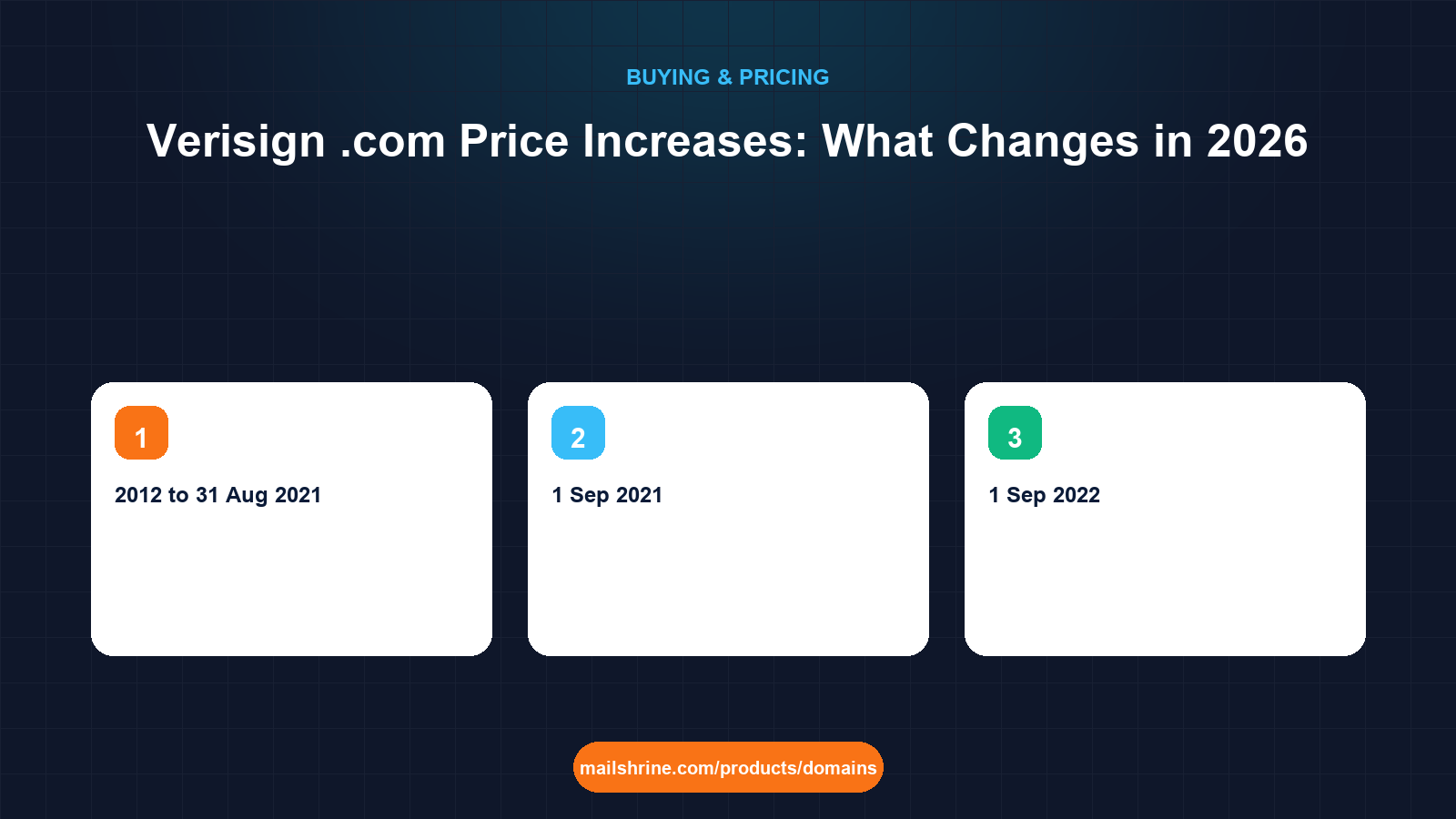
The .com wholesale price does not rise in 2026. Verisign, the registry operator for .com, has charged registrars $10.26 per domain-year since 1 September 2024, and under its agreement with ICANN it may not raise the price again until 1 September 2027 at the earliest. The years 2025 and 2026 are the two frozen years that begin each six-year pricing cycle. What can change in 2026 is the retail price, because registrars set their own markup and several have used the last cycle's increases as cover for larger rises of their own.
Understanding the schedule turns an anxious question, "will my domain get more expensive?", into arithmetic. The registry side is public, capped and predictable to the cent. The registrar side is where to look if your renewal moves this year.
MailShrine Domains prices a .com at typically $12.99 a year with the renewal shown next to the first-year price. Registry increases, when they come, are passed through at renewal; nothing changes mid-term, and registering for several years fixes the price for the whole term. WHOIS privacy, transfer lock and two Business Email mailboxes are included.
Real-life example: Grace's tour company
Grace Uwase runs Uwase Tours in Kigali, organising gorilla-trekking and Lake Kivu itineraries for visitors from Europe and North America. Her brand lives on uwasetours.com; the bookings, the email, the printed brochures all point at it. She has read headlines about .com prices going up and wants to know whether to renew for one year as usual or lock in ten.
Grace's goals this week:
- Know exactly when the registry price can and cannot change, with dates.
- Work out what a 7% increase actually does to a $12.99 renewal.
- Decide whether a longer term is worth paying for now.
The .com wholesale price, past and scheduled
| Effective date | Wholesale price | Change | Status |
|---|---|---|---|
| 2012 to 31 Aug 2021 | $7.85 | Frozen by the 2012 to 2018 US government agreement | Historical |
| 1 Sep 2021 | $8.39 | +7% | Historical |
| 1 Sep 2022 | $8.97 | +7% | Historical |
| 1 Sep 2023 | $9.59 | +7% | Historical |
| 1 Sep 2024 | $10.26 | +7% | Current |
| 2025 and 2026 | $10.26 | Frozen | Current cycle, years 1 and 2 |
| 1 Sep 2027 | Up to $10.98 | Up to +7% | Permitted, not yet announced |
| 1 Sep 2028 | Up to $11.75 | Up to +7% | Permitted |
| 1 Sep 2029 | Up to $12.57 | Up to +7% | Permitted |
| 1 Sep 2030 | Up to $13.45 | Up to +7% | Permitted; agreement term ends 30 Nov 2030 |
The rule behind the table: Amendment 3 to the .com Registry Agreement, signed in March 2020, lets Verisign raise the price by up to 7% in each of the last four years of every six-year period, and not at all in the first two. The agreement runs to 30 November 2030 with a presumptive right of renewal. Verisign has taken every permitted increase so far and announces each one to registrars at least six months ahead.
What a 7% registry increase does to a retail price
| Before | After a 7% registry rise | Difference | |
|---|---|---|---|
| Registry fee | $10.26 | $10.98 | +$0.72 |
| ICANN fee | $0.18 | $0.18 | $0 |
| Flat-markup retail (MailShrine model) | $12.99 | About $13.71 if passed through exactly | +$0.72 |
| Loss-leader renewal (typical) | $21.99 | Often $23.99 or $24.99 | +$2 to $3 |
The registry's share of the increase is 72 cents. If a renewal rises by more than about a dollar after a registry increase, the extra is the registrar's markup moving under cover of Verisign's announcement. The same applies in a frozen year: any .com renewal increase in 2026 is 100% registrar.
Grace's one-year renewal at $12.99 will not change in 2026 because of Verisign. Her exposure is in 2027 to 2030, when four increases could lift the registry fee by about $3.19 in total.
What you need before you start
| You need | Why |
|---|---|
| Your current renewal price and expiry date | To see which side of 1 September 2027 your next renewals fall on |
| Your registrar's pricing history | If it rose in a frozen year, that was the registrar's choice |
| A view on how long you will hold the name | The only reason to prepay is to lock the price for years you are sure about |
| The 10-year cap | You cannot push expiry more than ten years from today |
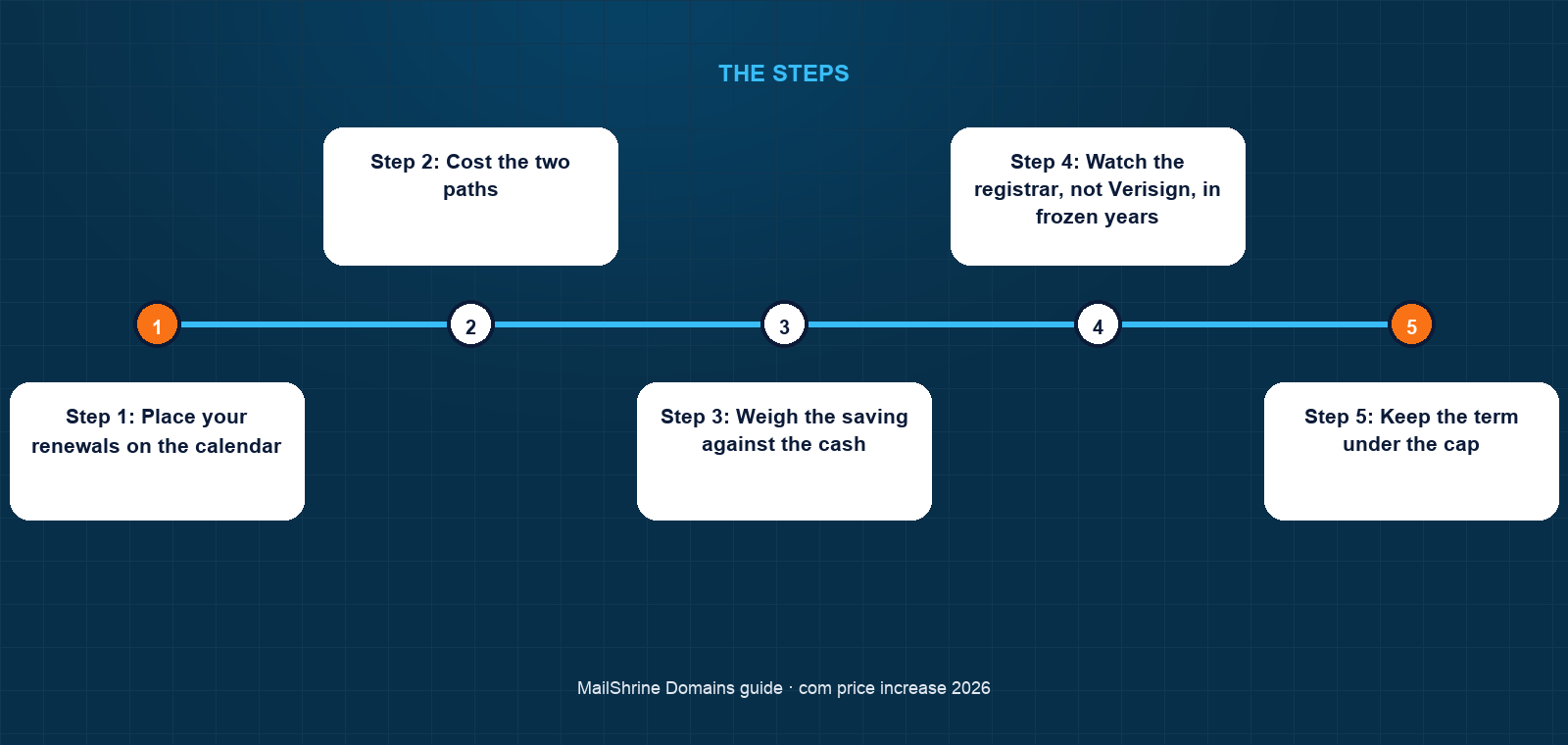
Step 1: Place your renewals on the calendar
Grace's .com expires each 14 March. Her 2026 and 2027 renewals happen before 1 September 2027, so both are at the current registry fee. From 2028 onward each renewal lands after another permitted increase.
Step 2: Cost the two paths
Path A: renew one year at a time. Four renewals from 2028 to 2031 at a flat registrar that passes increases through exactly: roughly $13.71, $14.48, $15.30, $16.18, about $59.67, versus $51.96 if the price never moved. Path B: renew five years in March 2027 at $12.99, total $64.95, covering through 2032 at today's price. The saving over Path A is a little over $5 per domain across the period, plus certainty.
Step 3: Weigh the saving against the cash
For one domain, $5 is not a reason to prepay; the reason is to stop thinking about it. For Grace's single brand domain that she is certain to hold, a five-year renewal in early 2027 is sensible. For a portfolio of twenty domains, the saving is $100 and the certainty is worth more.
Step 4: Watch the registrar, not Verisign, in frozen years
In 2025 and 2026 Grace's renewal should not move at all. If a renewal notice arrives higher, she compares it to the registrar's published price and to a flat-price alternative, and transfers if the gap has become a habit. A transfer adds a year to the term at the new registrar's price.
Step 5: Keep the term under the cap
If Grace renews for five years in March 2027 and the expiry becomes March 2032, she still has room: ten years from March 2027 is March 2037. Renewing for ten would use the entire allowance.
Grace's checklist
- Confirmed the registry price is frozen at $10.26 through 31 August 2027Completed
- Mapped her 14 March renewals against the 1 September increase datesCompleted
- Costed one-year renewals against a five-year prepayment in 2027Completed
- Checked her current renewal did not rise in a frozen yearCompleted
- Renew
uwasetours.comfor 5 years in March 2027 before the first new increaseNot completed - Review the
.rwdomain's pricing separately; RICTA sets it, not VerisignNot completed
Common mistakes
Panicking about a 2026 increase. There is none at the registry level. Any .com rise you see in 2026 is a registrar's markup change.
Blaming Verisign for a $3 renewal jump. Verisign's maximum step is 7% of $10.26, which is 72 cents. The rest is the registrar.
Prepaying ten years on a brand you may change. Registries do not refund unused years. Prepay the brand domain you are certain of, renew the speculative ones annually.
Assuming the schedule applies to every extension. It is .com only. .net has its own agreement allowing up to 10% a year; new gTLDs mostly have no cap; country codes follow their own registries.
Expecting the price to fall. The agreement permits increases, not decreases, and Verisign has taken every permitted increase since 2021. Plan for the staircase.
Check your work
Write down your renewal date and compare it to 1 September 2027. If your next two renewals fall before that date, the registry price for both is $10.26 and any change on your invoice is the registrar. Then confirm your term choice keeps the expiry within ten years of today. The dashboard shows the expiry date and the term total before you pay.
FAQ
Is the .com price going up in 2026?
Not at the registry. Verisign's wholesale fee stays at $10.26 for all of 2026 under the pricing rules in its ICANN agreement. Retail prices at individual registrars can change at any time for their own reasons.
When is the next possible .com increase?
1 September 2027, by up to 7%, which would take the wholesale fee to $10.98. Further increases of up to 7% are permitted on 1 September 2028, 2029 and 2030. Verisign announces each one to registrars at least six months in advance.
Does a price increase affect a domain I already paid for?
No. The years you have paid are at the price you paid. Increases apply only when you next renew, which is why a multi-year term fixes the price for its whole length.
Why is Verisign allowed to raise prices at all?
Because the 2018 amendment to Verisign's Cooperative Agreement with the US Department of Commerce, and the 2020 amendment to its ICANN agreement, restored the 7%-in-four-of-six-years formula that had been frozen since 2012. The freeze itself was a 2012 government decision.
Should I register for 10 years to beat the increases?
Only if you are sure you will hold the name for ten years. The total registry-side saving across the 2027 to 2030 increases is a few dollars per domain. The real benefit of a long term is certainty and fewer renewals to forget, not the price.
Next steps
- How Many Years Should You Register a Domain For? — choosing a term around the increase dates.
- What Is a Registrar Markup and Why Prices Differ — separating the registry's 72 cents from the registrar's $3.
- How Much Does a Domain Name Cost? — where the wholesale fee sits in the retail price.
Citations & References
- Reference: ICANN: .com Registry Agreement and amendments
- Reference: ICANN: Proposed Amendment 3 to the .com Registry Agreement (2020)
- Reference: NTIA: Verisign Cooperative Agreement
- Reference: Verisign: Domain Name Industry Brief
Written by Isabelle R., domains editor. Isabelle explains how names, DNS and registrars fit together so first-time buyers know exactly what they are paying for.