
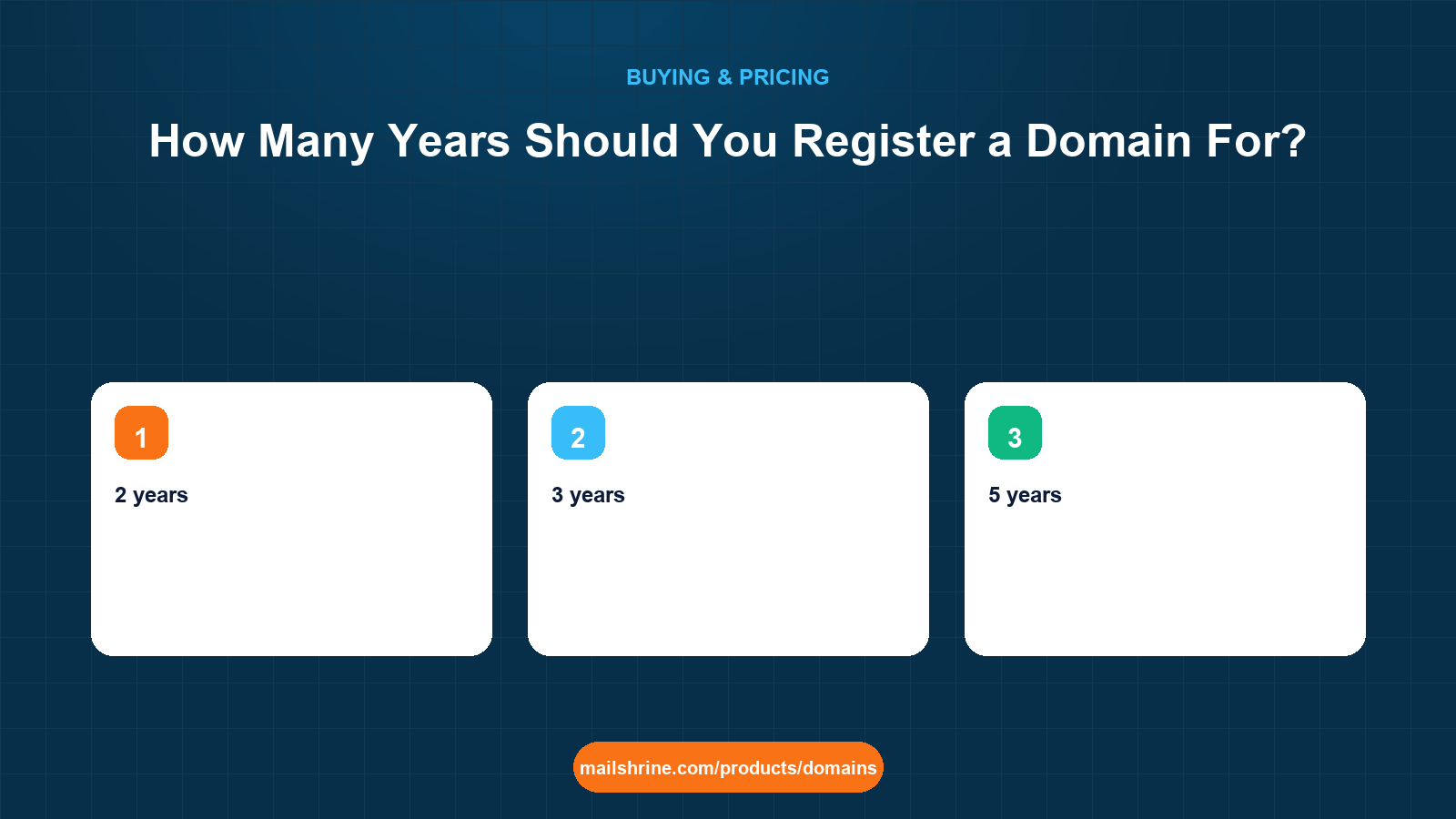
Register a domain for as many years as you are confident the business will exist, up to the 10-year maximum. Generic extensions such as .com, .net and .org allow terms from 1 to 10 years, and a longer term does three things: it fixes the renewal price for the whole period, it removes the yearly chance of forgetting to renew, and it reduces the number of times a payment card can fail. It does not improve search rankings, and it does not make the domain any more "yours" than a one-year term; the right to renew is the same either way.
The decision is a cash-flow question dressed up as a technical one. Paying $38.97 today for three years versus $12.99 a year is a choice between locking a price and keeping the cash. For most small businesses the answer is two or three years to start, extended as the business proves itself.
MailShrine Domains offers terms of 1 to 10 years on 150+ extensions and shows the total for the term alongside the yearly renewal before you pay. Renewal reminders go out at 30, 7 and 1 day and at expiry whatever the term, and auto-renew can be left on or switched off. Two Business Email mailboxes come with the name for the whole term.
Real-life example: Marc's accounting practice
Marc Tremblay is a CPA in Toronto opening his own practice after twelve years at a mid-size firm. He is registering tremblaycpa.ca and tremblaycpa.com. He knows the practice will exist in five years; accountancy clients do not churn. What he does not know is whether to pay for one year, five, or the full ten, and whether the long term is a bargain or a lock-in.
Marc's goals this week:
- Choose a term that protects the name without tying up cash he needs for software and insurance.
- Understand what a longer term protects against, and what it does not.
- Make sure a forgotten renewal can never take down client email in tax season.
What each term length buys you
| Term | Upfront for a $12.99 .com | What it protects against | What it costs you |
|---|---|---|---|
| 1 year | $12.99 | Nothing beyond the year | Yearly renewal risk; exposed to every registry price rise |
| 2 years | $25.98 | One registry increase cycle, one card expiry | A year of cash paid early |
| 3 years | $38.97 | Most planning horizons for a new business | Two years of cash paid early |
| 5 years | $64.95 | Several increases; fits a lease or a loan term | Lower flexibility if the brand changes |
| 10 years | $129.90 | The maximum the registry allows | Cash tied up; cannot exceed 10 years total at any time |
The right-hand column matters as much as the middle one. A ten-year term on a name you rebrand away from in year three is $90 you will not get back; registries do not refund unused years, and a domain transfer carries the remaining term to the new registrar but still cannot refund it.
What a long term does and does not do
| Claim | True? | Why |
|---|---|---|
| Locks the renewal price for the term | Yes | You paid at today's price; registry increases apply only to future renewals |
| Protects against forgetting to renew | Yes | Fewer renewals, fewer chances to miss one |
| Improves search rankings | No | Google has said registration length is not a ranking signal |
| Makes the domain permanently yours | No | The right to renew is the same for every term; ownership ends if you stop |
| Can exceed 10 years by renewing early | No | Registries cap the expiry date at 10 years from today for gTLDs |
| Transfers reset the term | No | A transfer adds one year to the existing expiry, up to the 10-year cap |
The 10-year cap is a registry rule enforced through EPP. If Marc holds a domain with 9 years left and renews for 2, the registry rejects the command or clips it, depending on the registrar's handling. Most dashboards will not offer a renewal that breaches the cap.
What you need before you start
| You need | Why |
|---|---|
| A realistic horizon for the business | Match the term to how long you are sure the name will be used |
| Your cash position | The upfront cost is the only downside of a longer term |
| Knowledge of the extension's rules | .ca allows 1–10 years; .ai has a 2-year minimum; some ccTLDs allow only annual terms |
| The renewal price | Multiply it by the term to see what you are locking in |
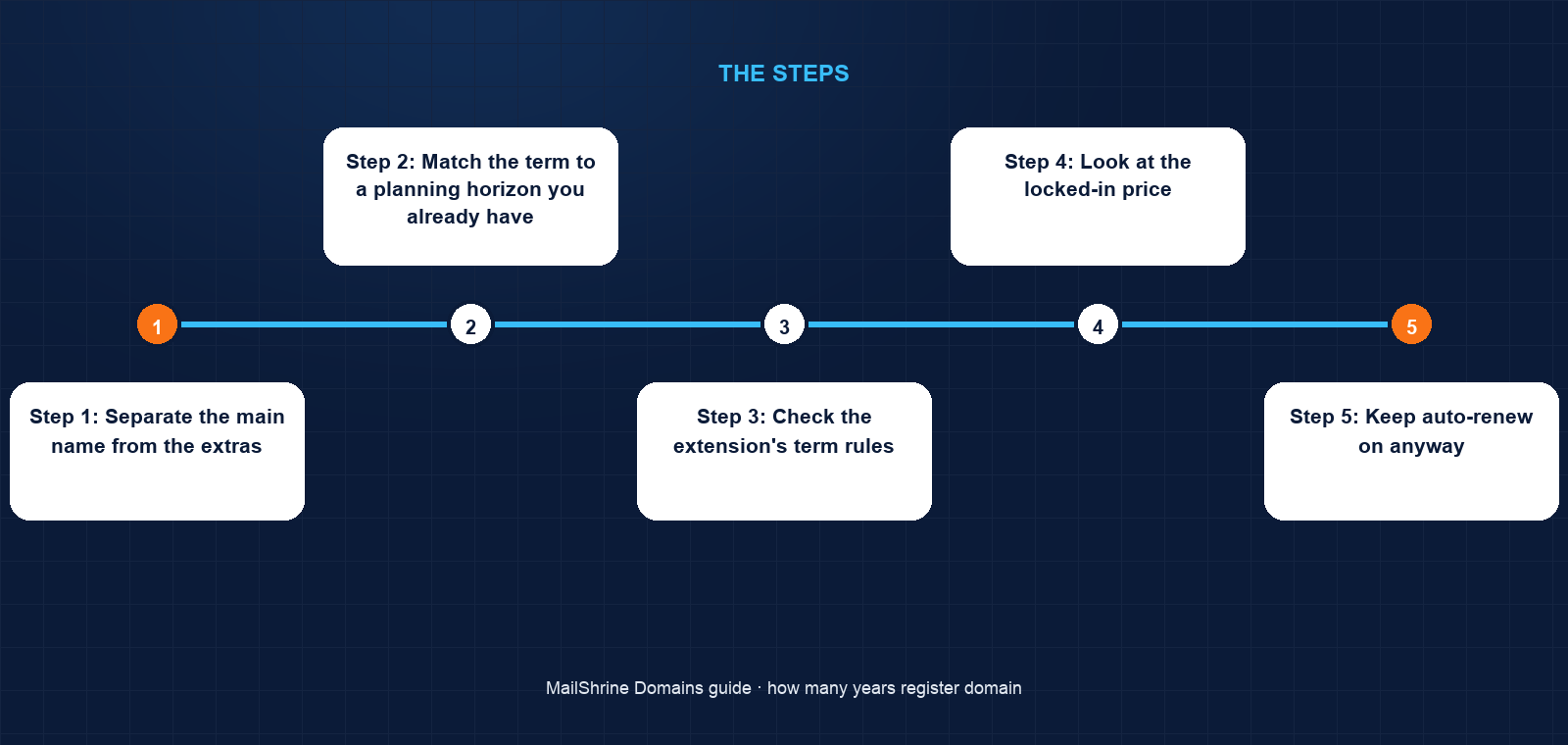
Step 1: Separate the main name from the extras
Marc's .ca is the main name: on the letterhead, in every email address, in the CRA correspondence. His .com is a defensive redirect. The main name gets the longer term; the extra gets one year, reviewed annually.
Step 2: Match the term to a planning horizon you already have
Marc has a three-year office lease and a five-year software contract. A three-year term on tremblaycpa.ca aligns renewal with lease renewal, a date he will already be paying attention to. Five years would also be defensible; one year is too short for a practice built on client email.
Step 3: Check the extension's term rules
.ca, governed by CIRA, allows 1 to 10 years. If Marc had wanted .ai, the minimum would have been two years; some country codes allow only annual renewal. The checkout shows the allowed terms for each extension.
Step 4: Look at the locked-in price
At $12.99 a year the three-year .com total is $38.97, and it will not change if Verisign raises its wholesale fee during that period. If the price had shown a $0.99 promo with a $21.99 renewal, the three-year total would be $44.97, and the lock would be locking in the higher price.
Step 5: Keep auto-renew on anyway
A long term reduces the number of renewals; it does not remove them. Marc leaves auto-renew on with a card that expires after the domain does, and notes that reminders at 30, 7 and 1 day will still arrive. In the registry grace period after expiry the name can still be renewed, but client email will be bouncing by then.
Step 6: Extend when the business proves itself
Two years in, with 40 clients, Marc can add years to the .ca from the dashboard, up to the 10-year cap. Extending early is not wasted money; the years are added to the existing expiry date, not restarted from today.
Marc's checklist
- Registered
tremblaycpa.cafor 3 years, aligned with the office leaseCompleted - Registered
tremblaycpa.comfor 1 year as a redirect, to review annuallyCompleted - Confirmed the total for the term matched renewal × 3 with no promo trapCompleted
- Left auto-renew on with a card valid past the expiry dateCompleted
- Set a calendar note at year two to extend the
.cato 5 or 10 yearsNot completed - Add the renewal date to the practice's compliance calendarNot completed
Common mistakes
Registering for ten years to "improve SEO". Google has stated it does not use registration length as a ranking signal. Choose the term for business reasons.
Locking in a promo price that does not exist. Multi-year terms at promo registrars are charged at the renewal rate from year two. Look at the term total, not the headline.
Paying ten years for an unproven brand. Names change. Start with two or three years and extend when the business is stable.
Assuming a long term means no reminders. Reminders and auto-renew still matter; the term only changes how often they fire. Keep the registrant email current for the whole period.
Trying to renew past ten years. The registry will refuse. If you want the maximum, renew annually to top the expiry back up to ten years out.
Check your work
In the dashboard, the expiry date should be exactly the chosen number of years from today, and the receipt total should equal the renewal price multiplied by the term. Confirm auto-renew shows on and the card on file expires after the domain does. If the expiry date is shorter than you paid for, the extension may have a shorter maximum term; support can see the registry's response.
FAQ
Does registering for more years help SEO?
No. Google has said publicly that domain registration length is not used in ranking. Any correlation between long registrations and good rankings comes from serious businesses tending to do both.
Can I register a domain for more than 10 years?
Not for .com, .net, .org and most generic extensions; the registry caps the expiry at ten years from today. You can renew each year to keep the expiry near the cap indefinitely.
If I register for 5 years and transfer, do I lose the years?
No. A transfer carries the existing expiry date to the new registrar and adds one year on top, subject to the ten-year cap. The years you paid for are never lost in a transfer.
Is a longer term cheaper per year?
Usually not; most registrars charge the same per year for each year of the term. The saving is protection against future increases, not a discount today. Promo registrars often charge more per year after the first.
What is the minimum term?
One year for most extensions. .ai requires two years at registration, and a few country codes have their own rules. The checkout shows what the registry allows for the extension you pick.
Next steps
- How Much Does a Domain Name Cost? — the yearly price you are locking in.
- Verisign .com Price Increases: What Changes in 2026 — the increases a longer term protects you from.
- Why Is the Renewal Price Higher Than the First Year? — why promo terms do not lock the promo.
Citations & References
- Reference: RFC 5731: EPP Domain Name Mapping (period and renew)
- Reference: ICANN: Expired Registration Recovery Policy
- Reference: CIRA: .CA registration policies
- Reference: Google Search Central: How Google Search works
Written by Samira K., small-business editor. Samira writes for owners who run the business and the IT, and wants the yearly bills to be as boring as possible.