
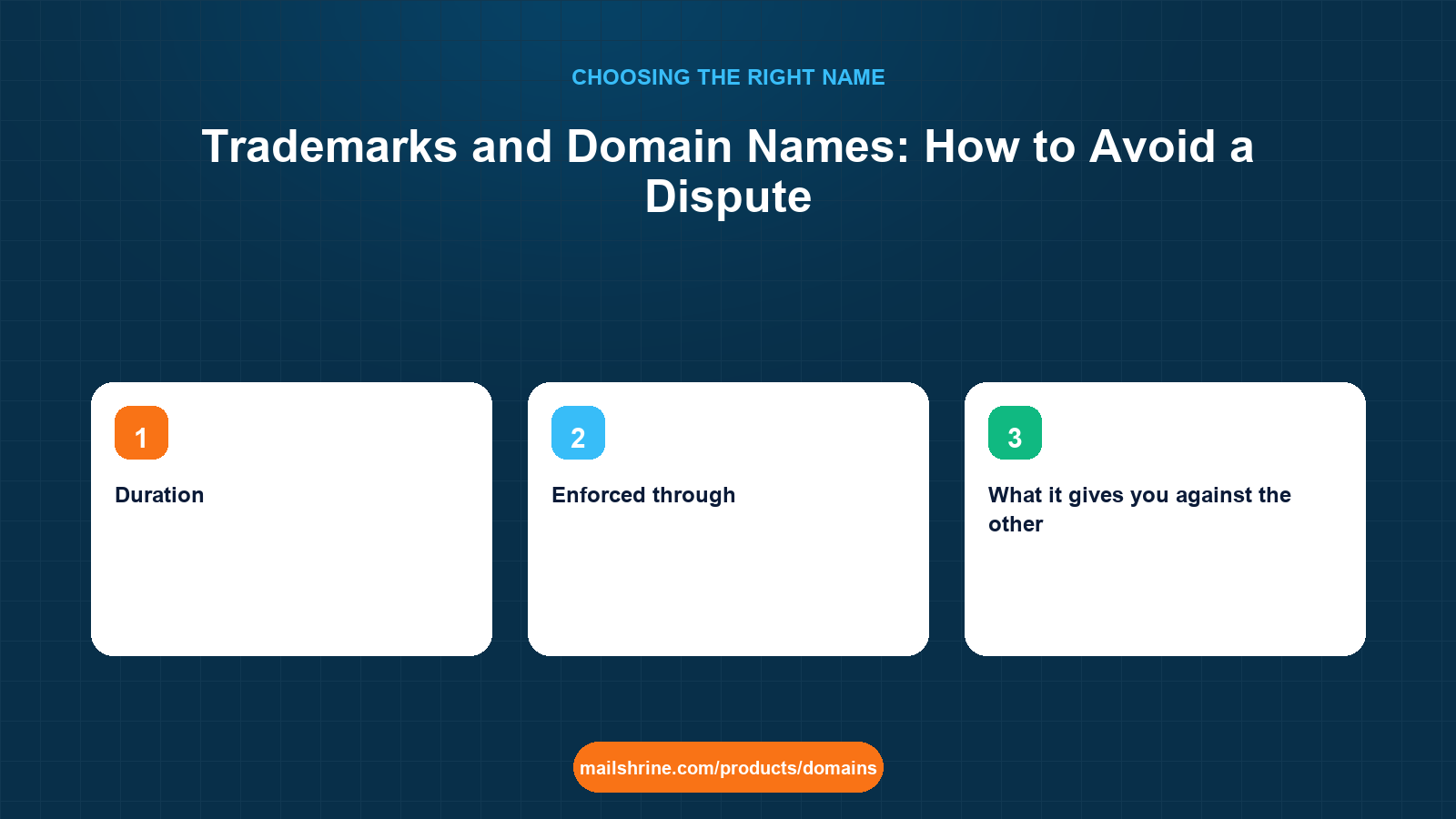
A domain name is not a trademark, and registering one gives you no rights against someone who holds the mark. The two systems were built separately: trademarks are granted by national offices for specific classes of goods and services, while domains are handed out first-come, first-served by registrars under ICANN's rules. Where they overlap, the trademark usually wins. Since 1999 ICANN's Uniform Domain-Name Dispute-Resolution Policy has let mark holders take domains from registrants in a paper proceeding that costs a few thousand dollars and takes about two months, and more than 60,000 such cases have been filed at WIPO alone.
This guide explains how the two systems collide, what a mark holder has to prove, how to search before you register so the question never arises, and what to do if you receive a complaint or want to file one.
MailShrine Domains cannot search trademarks for you, but it does make the domain side simple: the availability checker shows your name across 150+ extensions so you can register the variants that matter once your search is clean, and WHOIS privacy, transfer lock and email DNS are set up automatically on each.
Real-life example: Jean-Paul's coffee brand
Jean-Paul Habimana roasts and exports speciality coffee from Kigali under the brand "Mille Collines Coffee". He is about to register millecollinescoffee.com and .rw, start selling to European roasters, and apply for a trademark. He knows "Mille Collines" is also the name of a famous hotel in Kigali and has heard that a company in Belgium sells a "Mille Collines" chocolate. He wants to register the domain this week without buying a dispute.
Jean-Paul's goals:
- Find out whether "Mille Collines" is registered as a mark for coffee anywhere he plans to sell.
- Register the domains so that no one can take them from him later.
- Understand what to do if a complaint arrives anyway.
Trademarks and domains: two systems, one collision
| Trademark | Domain name | |
|---|---|---|
| Granted by | A national or regional IP office (USPTO, EUIPO, UKIPO, ARIPO, RDB in Rwanda) | An ICANN-accredited registrar on behalf of a registry |
| Scope | A territory and specific classes of goods and services (coffee is Nice class 30) | Global and unique: one millecollinescoffee.com on earth |
| Basis | Use or registration; examined for conflicts | First come, first served; no examination |
| Duration | Renewable every 10 years in most jurisdictions | 1 to 10 years, renewable |
| Enforced through | Courts, oppositions, customs | UDRP, URS, courts (e.g. US ACPA) |
| What it gives you against the other | A route to take a confusingly similar domain registered in bad faith | Nothing against the mark holder |
The asymmetry is the whole story. A mark in class 30 in the EU can be used to attack a .com registered by someone in Rwanda. A domain registered in 2016 cannot stop anyone from registering a mark in 2026, though prior use can be a defence.
What a complainant has to prove under UDRP
All three elements, not one:
- The domain is identical or confusingly similar to a mark in which the complainant has rights. Adding a generic word ("coffee") or a typo rarely avoids this; panels look at the dominant part.
- The registrant has no rights or legitimate interests in the domain. Using the name for a genuine business before any notice of a dispute, being commonly known by the name, or making fair non-commercial use are all legitimate interests.
- The domain was registered and is being used in bad faith. Registering it to sell to the mark holder, to block them, to disrupt a competitor, or to attract traffic by confusion. A name registered before the mark existed is almost never bad faith.
Filing fees at WIPO are $1,500 for one to five domains with a single panellist and $4,000 for a three-member panel. Decisions typically arrive within about 60 days of filing. The only remedies are transfer or cancellation of the domain; no damages. The faster, cheaper Uniform Rapid Suspension (URS) applies to the newer gTLDs and only suspends the name.
Jean-Paul's position: he will use the name for a real coffee business from day one (legitimate interest), and he did not register it to target anyone (no bad faith). Even if a chocolate company holds "Mille Collines" in class 30 in Belgium, a complaint would face a hard second and third element. But "would probably win" is still a dispute he would rather not have, which is why the search comes first.
How to search before you register
- WIPO Global Brand Database. Free, covers international registrations under the Madrid system and dozens of national offices. Search the words, then the words with "coffee".
- Your national office. For Rwanda the Rwanda Development Board's IP registry; for the US the USPTO's TESS successor, Trademark Search; for the EU, EUIPO's eSearch; for the UK, UKIPO.
- The markets you will sell into. A mark in Germany matters if you ship to Germany.
- Check the class. A hotel (class 43) and a coffee (class 30) can coexist. A chocolate (also class 30) is closer and worth a lawyer's hour.
- Search the common-law use too. In the US and other common-law countries, unregistered use can create rights. A Google search for the phrase plus your product is cheap due diligence.
Jean-Paul found the hotel's mark in classes 43 and 35, the Belgian chocolate in class 30 in the Benelux only, and nothing for coffee anywhere. He registered the domains and filed his own application in class 30 in Rwanda and through Madrid for the EU.
What you need before you start
| You need | Why |
|---|---|
| The exact brand words and two variants | Searches must cover what people would type |
| Your Nice classes | Coffee is 30; roasting services may be 40; a café is 43 |
| The list of countries you will sell in | Trademark rights are territorial |
| An hour with a trademark attorney if there is any class-30 match | Cheaper than a dispute |
| A record of first use | Dated invoices, photos, the registration date of the domain |
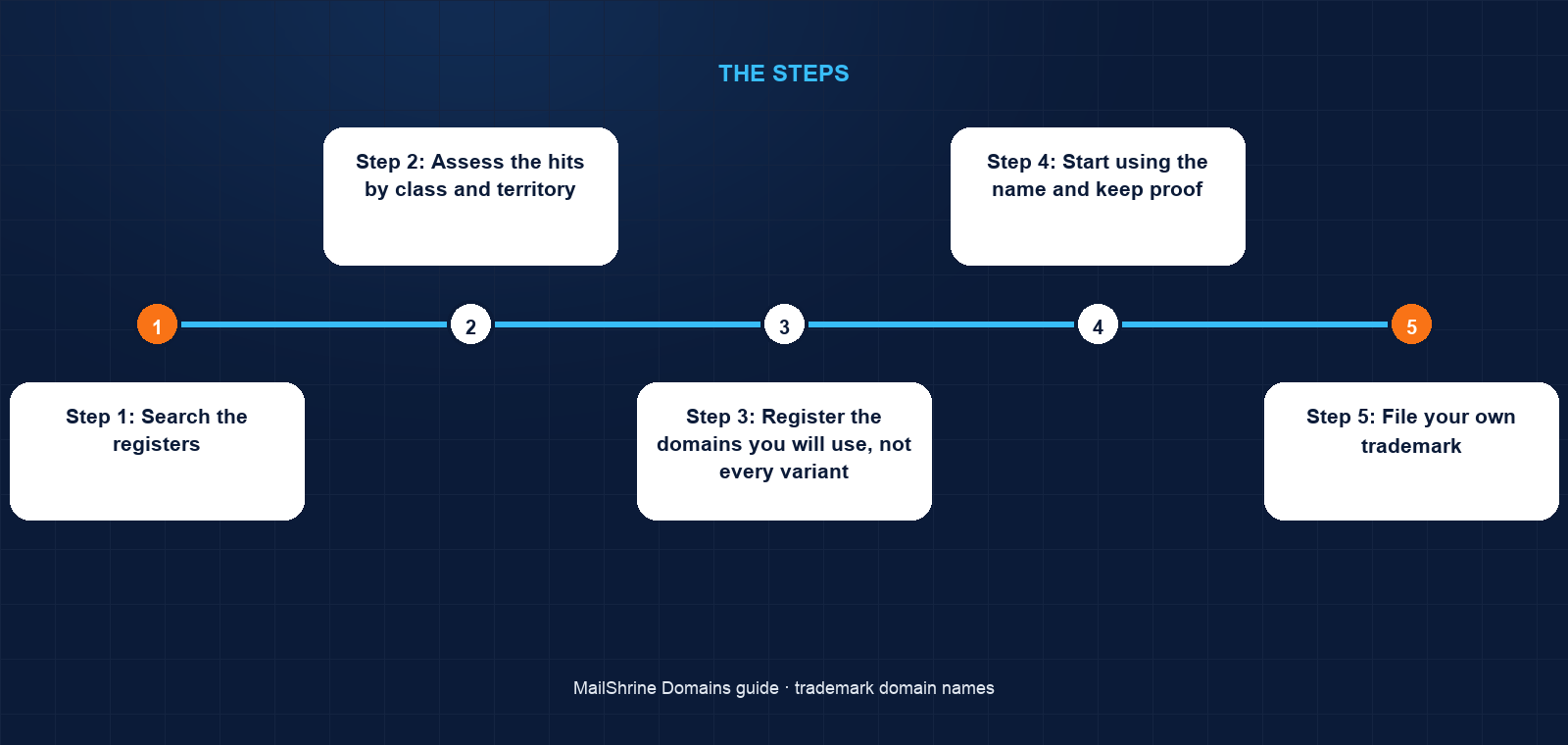
Step 1: Search the registers
WIPO Global Brand Database first, then each national office for your markets. Record every hit with its class and territory.
Step 2: Assess the hits by class and territory
Same class, same territory, similar goods: stop and get advice. Different class or territory: note it and proceed. Jean-Paul's chocolate hit was same class, different territory, different goods; his attorney called it low risk.
Step 3: Register the domains you will use, not every variant
Register the main .com and your country code. Do not register variants that include someone else's mark; that is how bad faith gets inferred.
Step 4: Start using the name and keep proof
Put the coffee on the site, send invoices from sales@, date everything. Genuine use before any notice of dispute is the strongest UDRP defence.
Step 5: File your own trademark
A registered mark lets you defend the brand and, if someone later squats a variant, file a complaint yourself. Jean-Paul filed in class 30 in Rwanda and designated the EU through Madrid.
Jean-Paul's checklist
- WIPO, RDB and EUIPO searched for "Mille Collines" and "Mille Collines Coffee"Completed
- Hotel mark in classes 43 and 35; chocolate in class 30, Benelux only; nothing for coffeeCompleted
- Attorney's view: low risk; proceedCompleted
- Registered
millecollinescoffee.comfor 3 years and.rwfor 2, privacy and lock onCompleted sales@andjeanpaul@live on Business EmailCompleted- Trademark application filed in class 30 (Rwanda, Madrid designating EU)Not completed
- Folder of dated first-use evidence startedNot completed
Common mistakes
Believing the domain registration protects the brand. It protects the address. Only a trademark protects the name, and a mark holder can take the domain.
Registering variants that contain someone else's mark. nespresso-rwanda.com is a complaint waiting to be filed, however good your intentions.
Searching only your own country. Rights are territorial, but a .com is global. Search where you sell.
Ignoring the class. A hit in an unrelated class is usually not a conflict; a hit in your class is. Most panic and most complacency come from not checking.
Letting the WHOIS privacy lull you. Privacy hides your details from the public; it does not hide you from a UDRP, which is served through the registrar.
Check your work
Your search notes should list every hit with class and territory and a one-line assessment. Your domains should show Active, privacy and lock on and email setup complete in the MailShrine dashboard, and the registrant contact should be an address you will read, because that is where a complaint would arrive. Your evidence folder should have at least one dated item showing use of the name for your goods.
FAQ
Can I register a domain that is someone else's trademark?
Technically yes, because registrars do not examine trademarks. Practically it is a bad idea: if you use it in a way that confuses customers or targets the mark holder, they can take it through UDRP or sue, and you will have paid for the privilege.
Does owning a domain give me trademark rights?
No. Rights come from registering a mark or, in some countries, from genuine use in trade. Owning millecollinescoffee.com alone gives Jean-Paul no claim against anyone.
What happens if I receive a UDRP complaint?
You have 20 days to respond after the provider notifies you. Respond, with evidence of your legitimate interest and lack of bad faith; registrants who respond win far more often than those who default. The domain is locked by the registrar during the case and cannot be transferred.
What is reverse domain name hijacking?
A finding that a complainant abused UDRP to try to take a domain it had no right to, typically where the domain predates the mark. It carries no penalty beyond the finding, but it is public.
Should I register the trademark before or after the domain?
Register the domain first because it can disappear in a day; file the mark as soon as you have done the search. Our guide on how to choose a domain name puts the trademark search at rule seven for exactly this reason.
Next steps
- What to Do When Your Domain Name Is Taken — including when a UDRP is and is not the answer.
- How to Choose a Domain Name for Your Business (12 Rules) — the full checklist your name should pass.
- Brandable vs Keyword Domains for SEO — why invented names are easier to trademark and own.
Citations & References
- Reference: ICANN: Uniform Domain-Name Dispute-Resolution Policy
- Reference: WIPO: Domain name dispute resolution and UDRP fees
- Reference: WIPO: Nice Classification
- Reference: ICANN: Uniform Rapid Suspension System (URS)
Written by Daniel O., security editor. Daniel covers the rules, lookups and locks that decide who really holds a name and who can take it away.