
Choosing a domain name is a one-time decision with a ten-year tail. The name goes on your business cards, your invoices, your van, and into the From line of every email you send. Change it later and you pay twice: once for the new name, and again in redirects, reprinted stationery and customers who still type the old address. Pick well the first time and the name quietly does its job for a decade.
The rules below are not taste. Each one is a measurable property: how many characters, how many ways to misspell it, whether it survives being read aloud over a phone line, whether a trademark office already has a claim on it. Run your shortlist through all twelve and the weak names fall out on their own.
MailShrine Domains is built for this stage. The search box checks 150+ extensions at once, shows the first-year and renewal price side by side, and when you register the name it writes the MX, SPF, DKIM and DMARC records for you and opens two business mailboxes, so the name is answering email the same afternoon. Try candidates in the availability checker while you read.
Real-life example: Kwame's catering company
Kwame Mensah runs a catering business in Accra with six staff and a growing corporate client list. He trades as "Mensah's Kitchen" but has been emailing quotes from a Yahoo address for four years. Two things pushed him to act: a bank asked for a business email to open a merchant account, and a competitor registered a name close to his trading name.
Kwame's goals for the week:
- Choose a name that staff can say over the phone without spelling it.
- Make sure the name does not collide with a registered trademark in Ghana or abroad.
- Register it with privacy on, email working, and a renewal price he understands.
The 12 rules at a glance
| # | Rule | Why it matters | Kwame's test |
|---|---|---|---|
| 1 | Keep it under 15 characters before the dot | Shorter names are typed correctly more often and fit on a van | mensahskitchen is 14 |
| 2 | Pass the radio test | If a listener cannot type it after hearing it once, it will leak customers | The apostrophe-s is a problem |
| 3 | No hyphens, no numbers | Both must be spoken aloud ("dash", "the digit four") and both are rare in real brands | Avoid mensahs-kitchen |
| 4 | Avoid double letters at word joins | mensahskitchen has an "s s" join that people drop | Consider mensahkitchen |
| 5 | Prefer .com, then your country code | .com is what people type by default; .com.gh signals a local business | Check both |
| 6 | Make sure the obvious misspellings are free or yours | A competitor on the typo takes your traffic | Check mensakitchen |
| 7 | Search the trademark registers | A UDRP complaint can take the name away after you have printed everything | GIPC Ghana, WIPO Global Brand Database |
| 8 | Check social handles | The name should be free on the two platforms you actually use | Instagram, LinkedIn |
| 9 | Say it in a sentence | "Email me at hello at mensahkitchen dot com" should flow | Yes |
| 10 | Avoid trends and slang | "Grub", "eats", "hub" date quickly | Skip mensaheats |
| 11 | Keep room to grow | Do not bake a city or a single product into the name if you plan to expand | No accracatering |
| 12 | Read it with the spaces removed | penisland.net is the classic example | mensahkitchen is safe |
The three rules people skip
Rule 2, the radio test. Say the name once to someone who has never seen it written, then ask them to type it. Kwame tried mensahskitchen.com on three staff. Two typed mensahkitchen. That is a 66 percent miss rate on his own team; strangers will do worse. He dropped the possessive.
Rule 6, the typo check. For a 13-character name there are usually three or four misspellings that real people make: a dropped double letter, a swapped vowel, a phonetic spelling. Type each into the availability checker. If they are free and cheap, register the one or two most likely and redirect them. If a competitor already owns one, that tells you something about the neighbourhood you are moving into.
Rule 7, trademarks. A domain registration gives you no trademark rights, and a registered trademark can be used to take a domain away through ICANN's Uniform Domain-Name Dispute-Resolution Policy. Search the WIPO Global Brand Database for the word itself, then your national register. Kwame found "Mensah" used by a cocoa exporter in a different class of goods, which is not a conflict, and nothing registered for "Mensah Kitchen".
What you need before you start
| You need | Why |
|---|---|
| A shortlist of 3 to 5 names | One name leaves you stuck when it is taken or trademarked |
| Your trading name as registered with the company registry | The domain should match what is on your invoices |
| Fifteen minutes with the trademark database | Cheaper than a dispute later |
| The two social platforms you actually post on | Check handles only where it matters |
| A budget for two names | The main name plus the most likely typo, around $26 a year for two .coms |
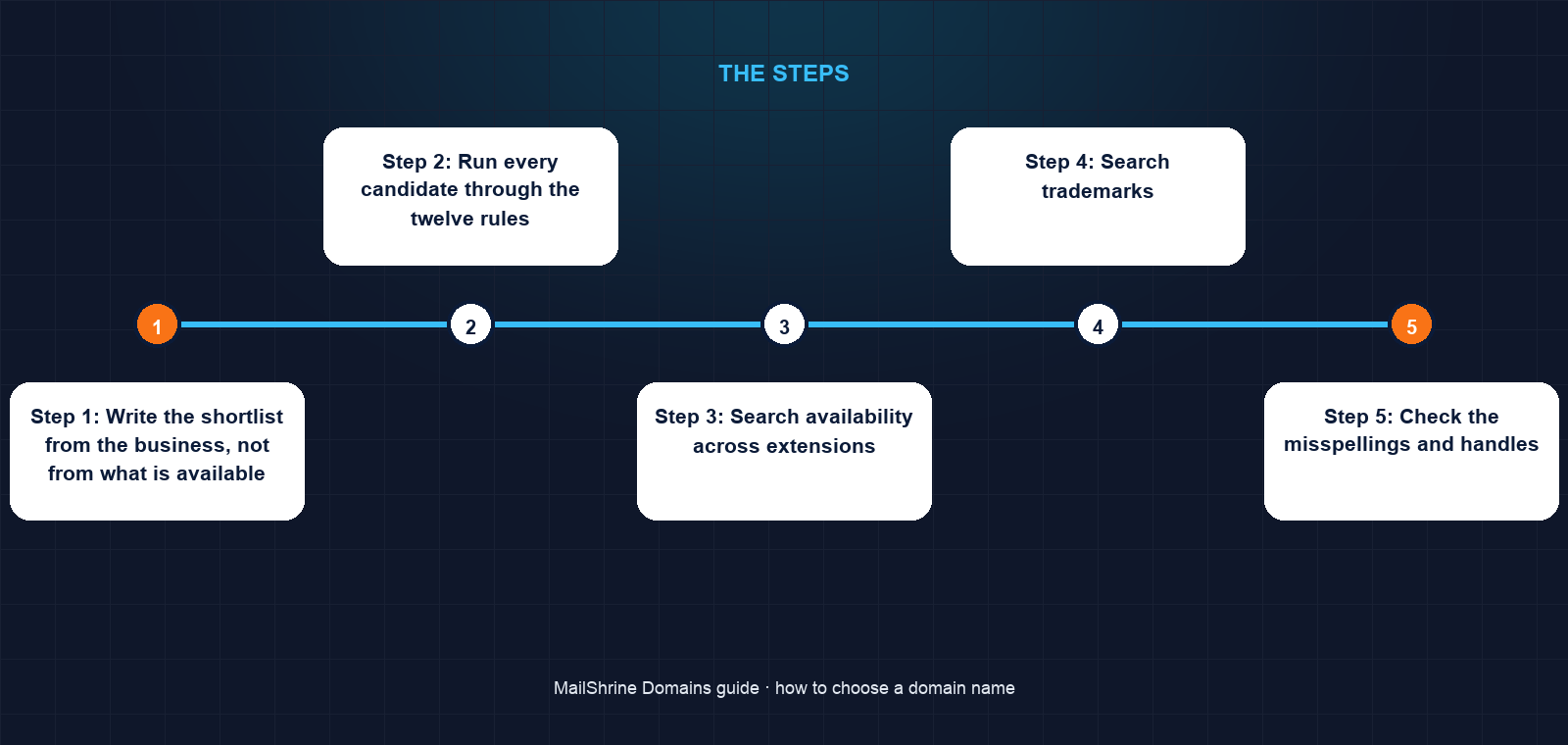
Step 1: Write the shortlist from the business, not from what is available
Start with what you want to be called, not with what the search box says is free. Write down the trading name, a shortened form, and one descriptive variant. For Kwame: mensahkitchen, mensahcatering, kitchenbymensah. Do not look up availability yet; it biases you toward whatever is free.
Step 2: Run every candidate through the twelve rules
Score each name on the table above. Be honest about the radio test and the word-join rule. Kwame's possessive version failed rule 2 and rule 4 and was cut before he searched for it.
Step 3: Search availability across extensions
Type the survivors into the availability checker. Look at .com first, then your country extension (.com.gh for Kwame), then anything else only if both are gone. Note the renewal price, not just the first year. MailShrine shows both before you buy.
Step 4: Search trademarks
Search the exact word and close variants in the WIPO Global Brand Database and your national office. Pay attention to the class of goods and services. A match in a different class is usually not a conflict; a match in your own class is a stop sign.
Step 5: Check the misspellings and handles
Type the two or three most likely misspellings into the checker. Check the handle on your main social platforms. If the handle is taken by an inactive account, that is acceptable; if it is taken by a competitor, think again.
Step 6: Register the main name and the top typo
Register the primary name for two or more years, leave WHOIS privacy and transfer lock on, and register the most likely typo for one year. Kwame registered mensahkitchen.com for three years and mensakitchen.com for one.
Kwame's checklist
- Shortlist of four names written before searchingCompleted
- Dropped the possessive after two of three staff mistyped itCompleted
- Searched WIPO and GIPC for "Mensah Kitchen"Completed
mensahkitchen.comfree at $12.99, renewal $12.99Completed- Registered
mensakitchen.comas the typoCompleted - Rename
you@tokwame@andhello@in Business EmailNot completed - Update quote template and bank merchant applicationNot completed
Common mistakes
Letting availability choose the name. If the search box drives the process you end up with mensahkitchen-gh.net because it was free. Write the shortlist first, search second.
Buying a first-year bargain without reading the renewal. A $1.99 first year on a niche extension that renews at $40 costs more over three years than a .com at $12.99.
Picking a name that only works in one city. accracatering.com is a problem the day Kwame gets a client in Kumasi.
Ignoring the trademark search because the name is "just my surname". Surnames are registered as trademarks all the time. The search takes ten minutes.
Treating the domain as the brand. The domain is the address. If the perfect .com is taken, a slightly longer name you can own everywhere beats a perfect name you own nowhere.
Check your work
Say the name once to someone outside the business and ask them to type it. Google the name in quotes and see what already ranks for it. Confirm in the MailShrine dashboard that the domain shows Active, that privacy and lock are on, and that the email setup is complete. Send a test email from the new mailbox to your old address and reply to it. If all four pass, the name is working and you can start printing.
FAQ
Should I include keywords like "catering" in the domain?
Only if the word is part of how you want to be known. Google stopped giving exact-match domains a ranking advantage in 2012, so the keyword buys you nothing in search. It can help people understand what you do when the name is new, which is a branding decision, not an SEO one.
Is .com really necessary if I only trade locally?
Not necessary, but useful. People type .com by default, so owning it stops your traffic going elsewhere. A country extension such as .com.gh or .com.ng signals that you are local and is a sensible second registration.
How long should a domain name be?
Under 15 characters before the dot is a good ceiling. The technical limit is 63 characters per label, but the practical limit is what fits on a sign and survives a phone call.
Should I buy the misspellings too?
Buy one or two that real people actually make, not every permutation. Redirect them to the main name. Each one costs about the same as the main domain each year.
What if the name I want is taken?
Check whether it is for sale, consider the country extension, or shorten and rework the name. Our guide on what to do when your domain is taken walks through the options with real prices.
Next steps
- .com vs .net vs .org: Which Extension Should You Buy? — what each extension signals and when .com is not the answer.
- Should You Use Hyphens or Numbers in a Domain? — the rule most people break and why it costs them.
- Trademarks and Domain Names: How to Avoid a Dispute — how UDRP works and how to search before you buy.
Citations & References
- Reference: ICANN: Uniform Domain-Name Dispute-Resolution Policy
- Reference: WIPO Global Brand Database
- Reference: Google Search Central: Exact-match domain update
- Reference: RFC 1035: Domain names, implementation and specification
Written by Samira K., small-business editor. Samira writes for owners who need a name that works on a van, a phone call and an invoice, not just a landing page.