
.com, .net and .org are the three original generic top-level domains, created together in January 1985 and still the three most recognised extensions on earth. They are run by different registries under different rules, they cost different amounts to renew, and they say different things to the person reading your email address. Only one of them is what people type when they guess.
The short version: .com is the default and you should own it if you can. .org is right for non-profits, communities and open projects, and it carries real trust in that role. .net is the one most people buy because .com was taken, and that is exactly how visitors read it. The rest of this guide gives you the numbers behind each of those claims so you can make the call for your own name.
MailShrine Domains sells all three with the first-year and renewal price shown side by side, so you can see the real cost of each before you decide. WHOIS privacy and transfer lock are on by default, and because the email DNS is written at registration, whichever extension you pick is receiving mail within minutes.
Real-life example: Priya's tutoring co-operative
Priya Raman runs a tutoring co-operative in Toronto. Eleven tutors share bookings, a small surplus goes back into free sessions for newcomer families, and the group is about to incorporate as a non-profit. They have been using brightpathtutors.wordpress.com and a shared Gmail inbox. brightpathtutors.com is taken by a parked page; .net and .org are both free.
Priya's goals:
- Understand what each extension signals to a parent looking for a tutor.
- Know whether the non-profit status changes the answer.
- Register one name, get
hello@working for bookings, and stop paying for nothing.
The three extensions compared
| .com | .net | .org | |
|---|---|---|---|
| Created | 1985 | 1985 | 1985 |
| Registry | Verisign | Verisign | Public Interest Registry |
| Original purpose | Commercial | Network infrastructure | Organisations not covered elsewhere |
| Restrictions today | None | None | None |
| Registered names | Roughly 155 million | Roughly 13 million | Roughly 11 million |
| Registry wholesale fee | About $10.26 | About $11 | About $11 |
| Typical MailShrine price | $12.99/yr | Shown with renewal at search | Shown with renewal at search |
| What a stranger assumes | A business | "The .com was taken" | A non-profit, community or project |
| Price cap | Verisign may raise 7% in 4 of 6 years under its US agreement | Verisign may raise 10% per year | No cap since 2019; PIR has pledged restraint |
The last two rows are the ones that matter. Price caps decide what the name costs you in year five. The "what a stranger assumes" row decides how many people type the wrong extension and land somewhere else.
.com: the default
Over half of all registered domains worldwide end in .com. When someone hears "brightpathtutors" and reaches for a keyboard, .com is what their fingers type. That is not an argument that .com is better; it is an observation about where traffic leaks to if you do not own it.
Verisign runs .com under a cooperative agreement with the US Department of Commerce that allows it to raise the wholesale price by up to 7 percent in four of every six years. The fee rose to $10.26 in September 2024. That means .com renewals creep upward but predictably; you can estimate your tenth-year renewal today.
Buy .com when: it is available, or when it is for sale at a price lower than the cost of losing the traffic for a decade.
.org: trust in a specific role
.org was meant for "organisations that did not fit elsewhere" and over four decades it has become shorthand for non-profits, charities, open-source projects, schools and community groups. Studies run by Public Interest Registry consistently find that visitors rate .org sites as more trustworthy than other extensions when the content is mission-driven.
That trust has a condition attached. A shop on .org reads as odd, and a business using .org because .com was gone looks like it is borrowing a reputation it has not earned. Priya's co-operative, which is incorporating as a non-profit and gives sessions away, is squarely inside the role.
In 2019 ICANN removed the 10 percent annual price cap on .org when it renewed PIR's registry agreement. Prices have risen modestly since, and PIR, itself a non-profit, has published commitments on restraint, but there is no contractual ceiling.
Buy .org when: you are a non-profit, a community group, an open project or an informational resource with no commercial pitch.
.net: the one you settle for
.net was created for network providers, and a handful of infrastructure companies still use it that way. For everyone else it functions as the overflow extension: available because fewer people want it, and recognised by visitors as exactly that.
That does not make it useless. If your name is a made-up word with no obvious .com owner competing for the same customers, .net can work. The risk is specific: if brightpathtutors.com ever becomes a live tutoring business, every parent who types .com by habit lands on a competitor.
Buy .net when: your audience is technical, or the .com is a dead parked page you are also trying to buy, or the name is distinctive enough that confusion is unlikely.
What you need before you start
| You need | Why |
|---|---|
| Availability of your name across all three | Decide with real data, not assumptions; the checker shows all three in one search |
| Who owns the .com if it is taken | A parked page may be for sale; a live competitor changes the calculation |
| Your legal structure | Non-profit status is the strongest case for .org |
| Your audience | Parents and consumers default to .com; developers accept .net and .io |
| A budget for two names | Owning both your extension and the .com, when possible, ends the confusion question |
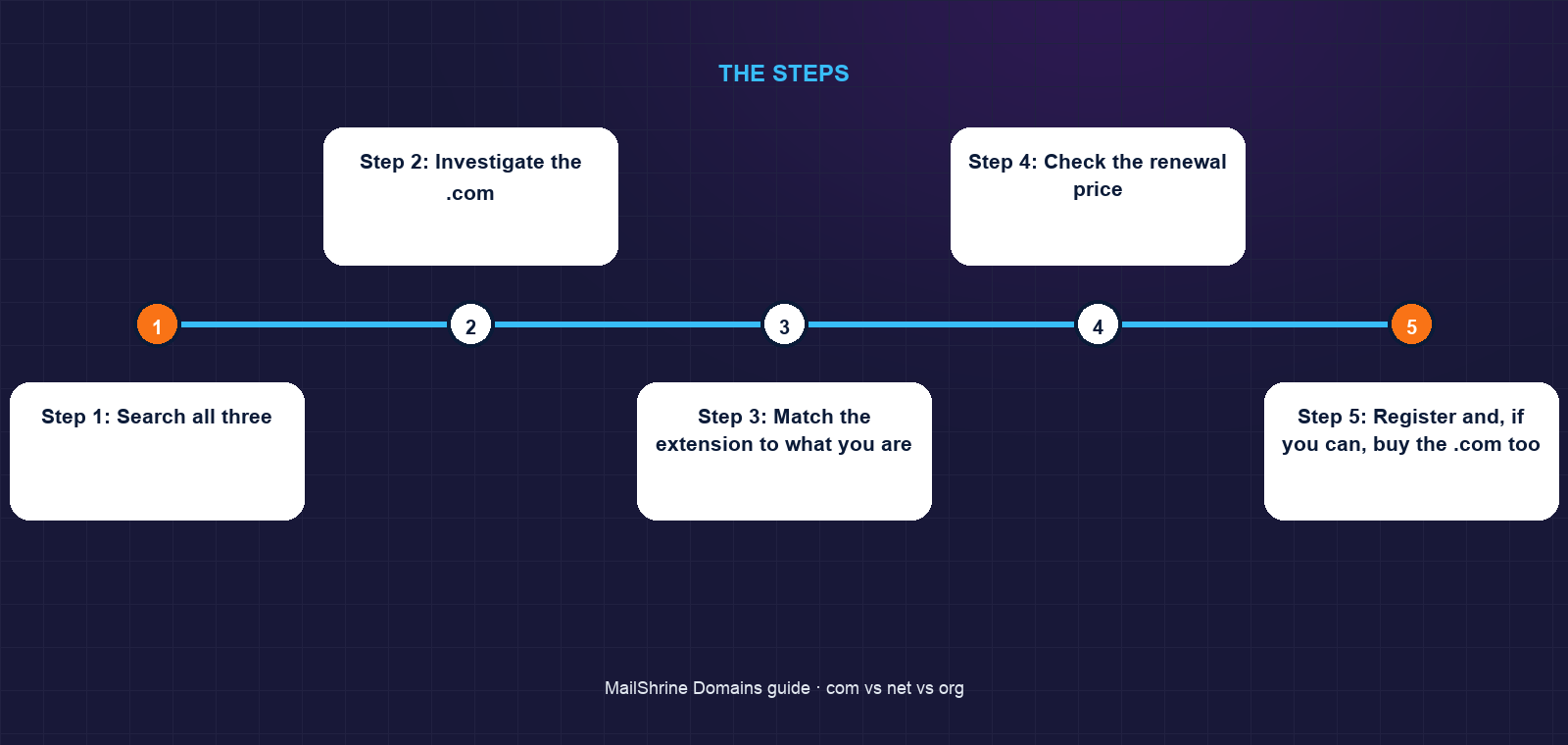
Step 1: Search all three
Type the bare name into the MailShrine availability checker. It returns .com, .net, .org and 150 other extensions in one result with the first-year and renewal price next to each.
Step 2: Investigate the .com
If .com is taken, open it. A parked page with a "for sale" banner means an aftermarket purchase may be possible; MailShrine shows Buy Now prices for listed names up to a cap. A live business in your field means .net is dangerous and you should consider a different name altogether.
Step 3: Match the extension to what you are
Non-profit, community, project: .org. Business selling to the public: .com, or rework the name until a .com is free. Technical audience with a distinctive name: .net is acceptable.
Step 4: Check the renewal price
Each extension has its own renewal. The checker shows it before you pay. Compare the three-year total, not the first year.
Step 5: Register and, if you can, buy the .com too
Register your chosen extension for two or more years. If the .com is for sale at a reasonable price, buy it and redirect it. Priya registered brightpathtutors.org for three years and made an offer on the parked .com.
Priya's checklist
- Searched the name; .com parked, .net and .org freeCompleted
- Confirmed the co-operative is incorporating as a non-profitCompleted
- Chose .org and registered for 3 yearsCompleted
- Left privacy and transfer lock onCompleted
- Sent an offer on the parked .com through the Buy Now listingCompleted
- Rename
you@tohello@in Business Email for bookingsNot completed - Redirect the WordPress.com site to the new domainNot completed
Common mistakes
Choosing .net to look "techy". Unless your customers are engineers, they read .net as the fallback extension, because for most sites that is what it is.
Using .org for a business. Visitors notice. It reads as either a mistake or a reputation borrowed from the non-profit sector.
Assuming .org is cheaper because it is "for charities". It is priced like .com and has had no price cap since 2019. Check the renewal.
Registering only one extension when the .com is for sale cheaply. For a few hundred dollars once, you end a decade of lost traffic.
Forgetting the price caps. .com's increases are bounded by contract; .org's are not. Over a ten-year term that difference can matter.
Check your work
Type your name with each of the three extensions into a browser. You should land on your site for the one you own and know exactly who owns the other two. In the MailShrine dashboard confirm Active, the correct expiry year, privacy and lock on, and email setup complete. Send a test message to hello@ from an outside address.
FAQ
Is .com still the best domain extension?
For a business selling to the general public, yes, because it is what people type by default. For non-profits and communities .org is often better. For most other uses .com remains the safe choice.
Does .org or .net affect SEO?
No. Google has said repeatedly that it treats generic extensions equally. What affects search is content, links and user behaviour, not whether the address ends in .com or .org.
Can anyone register a .org?
Yes. .org has never been restricted to non-profits. The association with non-profits is cultural, built over forty years, which is why using it for a business stands out.
Why is .net sometimes more expensive than .com?
Verisign's .net agreement allows larger annual increases (10 percent) than its .com agreement (7 percent in four of six years), and the .net wholesale fee has already passed .com's. Registrars pass that through.
Should I buy all three?
Only if your brand is big enough for people to type the wrong one. For a small business the .com plus the one you actually use is usually enough. See our guide on brandable vs keyword domains for how the name itself affects this.
Next steps
- How to Choose a Domain Name for Your Business (12 Rules) — the rules for the name before the dot.
- .co vs .com: Is .co a Good Domain? — the fourth option people reach for when .com is gone.
- What to Do When Your Domain Name Is Taken — buying, waiting or reworking the name.
Citations & References
- Reference: Verisign: .com registry
- Reference: Public Interest Registry: About .org
- Reference: ICANN: .org Registry Agreement
- Reference: IANA: Root zone database
Written by Isabelle R., domains editor. Isabelle explains how names, DNS and registrars fit together so first-time buyers know exactly what they are paying for.