
A short domain name is scarce in a way almost nothing else online is. There are exactly 26 one-letter .com names, 1,296 two-character names using letters and digits, and 46,656 three-character names. Every one of them has been registered for over a decade. Four-letter .com names, all 456,976 of them, were exhausted in 2013. The supply is fixed by arithmetic and the demand grows every year, which is why a four-letter .com that is a real word sells for tens of thousands and a meaningless four-letter string still fetches hundreds.
This guide explains the math behind the prices, the difference between a registry premium and an aftermarket price, where short names are still available at normal prices, and a method for finding a short name you can actually afford.
MailShrine Domains shows aftermarket "for sale" names with a Buy Now price up to a cap, alongside standard registrations across 150+ extensions, so a search for a short name returns both what is free and what is purchasable. Every name comes with WHOIS privacy, transfer lock and email DNS written at registration.
Real-life example: Grace's payments startup
Grace Wanjiru is launching a payments product for market traders in Nairobi. The working name is "Pesa Flow" and she wants something short enough to print on a sticker on a trader's stall. pesaflow.com is listed for sale at $4,800. pesa.co.ke is taken. pflow.com is listed at $1,200. She has a $500 budget for the domain and wants to know what short actually buys her.
Grace's goals:
- Understand why a four- or five-letter name costs what it does.
- Find a short name she can register at a normal price, or buy within budget.
- Get
support@andgrace@live so the pilot can start.
The arithmetic of scarcity
| Length (letters only) | Possible .com names | Status | Typical aftermarket range |
|---|---|---|---|
| 1 | 26 | Reserved by Verisign except q, x and z, held since the 1990s | Not for sale at any realistic price |
| 2 | 676 | All registered | Hundreds of thousands to millions |
| 3 | 17,576 | All registered since 1997 | $10,000 to $1,000,000+ |
| 4 | 456,976 | All registered since December 2013 | $200 for random strings; $5,000 to $100,000 for words |
| 5 | 11,881,376 | Most pronounceable ones taken; many random strings free | $0 to $5,000 |
| 6 | 308,915,776 | Plenty free | Usually standard registration |
Two forces set the price. The first is the table above: there are simply not enough short strings. The second is that short names are easier to type, remember and fit on a sticker, so the demand concentrates on the smallest pool.
Registry premium vs aftermarket price
The two kinds of expensive short names are often confused.
A registry premium is a name the registry itself prices above standard. Many newer extensions (.io, .co, .app, .shop) hold back short and dictionary names and charge a higher wholesale fee every year, not just once. flow.app might renew at $300 a year forever. MailShrine shows the renewal before you buy, which is the only way to spot this.
An aftermarket price is set by the current registrant, who registered the name years ago and is selling the right to it. You pay the owner once, then renew at the standard price. pesaflow.com at $4,800 is this kind. After the sale it renews at $12.99.
Over five years a $4,800 aftermarket .com costs $4,852. A $300-a-year registry premium costs $1,500 and keeps going. Compare the right numbers.
Where short names are still available
- Longer generic extensions. Four-letter names on .net and .org are mostly gone, but five-letter ones exist.
- Country codes treated as generic. .co, .io and .me still have four- and five-letter pronounceable names at standard or modest premium prices.
- Local country codes. .co.ke, .com.ng, .co.za and .com.gh have far fewer registrations; four-letter names are often free.
- Newer generics. .app, .dev, .shop and .store have availability, but check for registry premiums on the short ones.
- Made-up words. A five-letter string nobody has thought of is free on .com. Pronounceable and spellable beats short.
What you need before you start
| You need | Why |
|---|---|
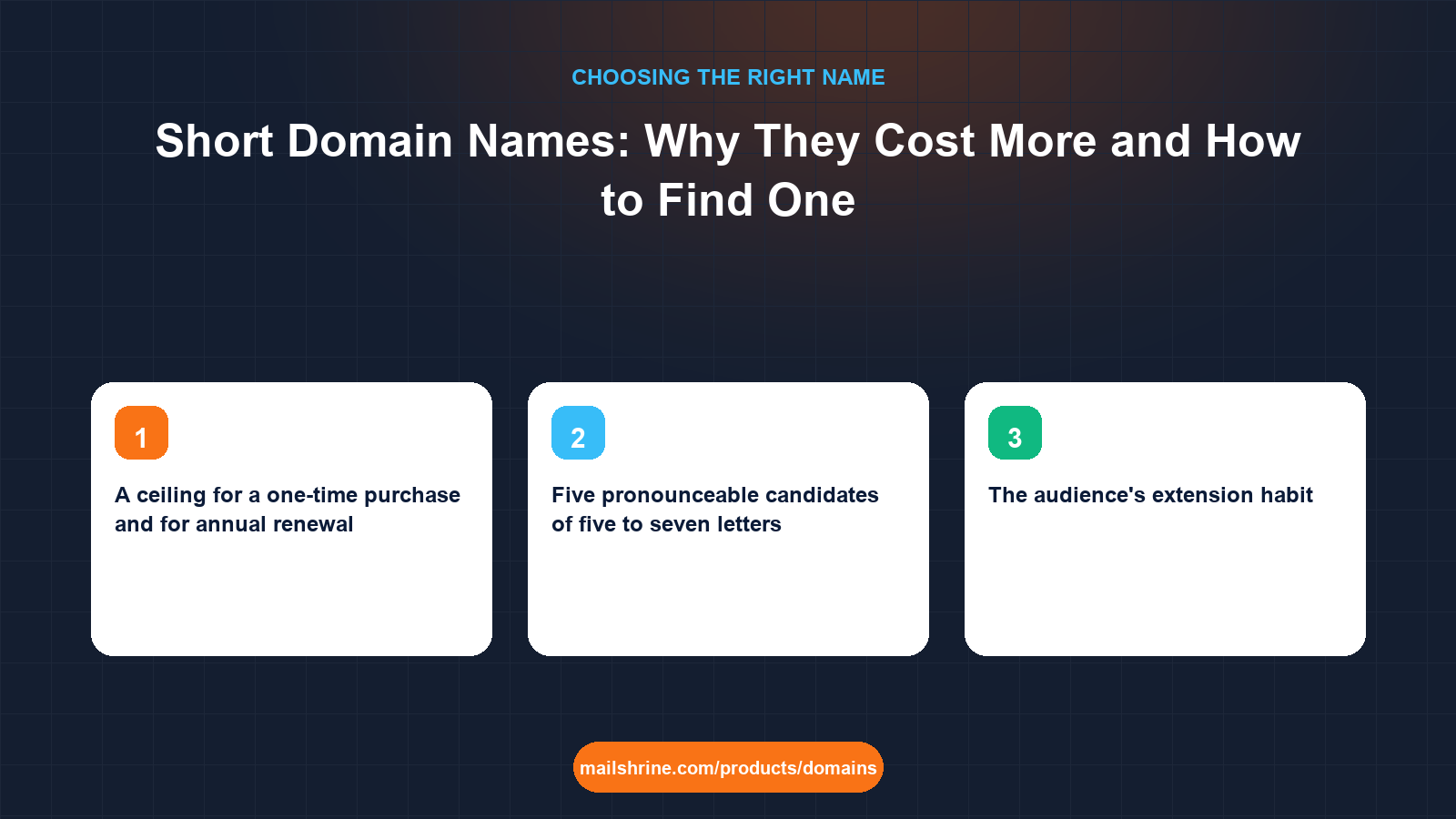
| A ceiling for a one-time purchase and for annual renewal | They are different budgets |
| Five pronounceable candidates of five to seven letters | Short-enough names you can actually get |
| The audience's extension habit | Nairobi traders type .co.ke and .com |
| An RDAP lookup of any for-sale name | Confirms the seller actually holds it |
| A rule for yourself on registry premiums | Many are not worth a recurring fee |
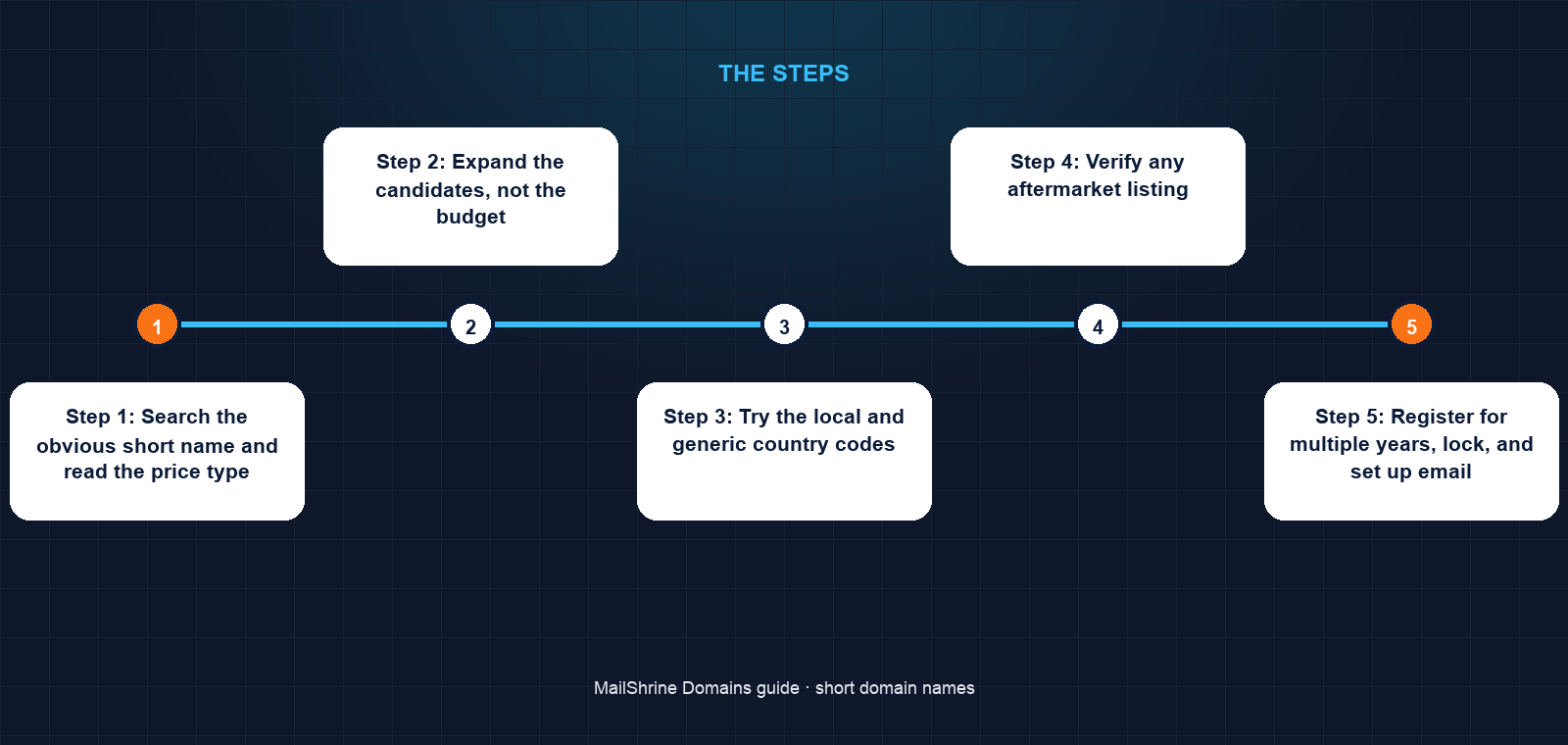
Step 1: Search the obvious short name and read the price type
Type pesaflow into the checker. If a result shows a Buy Now price, it is aftermarket and renews at standard. If the registration price itself is high, it is a registry premium and the renewal will be too.
Step 2: Expand the candidates, not the budget
Write five variants that stay short: pesaflo, flowpesa, pesafl, getpesa, pesaly. Pronounceable five- to seven-letter made-up words are where availability still lives on .com.
Step 3: Try the local and generic country codes
pesaflow.co.ke was free for Grace at a standard price. For a product sold to Kenyan traders, that is a strong primary.
Step 4: Verify any aftermarket listing
Run an RDAP query on the name. Confirm it is registered, note the registrar, and only pay through a listing or escrow, never by direct bank transfer to a stranger.
Step 5: Register for multiple years, lock, and set up email
Register the chosen name for two or more years. Leave transfer lock and privacy on. Grace registered pesaflow.co.ke for two years, getpesa.com as a .com fallback, and kept the $4,800 .com on a watch list.
Grace's checklist
- Confirmed
pesaflow.comis aftermarket (renews at standard after purchase), not a registry premiumCompleted - Decided $4,800 is outside budget for nowCompleted
- Registered
pesaflow.co.kefor 2 years as the primaryCompleted - Registered
getpesa.comfor 1 year as the .com fallbackCompleted - Privacy and lock on;
support@andgrace@live on Business EmailCompleted - Print stall stickers with the .co.ke addressNot completed
- Revisit the .com listing after the pilotNot completed
Common mistakes
Confusing a registry premium with an aftermarket price. One is paid once, the other is paid every year. The renewal column tells you which.
Paying for a four-letter string nobody can pronounce. pfkq.com is short and useless. Short only helps if people can say it and spell it.
Wiring money directly to a seller. Use a marketplace listing or escrow so the transfer and the payment are tied together.
Ignoring the local country code. Short names are routinely free on .co.ke, .com.ng and .co.za because the pools are far less crowded.
Letting a short name drive a bad brand. A five-letter made-up word you own everywhere beats a four-letter word you share with three other companies.
Check your work
Confirm in the MailShrine dashboard that the domain shows Active, the expiry year you paid for, privacy and lock on and email setup complete. If you bought an aftermarket name, confirm in RDAP that the registrant has changed to you and that the expiry matches what you expect. Send a test to support@ from an outside address.
FAQ
Why are short domain names so expensive?
Because the supply is fixed by the number of possible letter combinations and every short .com has been registered for years. Prices reflect scarcity and the demand from brands that want something easy to type.
Are all four-letter .com domains taken?
Yes. The last unregistered four-letter .com was taken in December 2013. Any four-letter .com you want must be bought from its current owner.
What is the shortest domain I can register normally?
On .com, realistically five letters if the string is uncommon, six if you want something pronounceable. On local country codes and some newer extensions, four letters are still available at standard prices.
Is a premium domain renewal always expensive?
A registry premium renews at the premium price every year. An aftermarket purchase renews at the standard price once it is yours. MailShrine shows renewal prices before purchase so you can tell them apart.
Should I spend thousands on a short name?
Only if the name is the brand and you have the budget after everything else. Most businesses do better with a slightly longer, fully owned, pronounceable name. See our guide on how to choose a domain name.
Next steps
- Brandable vs Keyword Domains for SEO — why made-up short words are both cheaper and stronger.
- What to Do When Your Domain Name Is Taken — buying, backordering or reworking.
- .co vs .com: Is .co a Good Domain? — the extension where short names are still available.
Citations & References
- Reference: Verisign: Domain Name Industry Brief
- Reference: ICANN: Reserved names in gTLD registry agreements (Specification 5)
- Reference: ICANN: Registration Data Access Protocol (RDAP)
- Reference: RFC 1035: Domain names, implementation and specification
Written by Isabelle R., domains editor. Isabelle explains how names, DNS and registrars fit together so first-time buyers know exactly what they are paying for.