
.ca and .co.uk are two of the most trusted country-code domains in the world, and they work in opposite ways. Canada's .ca, run by the Canadian Internet Registration Authority (CIRA), is restricted: you must meet the Canadian Presence Requirements to hold one. The UK's .co.uk, run by Nominet, is open to anyone anywhere. Both compete with .com in markets where customers are perfectly comfortable typing a country code, and both have a direct second-level sibling (.ca is already direct; .uk opened in 2014) that changes the calculation.
This guide compares the options in each country, explains the presence rules, pricing and the .uk versus .co.uk question, and gives a process for a business that sells in Canada, the UK or both.
MailShrine Domains sells .ca, .co.uk, .uk and .com with first-year and renewal prices shown together, collects the registrant details each registry requires at checkout, and writes the email DNS and opens two business mailboxes on whichever name you choose.
Real-life example: Hannah's design studio
Hannah Whitfield runs a four-person brand-design studio in Bristol trading as "Whitfield Studio". She uses whitfieldstudio.co.uk. Half of her new enquiries now come from Toronto after a client there referred her to two others, and she is planning to register a Canadian company and open a small office. whitfieldstudio.com is held by a photographer in Oregon; whitfieldstudio.ca is free. A Canadian prospect asked if she has "a .ca".
Hannah's goals:
- Understand whether she can hold a .ca before she has a Canadian entity.
- Decide whether to keep .co.uk, add .ca, or move everything to a .com variant.
- Keep one set of mailboxes and not break the email signature every client already has.
The options compared
| .ca | .co.uk | .uk | .com | |
|---|---|---|---|---|
| Registry | CIRA | Nominet | Nominet | Verisign |
| Eligibility | Canadian Presence Requirements: citizen, permanent resident, Canadian corporation, registered trademark in Canada, among others | Open to anyone | Open to anyone | Open to anyone |
| Registration speed | Seconds, once presence declared | Seconds | Seconds | Seconds |
| Typical price | Moderate; a little above .com | Low; often below .com | Same as .co.uk | $12.99/yr |
| Minimum term | 1 year | 1 year | 1 year | 1 year |
| Registered names | About 3.4 million | About 10 million | Over 1 million | About 155 million |
| How locals read it | Canadian, trusted; CIRA surveys show a strong preference | British, trusted, the national default | Modern British; still less familiar than .co.uk | Default |
| Google geo-targeting | Canada | UK | UK | Global |
| Transfer rules | CIRA policy; auth code; registrant must still meet presence | Nominet uses IPS tags rather than auth codes; registrar-to-registrar push | Same as .co.uk | ICANN 60-day lock after registration or owner change |
Canada: .ca and the presence requirement
CIRA's Canadian Presence Requirements list eighteen categories of eligible registrant, including Canadian citizens, permanent residents, corporations or partnerships registered in Canada, and foreign holders of a trademark registered in Canada. A UK company with no Canadian entity and no Canadian trademark does not qualify. Registering a .ca while declaring a presence you do not have is a breach and the name can be cancelled.
For Hannah this sets the order of operations: incorporate the Canadian company first, then register the .ca in the company's name. CIRA also offers free WHOIS privacy for individuals by default; corporate registrants' details are public. CIRA's own research consistently finds that Canadians prefer .ca for Canadian businesses, so the prospect's question was not idle.
UK: .co.uk versus .uk
Nominet opened direct .uk registrations in June 2014. Holders of existing .co.uk names had a five-year right of first refusal on the matching .uk, which ended in June 2019; since then .uk names are first come, first served. In practice .co.uk remains what British customers type and expect. .uk is shorter and reads as modern, but a business on .uk alone will lose some traffic to whoever holds the .co.uk. The usual recommendation is to hold both if the .uk is free, and treat .co.uk as the primary.
Two UK quirks worth knowing. Nominet transfers use an IPS tag set by the losing registrar rather than an EPP auth code, so moving a .co.uk between registrars is a different process from moving a .com. And Nominet requires accurate registrant details with a validation process; a name can be suspended if the data fails validation.
.com in both markets
Canadians and Britons both type .com by default when they are unsure, so the familiar leak applies. Hannah's .com is a live photographer: not a competitor, but a destination for mistyped emails. A longer, clean .com such as whitfieldstudio.design or whitfieldbrandstudio.com would end that, but she has four years of client signatures on the .co.uk and no appetite for a migration.
Choosing a structure
- UK business, UK customers: .co.uk primary; .uk if free; .com if free.
- Canadian business, Canadian customers: .ca primary; .com if free.
- Trading in both: keep the existing primary for email; register the other country's ccTLD once eligible and redirect it; decide on a .com only if a clean one is free.
Hannah kept .co.uk as the mailbox domain, registered whitfieldstudio.uk, and set a reminder to register .ca the day the Canadian incorporation certificate arrives.
What you need before you start
| You need | Why |
|---|---|
| Availability on .ca, .co.uk, .uk and .com | Full picture before deciding |
| Proof of Canadian presence, if registering .ca | Incorporation, residency or a Canadian trademark |
| Accurate registrant details for Nominet | Validation failures suspend names |
| A decision on the mailbox domain | One domain carries email; the rest redirect |
| Awareness of the IPS tag process | If you ever move the .co.uk |
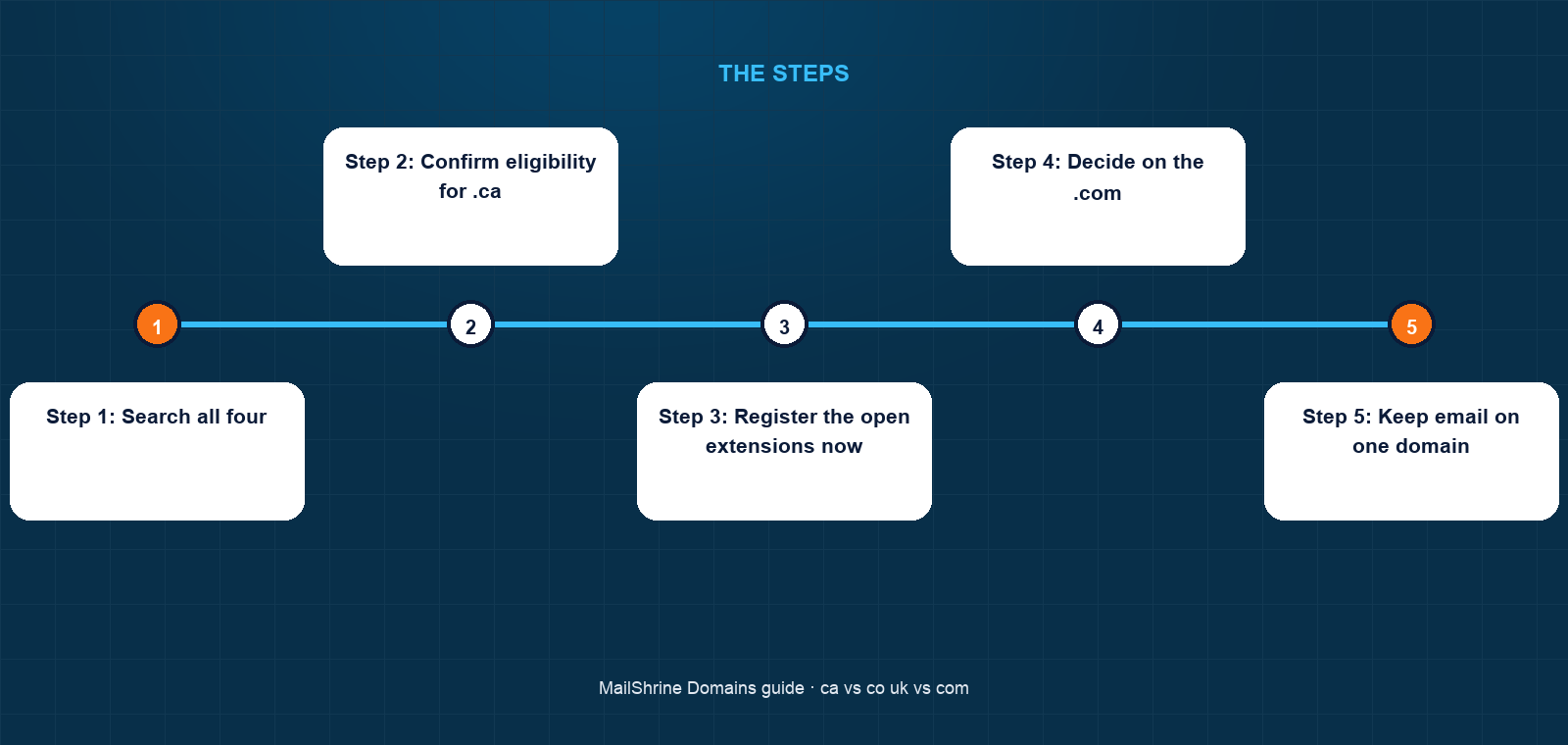
Step 1: Search all four
One query in the MailShrine checker returns every extension with promo and renewal prices.
Step 2: Confirm eligibility for .ca
If you meet a Canadian Presence Requirement today, register. If not, incorporate or file a Canadian trademark first. Do not declare a presence you lack.
Step 3: Register the open extensions now
.co.uk and .uk register instantly for anyone. Take both with privacy and lock on; two years locks the renewal.
Step 4: Decide on the .com
Free: register and redirect. Held by an unrelated party: live with the leak or lengthen the name. Held by a competitor: lengthen the name.
Step 5: Keep email on one domain
Set every other domain to redirect to the primary. Hannah's hannah@whitfieldstudio.co.uk stays as it is; the .uk and, later, the .ca forward there.
Hannah's checklist
- Confirmed she does not yet meet a Canadian Presence RequirementCompleted
- Registered
whitfieldstudio.ukfor 2 years alongside the existing.co.ukCompleted - Privacy and lock on; Nominet registrant details verifiedCompleted
- Mailboxes stay on
.co.ukin Business EmailCompleted - Register
whitfieldstudio.cathe day the Canadian incorporation completesNot completed - Redirect
.ukand.cato the.co.ukNot completed - Add the .ca address to the Canadian company's letterheadNot completed
Common mistakes
Registering a .ca without meeting the presence requirement. CIRA can cancel the name, and you will have printed it.
Assuming .uk has replaced .co.uk. British customers still default to .co.uk. Hold both; make .co.uk primary.
Trying to transfer a .co.uk with an auth code. Nominet uses IPS tags. Ask the losing registrar to change the tag to the gaining registrar's.
Moving email to a new domain to "tidy up". Four years of signatures, contracts and client address books point at the old one. Redirect new domains to the old mailbox domain instead.
Letting Nominet data validation lapse. Inaccurate registrant details can get a .co.uk suspended. Keep them current.
Check your work
Type each address and confirm where it lands. In the MailShrine dashboard every domain should show Active, the right expiry, privacy and lock on, and the mailbox domain should show email setup complete. For a .ca, confirm the registrant shown in CIRA's WHOIS is the eligible entity. For a .co.uk, confirm Nominet's validation status is clear.
FAQ
Can a non-Canadian register a .ca domain?
Only by meeting one of CIRA's Canadian Presence Requirements, such as owning a Canadian corporation or holding a trademark registered in Canada. Citizens and permanent residents qualify directly. Declaring a presence you do not have risks cancellation.
Is .uk better than .co.uk?
It is shorter, but .co.uk is what British customers type and trust. Most businesses should hold both and use .co.uk as the primary, with .uk redirecting.
Do I need the .com if I have a .ca or .co.uk?
If the .com is free or affordable, yes, because Canadians and Britons type .com when unsure. If it is held by an unrelated party, decide whether the leak is tolerable or the name should be lengthened.
How do I transfer a .co.uk to another registrar?
Ask your current registrar to change the domain's IPS tag to the new registrar's tag. There is no auth code and no 60-day lock as with .com. The new registrar then accepts the name into its account.
Does a .ca or .co.uk help SEO in that country?
Google geo-targets ccTLDs to their country, which helps local relevance for searches from that country. It does not help rankings elsewhere, which is why a multi-country business often uses a .com for the global site. Our guide on African extensions applies the same logic to three other markets.
Next steps
- Best Domain Extensions for Ghana, Kenya and South Africa — the same decision across three African markets.
- .com vs .net vs .org: Which Extension Should You Buy? — when a generic extension is the right primary.
- How to Check If a Domain Name Is Taken — finding out who holds that .com.
Citations & References
- Reference: CIRA: Canadian Presence Requirements for Registrants
- Reference: Nominet: .UK registry
- Reference: IANA: .uk delegation record
- Reference: Google Search Central: Managing multi-regional and multilingual sites
Written by Elena V., migrations editor. Elena helps businesses that are moving, expanding or consolidating keep one set of mailboxes working through the change.