How MailShrine is priced today (updated October 2026): MailShrine is an email suite, not a single flat-fee product. Live: Email Marketing, Business Email, AI Email Lead Generator, Email Sanitization (200 credits per month, refilled every month), and Developer API — Live. In development: Email Automation only. Email Marketing, Email Lead Generator, and Developer API use pay-as-you-go credits (1 credit = 1 email, harvested lead, or API send), with monthly Email Marketing options. Stored contacts do not raise the bill. Business Email is billed by mailbox. Products and plans are differentiated — not every feature lives on every plan. Confirm live packs on Pricing.

In the world of B2B sales, the "Perfect Template" is a myth. What works today will be flagged as spam tomorrow if 50,000 other people start copying and pasting it.
To win in 2026, you don't need a script; you need a framework. You need templates that utilize Spintax and Dynamic Personalization to ensure every email is unique in the eyes of Google's algorithms.
This guide provides the exact 10 templates we use to book meetings for 7-figure SaaS and Agency clients — organized by use case, with Spintax built in.
The Outreach Scenario: "The 32% Reply Rate Secret"
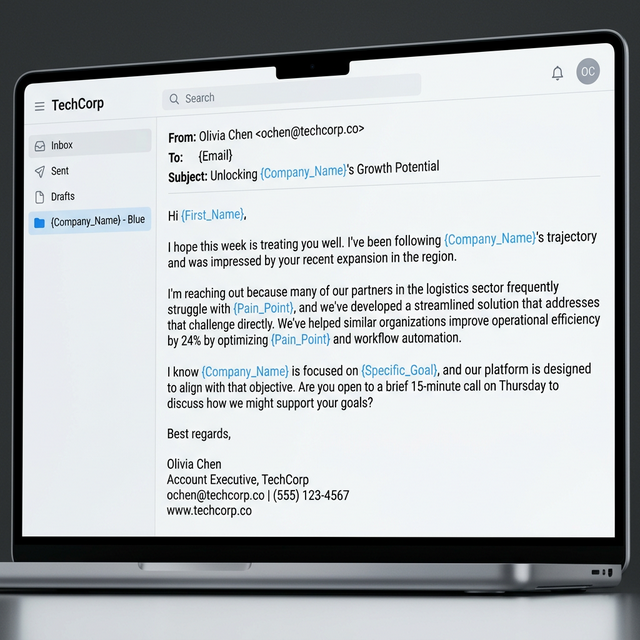
Meet Olivia, an SDR at a growing cybersecurity firm.
- The Failure: She spent weeks sending 500 identical "Intro" emails a day. Her open rate? 12%. Her reply rate? 0.5%.
- The MailShrine Shift: She moved her templates into MailShrine Email Marketing and wrote Dynamic Spintax variations (a copywriting technique). Instead of "Hi {Name}", she used \{Hi|Hello|Hey|Greetings\} {Name}.
- The Result: Her emails now look like unique, human-to-human conversations. Open rates jumped to 52% and reply rate hit 32% within 30 days.
Template Selection Matrix: Which Template for Which Situation?
| Template | Best For | Difficulty | Expected Reply Rate |
|---|---|---|---|
| #1 Recent News | Enterprise, high-ACV | Medium (requires research) | 12-18% |
| #2 Quick Question | Volume outreach, mid-market | Easy | 8-12% |
| #3 Social Proof | Competitive markets | Easy | 10-15% |
| #4 Mutual Connection | Warm outreach via referral | Easy | 15-25% |
| #5 Problem-Agitate | Pain-point driven sales | Medium | 10-14% |
| #6 The Case Study | Results-oriented buyers | Easy | 8-12% |
| #7 The Compliment | Relationship building | Medium (requires research) | 12-16% |
| #8 The "I'm Not Selling" | Gatekept prospects | Easy | 10-14% |
| #9 The Founder-to-Founder | Startup/SMB outreach | Medium | 14-20% |
| #10 The Breakup/Final | Non-responsive prospects | Easy | 8-15% |
The 10 Templates (All Spintax-Ready)
Template 1: The "Recent News" Opener
Best for: High-ticket sales and enterprise accounts.
Subject: {First_Name}, \{congrats on|impressive news about\} {Recent_News_Event}
>
\{Hi|Hey|Hello\} {First_Name},
>
Saw that {Company_Name} just {News_Detail}. \{Huge milestone|That's exciting\}!
>
I was \{researching|looking into\} your team's current {Workflow_Process} and noticed you might be \{facing|dealing with\} {Pain_Point}. We recently helped {Competitor_Name} \{reduce that by {Percentage}%|solve that in under 30 days\}.
>
\{Worth a 10-minute chat?|Open to a quick sync this week?\}
>
\{Cheers|Best|Regards\},
{Your_Name}
Why it works: Leading with genuine news proves you did research. Referencing a competitor result adds credibility.
Template 2: The "Quick Question" (The Workhorse)
Best for: General B2B outreach and high-volume campaigns.
Subject: Quick question re: {Current_Objective}
>
\{Hey|Hi\} {First_Name},
>
I'm working with a few {Job_Title}s in the {Industry_Name} space on \{solving {Pain_Point}|improving {Desired_Outcome}\}.
>
\{Quick question|Curious\}: Who is currently managing your {Process_Name} at {Company_Name}?
>
Would love to \{share|send over\} a brief case study on how we \{helped {Similar_Company} {Specific_Result}|delivered {Metric} for a similar team\}.
>
\{Talk soon|Best\},
{Your_Name}
Why it works: Asking a question forces a response. It also helps you identify the correct decision-maker if you're emailing the wrong person.
Template 3: The "Social Proof" (Competition Driven)
Best for: Competitive markets where results matter most.
Subject: \{How {Competitor_Name} achieved|{Specific_Result} for\} {Competitor_Name}
>
\{Hi|Hello\} {First_Name},
>
We recently helped {Competitor_Name} \{generate {X_Amount} in new pipeline|increase {Metric} by {Percentage}%\} using {Your_Strategy}.
>
Given your focus on {Recipient_Goal} at {Company_Name}, I thought this might be \{valuable|interesting|worth seeing\}.
>
\{Do you have 10 minutes next week?|Free for a brief intro call?\}
>
\{Regards|Best\},
{Your_Name}
Why it works: Name-dropping a competitor triggers competitive urgency. Decision-makers don't want to be left behind.
Template 4: The "Mutual Connection" Referral
Best for: Warm introductions and inbound-assisted outbound.
Subject: {Referrer_Name} suggested I reach out
>
\{Hi|Hey\} {First_Name},
>
\{I was chatting with|I recently spoke to\} {Referrer_Name} and your name came up. \{They mentioned|They suggested\} that {Company_Name} might be \{exploring|interested in\} {Topic}.
>
We \{helped {Referrer_Company}|worked with {Referrer_Name}'s team\} on something similar and \{the results were impressive|they saw {Specific_Result}\}.
>
\{Worth a quick intro?|Happy to share more if it's relevant.\}
>
\{Best|Cheers\},
{Your_Name}
Why it works: Referral-based emails have 2-3x higher reply rates than cold emails because they carry implicit trust.
Template 5: The "Problem-Agitate" Framework
Best for: Pain-point driven sales where the prospect may not know they have a problem.
Subject: {First_Name}, \{a thought|something I noticed\} about {Company_Name}'s {Process}
>
\{Hi|Hey\} {First_Name},
>
\{I've been studying|I noticed\} how {Company_Name} handles {Process}. \{From what I can see|Based on my research\}, you might be \{leaving money on the table|spending more than necessary\} because of {Specific_Issue}.
>
This is \{surprisingly common|more frequent than you'd think\} in {Industry} — we found that {Percentage}% of \{companies your size|teams like yours\} face the same challenge.
>
\{We built a way to fix this.|I have an idea on how to solve it.\} Worth 10 minutes?
>
\{Best|Cheers\},
{Your_Name}
Why it works: Agitating a pain point the prospect hasn't consciously identified creates an "aha" moment that demands a response.
Template 6: The "Case Study Teaser"
Best for: Results-oriented buyers who want proof before a meeting.
Subject: How {Similar_Company} \{achieved {Result}|went from {Problem} to {Result}\}
>
\{Hi|Hey\} {First_Name},
>
Quick share — we just published a case study showing how {Similar_Company} (\{same industry|similar stage\} as {Company_Name}) \{increased {Metric} by {Percentage}%|reduced {Pain_Metric} by {Amount}\} in just {Timeframe}.
>
\{Given {Company_Name}'s focus on {Goal}|Since you're working on {Initiative}\}, I thought this might be \{directly relevant|worth a look\}.
>
\{Want me to send the full study?|Happy to share the breakdown.\}
>
\{Best|Cheers\},
{Your_Name}
Why it works: Offering a case study instead of asking for a meeting lowers the commitment barrier. Once they read the study, they self-qualify.
Template 7: The "Genuine Compliment"
Best for: Building relationships with thought leaders and senior executives.
Subject: \{Loved|Really enjoyed\} your \{take on {Topic}|recent post about {Topic}\}
>
\{Hi|Hey\} {First_Name},
>
I \{read|came across\} your \{article|LinkedIn post|talk\} on {Specific_Topic} — the point about {Specific_Insight} really \{resonated|stood out\}.
>
It actually connects to \{something we're building|a problem we're solving\} at {Your_Company}. We help {ICP_Description} \{achieve {Result}|solve {Problem}\}, and your perspective on {Topic} \{aligns with our approach|validates what we're seeing\}.
>
\{Would love to swap notes.|Curious if you'd be open to a quick chat.\}
>
\{Best|Cheers\},
{Your_Name}
Why it works: A genuine, specific compliment proves you're not a robot. It triggers reciprocity — people want to respond to someone who took the time to engage with their work.
Template 8: The "I'm Not Selling" Low-Pressure Opener
Best for: Highly gatekept prospects who are tired of sales pitches.
Subject: Not a sales pitch, {First_Name}
>
\{Hi|Hey\} {First_Name},
>
Full transparency — I'm not going to pitch you anything in this email.
>
I \{noticed|saw\} {Company_Name} is \{scaling into {Market}|building out the {Team} function|investing heavily in {Initiative}\}. We work with \{a handful of|a few\} companies at a similar stage, and I've \{noticed some patterns|learned some interesting things\} about what \{works|doesn't work\} in {Area}.
>
If you're ever open to \{a casual conversation|exchanging notes\} on {Topic}, I'm genuinely \{curious|interested\} to hear your perspective.
>
\{No agenda, no deck.|Just a conversation.\}
>
\{Best|Cheers\},
{Your_Name}
Why it works: By explicitly removing the sales pressure, you disarm the prospect's defenses. This template has unusually high reply rates from C-Suite executives who are exhausted by aggressive pitches.
Template 9: The "Founder-to-Founder" Peer Outreach
Best for: Startup/SMB founders reaching out to other founders.
Subject: Fellow \{founder|CEO\} in {Industry} — quick thought
>
\{Hi|Hey\} {First_Name},
>
I'm the founder of {Your_Company} — we're a \{small|growing\} team of {Team_Size} building {Product_Description}.
>
I've been \{following {Company_Name}|watching what you're building\} and noticed we're \{solving similar problems|serving a similar market\}. Not a competitor — more of a \{complementary tool|potential partner\}.
>
\{I'd love to swap notes on {Topic}.|Curious how you're thinking about {Challenge}?\}
>
\{Best|Cheers\},
{Your_Name}
Why it works: Peer-to-peer framing (founder-to-founder, CTO-to-CTO) removes the power imbalance of a typical sales email and creates genuine curiosity.
Template 10: The "Breakup" / Final Touch
Best for: Non-responsive prospects at the end of a sequence.
Subject: \{Closing the loop|Should I close your file?\}
>
{First_Name},
>
I've \{reached out a few times|sent a couple of notes\} and haven't heard back. \{Totally get it — timing matters.|No worries at all.\}
>
I'm going to \{assume this isn't a priority right now|close out your file\}. If \{scaling {Goal}|improving {Metric}\} becomes a focus for {Company_Name} later, \{I'm always happy to chat|you can always reach me here\}.
>
\{Wishing you a great quarter.|All the best.\}
>
\{Best|Cheers\},
{Your_Name}
Why it works: The "breakup" email consistently generates the highest reply rate in any sequence (often 3-5x the initial email). Loss aversion is a more powerful motivator than gain.
Why Scaling With Personalization is the Only Way Forward
In 2026, Google and Outlook's AI can detect "Bulk Patterns" instantly. If you send 1,000 emails with the exact same body text, you will be routed to the Promotions tab (or Spam).
The Solution? Spintax + Dynamic Variables (copy technique).
By writing templates in MailShrine Email Marketing, you can rotate your language:
- Greeting: \{Hi|Hey|Hello|Hi there\}
- Value Statement: \{We help|Our platform enables|We specialize in helping\}
- Closing: \{Best|Cheers|Hope to chat soon|Regards\}
Combined with CSV variables ({First_Name}, {Company}, {Recent_News}), this creates thousands of unique cryptographic hashes, making your bulk campaign look like 1,000 individual emails sent by a human.
MailShrine does not have a native Spintax engine that ensures you never land in spam. Unique copy helps filters; it is not a deliverability guarantee.
Industry-Specific Template Recommendations
| Industry | Best Templates | Key Personalization Variable |
|---|---|---|
| SaaS / Tech | #1, #5, #9 | Tech stack used, recent product launch |
| Professional Services | #4, #7, #8 | Mutual connections, published content |
| E-commerce / DTC | #3, #6 | Competitor comparison, revenue metrics |
| Agency / Consulting | #2, #5, #9 | Client case studies, industry pain points |
| Finance / FinTech | #1, #3, #8 | Regulatory changes, funding rounds |
The 3 Mistakes That Kill Template Performance
| Mistake | Why It Fails | Fix |
|---|---|---|
| Using the template verbatim | Every SDR on the internet has access to these templates. If you don't customize, your email is identical to thousands of others. | Add 1 unique research-based line per prospect. |
| Skipping Spintax | Identical emails trigger Google's Snowshoe filter. | Write Spintax-style variations in every template (copy technique, not a native never-spam engine). |
| Wrong template for wrong audience | Sending a "Breakup" email as your first touch, or a "Quick Question" to a C-Suite exec. | Use the Template Selection Matrix above. |
Citations & References
- Reference: The Science of the Cold Email Subject Line
- Reference: Spintax Guide for High-Deliverability Outreach
- Reference: Woodpecker: Cold Email Template Best Practices
Written by Olivia C., Outreach Strategist. Olivia has optimized over 5,000 cold email sequences, specializing in "Spam-Free" scaling for high-growth tech companies.