
How MailShrine is priced today (updated October 2026): MailShrine is an email suite, not a single flat-fee product. Live: Email Marketing, Business Email, AI Email Lead Generator, Email Sanitization (200 credits per month, refilled every month), and Developer API — Live. In development: Email Automation only. Email Marketing, Email Lead Generator, and Developer API use pay-as-you-go credits (1 credit = 1 email, harvested lead, or API send), with monthly Email Marketing options. Stored contacts do not raise the bill. Business Email is billed by mailbox. Products and plans are differentiated — not every feature lives on every plan. Confirm live packs on Pricing.
There is a dangerous paradox in modern sales: To grow, you must send more emails. But as you send more emails, your quality naturally declines, your "human touch" disappears, and you land in the spam folder.
Most businesses try to scale by hiring 5 more SDRs to manually type every email. This is expensive and slow. Others try to scale by blasting 10,000 identical templates via a cheap SMTP server. This gets their domain blacklisted.
In 2026, the winners are those who use Automated Personalization Frameworks.
The Growth Scenario: "The SDR Who Outperformed the Team"
Meet Ryan, a junior SDR at a B2B agency.
- The Manual Grind: His teammates were spending 6 hours a day manually researching and typing 40 emails each. They averaged 4 booked meetings a week.
- The MailShrine Shift: Ryan spent 2 hours a day building Personalization Frameworks in MailShrine Email Marketing.
- The Result: Using Spintax copy variations and dynamic CSV tags, Ryan was able to send 400 hyper-personalized emails a day in the same amount of time. That is not an AI Spintax engine.
- The Math: Ryan booked 15 meetings a week, single-handedly outperforming the rest of the 5-person sales team combined.
Ryan's Before vs. After Dashboard
| Metric | Manual Team (5 reps) | Ryan (MailShrine Framework) |
|---|---|---|
| Daily emails sent | 200 total (40 each) | 400 (solo) |
| Time per email | 9 minutes | 18 seconds |
| Weekly meetings booked | 4 | 15 |
| Cost per meeting | $625 (labor) | Credits per email (not a flat tool fee) |
| Monthly pipeline | $20,000 | $75,000 |
3 Pillars of Template-Driven Scaling
1. The 20/80 Rule of Personalization
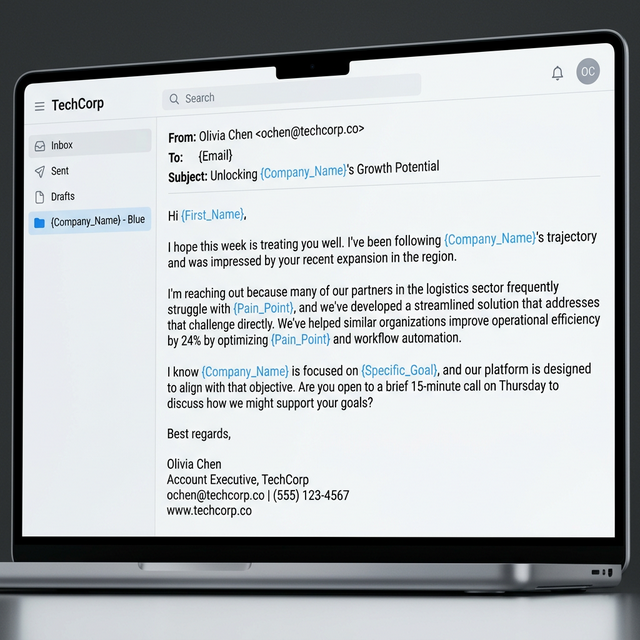
You do not need to rewrite the entire email for every prospect. You only need to personalize the Hook (the first line) and the PS.
Legacy platforms make this hard. MailShrine Email Marketing makes merge fields native. By using dynamic CSV variables like ${Recent_LinkedIn_Post} or ${Tech_Stack_Used}, you can make a template feel 100% custom in seconds.
2. Implementation of Spintax
If you send 1,000 identical emails, Google’s "Snowshoe" filter will catch you. You must use Spintax to rotate your language (a copywriting technique — MailShrine does not ship a native Spintax engine that ensures you never land in spam):
{Hi|Hey|Hello}{I noticed you are using|I saw that your team relies on|Checking out the tech stack for}{Worth a quick chat?|Open to a 10-minute sync?|Free for a brief intro?}
3. Throttling and Human-Looking Cadence
Automation shouldn't look like a machine-gun. It should look like a human typing. Pace Email Marketing campaigns and stay under each provider's daily limits. MailShrine does not mimic mouse movements, run an AI warm-up network, or sell a “Direct-Inbox API.” Send from Gmail, Microsoft, Yahoo, Custom SMTP, or MailShrine Cloud.
How to Build a Personalization Framework (Step-by-Step)
Follow this process to create your first template framework in under 30 minutes:
- Write your "master" email — the version you would send to your dream prospect.
- Identify the 3-5 personalizable elements (opening line, pain point, competitor mention, CTA).
- Convert each to a CSV variable ({First_Name}, {Recent_News}, {Competitor_Used}, {Pain_Point}).
- Add Spintax to non-variable text (greetings, transitions, closings) to create structural uniqueness.
- Build your CSV with one row per prospect and one column per variable.
- Import to MailShrine Email Marketing and map columns to template variables.
- Send a 50-prospect test campaign and measure open/reply rates before scaling.
Time Investment: 30 minutes to build the framework. Then reuse it on later Email Marketing campaigns. (The dedicated Email Automation sequence-builder is still in development.)
The Personalization vs. Volume Matrix
| Approach | Volume | Quality | Reply Rate | Sustainability |
|---|---|---|---|---|
| Manual (type each email) | 40/day | ⭐⭐⭐⭐⭐ | 15%+ | ❌ Burns out team |
| Generic blast (no personalization) | 10,000/day | ⭐ | 0.5% | ❌ Gets blacklisted |
| Template + Spintax (no research) | 500/day | ⭐⭐⭐ | 5-8% | ✅ Sustainable |
| Framework + CSV + Spintax | 500/day | ⭐⭐⭐⭐ | 10-14% | ✅ Best ROI |
| Framework + Intent Data | 500/day | ⭐⭐⭐⭐⭐ | 14-20% | ✅ Enterprise-grade |
The sweet spot for most teams: Framework + CSV + Spintax. It delivers 10x the volume of manual at 70% of the quality — with dramatically higher total output.
Common Scaling Mistakes
| Mistake | What Happens | Fix |
|---|---|---|
| Scaling volume before quality | More emails = more spam complaints = blacklisted domain | Perfect your template with 50 prospects first, THEN scale |
| Using one inbox for everything | Google throttles after 100 cold emails/day per inbox | Connect 5-10 inboxes (Gmail, Microsoft, Yahoo, Custom SMTP) or use MailShrine Cloud and split campaign volume |
| No warm-up period | New domains get flagged immediately if you blast on Day 1 | Warm up new domains for 14 days before cold outreach (manual / third-party — MailShrine does not run an AI warm-up network) |
| Ignoring bounce rates | High bounces destroy sender reputation permanently | Verify every email before import with a third-party tool (ZeroBounce, NeverBounce). Native Email Sanitization is live. |
| Same template for 6 months | Recipients see the same patterns; reply rates decay | Refresh templates every 60-90 days |
Implementation Roadmap: Week 1-4
| Week | Action | Expected Outcome |
|---|---|---|
| Week 1 | Build first framework + test with 50 prospects | Baseline reply rate established |
| Week 2 | A/B test subject lines and opening lines | Identify winning variants |
| Week 3 | Scale to 200/day across 4 inboxes | Pipeline begins building |
| Week 4 | Scale to 500/day across 10 inboxes | Full pipeline engine running |
Why "Templates" Aren't the Problem—The "Delivery" Is.
A template only sounds robotic if it’s delivered like a machine.
When you use a legacy tool (Mailchimp, HubSpot), your email arrives with a "Unsubscribe" header from a shared IP. When you use MailShrine Email Marketing, you can send from a connected Gmail, Microsoft, Yahoo, or Custom SMTP inbox — or from MailShrine Cloud. That is not a Direct-Inbox API product.
This is the difference between an "Ad" and a "Conversation."
Citations & References
- Reference: SalesLoft: The state of personalization at scale
- Reference: Sales Hacker: How to scale cold email without burning your domain
Written by Ryan W., Sales Automation Expert. Ryan specializes in building high-velocity sales engines that maintain the 1-to-1 human touch at massive scale.