How MailShrine is priced today (updated October 2026): MailShrine is an email suite, not a single flat-fee product. Live: Email Marketing, Business Email, AI Email Lead Generator, Email Sanitization (200 credits per month, refilled every month), and Developer API — Live. In development: Email Automation only. Email Marketing, Email Lead Generator, and Developer API use pay-as-you-go credits (1 credit = 1 email, harvested lead, or API send), with monthly Email Marketing options. Stored contacts do not raise the bill. Business Email is billed by mailbox. Products and plans are differentiated — not every feature lives on every plan. Confirm live packs on Pricing.
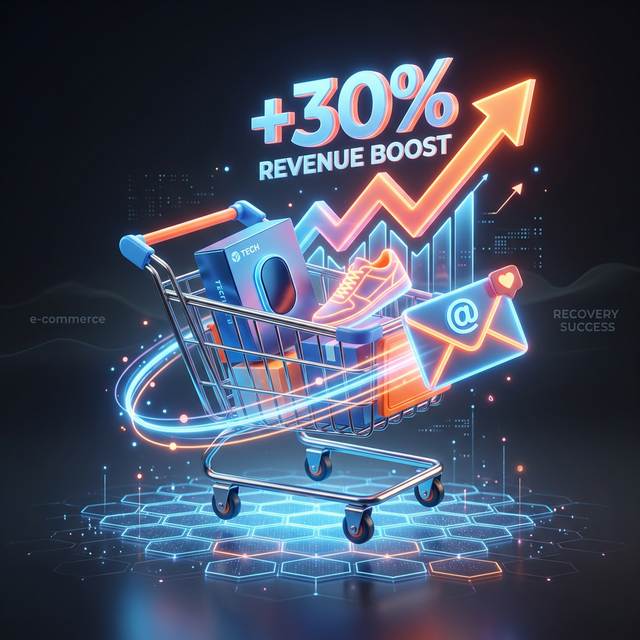
It is the silent killer of E-commerce growth: The Abandoned Cart.
According to recent data, nearly 70% of all online shopping carts are abandoned before checkout. Whether it's a sudden distraction, unexpected shipping costs, or simple "comparison shopping" fatigue, your store is likely leaking thousands of dollars every month.
But there's good news. A well-timed, scheduled email campaign can recover up to 30% of those lost sales. (MailShrine Email Automation — the dedicated sequence-builder product — is still in development. You can run these as Email Marketing campaigns with scheduled sends.)
Why Shoppers Abandon (And How to Respond)
| Abandonment Reason | % of Cases | Best Response |
|---|---|---|
| Unexpected shipping costs | 48% | Email 3: Offer free shipping or a discount code |
| Just browsing / not ready | 26% | Email 2: Social proof and reviews |
| Technical issues | 12% | Email 1: "Did something go wrong?" |
| Better price elsewhere | 9% | Email 3: Price-match or exclusive offer |
| Complicated checkout | 5% | Email 1: Direct link back to cart |
Understanding why they left determines which email converts them back.
The Recovery Scenario: "The 400% ROI Sequence"
Meet Maya, a founder of a premium coffee subscription brand.
- The Problem: Her cart abandonment rate was 78%. She was losing over $5,000 in potential monthly revenue.
- The MailShrine Shift: She implemented a 3-part recovery campaign with scheduled sends in MailShrine Email Marketing.
- The Result: Maya sent from her connected inbox (or MailShrine Cloud) instead of a shared-ESP blast, so recovery emails looked like a personal follow-up. She recovered $2,200 in her first 30 days. That is not a guaranteed Primary Inbox placement.
The 3-Part Abandoned Cart Blueprint
Email 1: The Helpful Reminder (Sent after 1 hour)
Goal: Address technical issues or distractions without being pushy.
Subject: {First_Name}, did something go wrong?
>
{Hi|Hey} {First_Name},
>
We noticed you left {item_count} {item_plural|item} in your cart just a bit ago.
>
If you ran into a technical glitch or just got {distracted|interrupted}, don't worry—we've {saved|reserved} your cart for you.
>
[Take me back to my cart →]
>
{Cheers|Best},
[Brand Name]
Email 2: The Social Proof / Objection Buster (Sent after 24 hours)
Goal: Build trust and show why people love the product.
Subject: See why {Total_Reviews} people choose {Brand_Name}
>
{Hey|Hi} {First_Name},
>
Still {thinking about|considering} the {Product_Name}?
>
{Company_Name} customers are obsessed—here's what {Customer_Name} had to say:
>
"This is literally the {Best_Benefit} I've ever experienced."
>
Click below to finish your order and join the {Community_Size} people who love our {Product_Category}.
>
{Best|Take care},
[Brand Name]
Email 3: The "Final Chance" Discount (Sent after 48 hours)
Goal: Create urgency and push the comparison shopper to a decision.
Subject: 15% off? Only for the next 24 hours.
>
{First_Name},
>
We really want to get {Product_Name} into your hands.
>
For the next {24|48} hours, use code COMEBACK15 for 15% off your entire order.
>
[Claim my 15% discount now →]
>
{Best|Cheers},
[Brand Name]
Email 4: The "We Miss You" Win-Back (Sent after 7 days)
Goal: Re-engage shoppers who didn't convert from the discount.
Subject: {First_Name}, your {Product_Name} is almost gone
>
{Hi|Hey} {First_Name},
>
Just a heads-up — the {Product_Name} you were {looking at|considering} is {selling fast|almost out of stock}.
>
We {only have|have fewer than} {Stock_Count} left, and at this rate they'll be gone by {Day}.
>
[Complete my order before it's too late →]
>
{Best|Cheers},
[Brand Name]
Why it works: Scarcity and urgency. Even if the stock claim is approximate, the fear of missing out on a product they already wanted is a powerful motivator.
Optimal Timing: When to Send Each Email
| When to Send | Open Rate | Conversion Rate | |
|---|---|---|---|
| Email 1 | 1 hour after abandonment | 45% | 5% |
| Email 2 | 24 hours after | 38% | 8% |
| Email 3 | 48 hours after | 32% | 12% (with discount) |
| Email 4 | 7 days after | 25% | 4% |
Key Insight: Email 3 (the discount) has the highest conversion rate because it combines urgency with a financial incentive. But sending a discount in Email 1 trains customers to always abandon and wait for discounts. Always lead with helpfulness, not discounts.
The Psychology Behind Cart Recovery
| Principle | How It's Used | Which Email |
|---|---|---|
| Loss Aversion | "Your cart is about to expire" | Email 1 |
| Social Proof | "See why 5,000 people love this product" | Email 2 |
| Reciprocity | "Here's 15% off as a thank-you" | Email 3 |
| Scarcity | "Only 3 left in stock" | Email 4 |
| The Endowment Effect | "We've saved YOUR cart" (ownership language) | All emails |
Common Cart Recovery Mistakes
| Mistake | Why It Fails | Fix |
|---|---|---|
| Leading with a discount | Trains customers to always abandon for a deal | Save discounts for Email 3 (48 hours later) |
| Sending only 1 email | 60% of recoveries happen on Email 2 or 3 | Always use a 3-4 email sequence |
| Generic subject lines | "You left something behind" is overused | Use the product name and personalization |
| No product image | Shoppers need to be reminded what they wanted | Include a visual or description of the specific item |
| Too late | Sending the first email 24 hours later misses the hot window | Send Email 1 within 60 minutes of abandonment |
Why Abandoned Cart Emails Often Fail
Most abandoned cart emails end up where they are never seen: The Promotions Tab.
Generic e-commerce platforms like Shopify or Klaviyo send emails from massive shared servers. Because thousands of stores are sending at the same time, Google's filters automatically categorize them as "Commercial Bulk."
The MailShrine send-path difference: By sending with MailShrine Email Marketing from your professional inbox (Gmail, Microsoft, Yahoo, Custom SMTP) or MailShrine Cloud, recovery emails can look like a personal follow-up instead of a shared-ESP blast. That is not a guaranteed Primary Inbox or 99% deliverability claim.
Citations & References
- Reference: Baymard Institute: 49 Cart Abandonment Rate Statistics
- Reference: SaleCycle: Abandoned Cart Recovery Benchmarks
Written by Caleb R., E-commerce Conversion Specialist. Caleb has recovered over $4.2M in lost revenue for DTC brands by optimizing automated recovery workflows and deliverability.