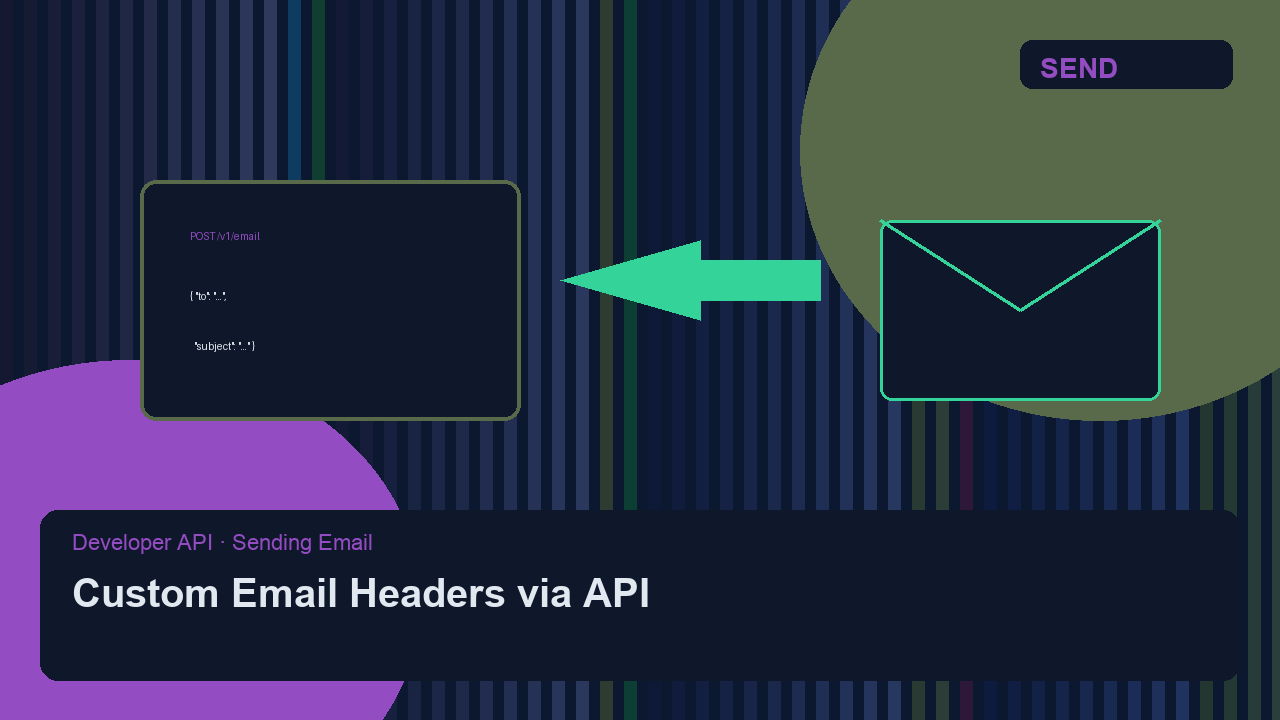
custom headers email API is a common starting question when teams wire product events to email. This guide targets the search intent custom headers email API and fits under Sending Email. You will leave with a practical checklist you can apply in staging before touching production traffic on MailShrine Developer API.
Use this page when you need a structured answer—not a marketing gloss—and when you want links to the next guides in Sending Email.
Real-life example: Nadia at LearnHub
Nadia maintains a production app where email is not optional: signups, billing, and security alerts all depend on reliable delivery. The team bookmarked this topic because stakeholders asked: "custom headers email API"
Nadia's goals for this sprint:
- Align engineering and support on vocabulary for custom email headers via api.
- Map the concept to MailShrine Developer API objects (domains, keys, messages, webhooks).
- Ship a staging test that proves the happy path before DNS or volume changes.
Key terms in one table
| Term | Plain meaning | Example |
|---|---|---|
| Core idea | Plain-language definition of custom email headers via api | Password reset after login |
| API surface | HTTP endpoint or SDK method you call from app code | POST /v1/messages |
| Identity | Verified domain and From address recipients trust | receipts@yourbrand.com |
| Observability | Message ID, webhooks, and logs for support | delivery webhook → ticket |
| Failure mode | What breaks when this step is skipped | Mail lands in spam or is rejected |
How this fits your send pipeline
- Trigger — A user action or cron job decides mail should send (signup, invoice, alert).
- Build — Your service composes subject, HTML/text, and metadata (tags, message ID).
- Authenticate — API key or SMTP credentials scoped to the right environment.
- Send — HTTPS API call or SMTP transaction; capture the provider message ID in your logs.
- Observe — Webhooks or polling confirm delivery, bounces, or delays; update user records.
Skipping documentation at this step is how teams confuse accepted with delivered—especially under load.
Step-by-step: apply this guide today
Step 1 — Write the one-sentence policy
Document what custom email headers via api means for your product. If two engineers explain it differently, fix the doc before changing DNS or keys.
Step 2 — Mirror in staging
Create a non-production API key, verified staging domain, and a test recipient inbox. Reproduce one real workflow (reset link, receipt, alert).
Step 3 — Instrument message IDs
Log provider message IDs alongside user IDs in your application database. Support should trace a ticket to a single send in under a minute.
Step 4 — Add failure alerts
Alert when error rates spike or bounce categories change. Transactional mail fails quietly until customers complain—monitor proactively.
Step 5 — Link to the next guide
Checklist before production
- Staging send succeeded with the same From domain you will use in production.Not completed
- SPF, DKIM, and DMARC records published if this topic touches domains or deliverability.Not completed
- API keys rotated on a schedule and stored outside git.Not completed
- Webhooks (if used) verify signatures and return 2xx quickly.Not completed
- Runbook updated so on-call knows which log fields to inspect.Not completed
Common mistakes
- Treating marketing and transactional mail the same — Different consent, frequency, and infrastructure assumptions.
- No idempotency — Retries duplicate receipts or OTPs; use idempotency keys or dedupe tables.
- Ignoring bounces — Hard bounces should suppress future sends to that address.
- Shipping without a rollback — Keep previous DNS or provider config documented for fast revert.
Check your work
- Can you explain custom headers email API to a new hire in two minutes?
- Does staging mirror production domains and From addresses?
- Do logs tie a user complaint to one message ID?
- Did you schedule a review after the first week of traffic?
Next steps
Citations & References
- Reference: Google: Email sender guidelines
- Reference: RFC 5321 — SMTP
- Video: Send email in a few lines of code with Twilio SendGrid
- Video: Liftoff and Learn Twilio SendGrid Email
Written by Daniel K., Developer API Specialist. Daniel helps product teams ship reliable transactional mail without reinventing SMTP.