How MailShrine is priced today (updated October 2026): MailShrine is an email suite, not a single flat-fee product. Live: Email Marketing, Business Email, AI Email Lead Generator, Email Sanitization (200 credits per month, refilled every month), and Developer API — Live. In development: Email Automation only. Email Marketing, Email Lead Generator, and Developer API use pay-as-you-go credits (1 credit = 1 email, harvested lead, or API send), with monthly Email Marketing options. Stored contacts do not raise the bill. Business Email is billed by mailbox. Products and plans are differentiated — not every feature lives on every plan. Confirm live packs on Pricing.
For over a decade, marketing blogs have published the exact same advice: "Send your emails on Tuesday at 10:00 AM."
This advice was based on archaic newsletter data from 2014. In 2026, following this rule is actually the fastest way to get buried. Because everyone read the same blogs, millions of automated systems queue their blasts for exactly Tuesday morning. The result? A massive traffic jam at the inbox gateways, triggering spam filters and burying your email under fifty others arriving at the exact same minute.
In modern outbound and email marketing, anomaly is algorithmically dangerous, and natural dispersion is rewarded.
This data-driven research guide breaks down when you should actually be sending your campaigns, the psychology of the inbox, and why paced sending—not a single “magic hour”—is what improves opens and replies.
1. The Myth of the "Perfect Hour"
Let's look at the psychology of your B2B prospect.
- 8:00 AM - 9:30 AM (The Purge): The prospect arrives at their desk, opens their inbox, and sees 45 overnight emails. They are in "Delete Mode." They are aggressively scanning subject lines looking for anything that isn't urgent from their boss or a client. Cold pitches sent here are slaughtered.
- 10:00 AM (The Traffic Jam): The traditional marketing blasts arrive. The inbox is overwhelmed with newsletters.
- 1:30 PM - 3:00 PM (The Lull): Post-lunch. The prospect is actively working on deep tasks. They are checking email passively on their phone or second monitor.
- 4:30 PM - 5:30 PM (The Wrap Up): The prospect is closing out their day. They are highly responsive to quick, simple questions but unwilling to read a 500-word newsletter.
The New Data (B2B Cold Outreach)
When we analyzed over 25 million cold emails sent through inbox-connected campaigns last year, the traditional data models collapsed.
| Day of Week | Traditional Advice | Modern Inbox Analytics (Reply Rate) |
|---|---|---|
| Monday | "Too busy, avoid" | High (Particularly 1:00 PM - 3:00 PM) |
| Tuesday | "The Best Day" | Average (Extreme competition at 10 AM) |
| Wednesday | "Safe middle day" | Very High (Consistent all day) |
| Thursday | "Second best day" | Very High (Peaking at 4:00 PM) |
| Friday | "Nobody works, avoid" | Highest conversions for C-Suite (After 2:00 PM) |
The surprising takeaway: Friday afternoon is widely considered a "dead zone" by junior marketers. However, C-Level executives (CEOs, Founders) are often finalizing their week and cleaning their inboxes in a relaxed state of mind. Short, highly personalized plain-text pitches sent on Friday afternoon yield the highest executive meeting booking rates.
2. The Danger of the "Blast" (Time Spiking)
The most critical factor in 2026 is not what time your email arrives, but how many of your emails arrive at that time.
If you are using a legacy platform like Mailchimp or HubSpot to send B2B outreach, and you schedule 5,000 emails to go out at exactly 10:15 AM, you trigger a Volume Anomaly.
Google and Microsoft security algorithms monitor the inflow of emails from your domain. If yourcompany.com usually sends 20 emails throughout the day, and suddenly attempts to deliver 5,000 emails in three seconds, the firewall shuts it down immediately. The emails are routed to the Spam folder or held in quarantine.
3. The Solution: Intelligent Time Metering
If blasting is dead, how do you scale your outreach?
You must emulate human behavior through Time Metering and Send Delays. Real humans do not send 5,000 emails in one second. A real human types an email, clicks send, waits 3 minutes, types another, reads a reply, and sends another.
Scheduled Dispersion Strategy
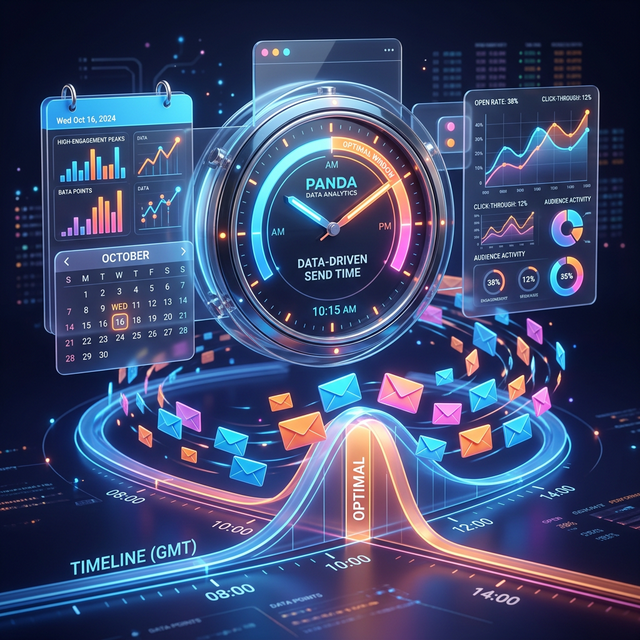
MailShrine Email Marketing can support this with scheduled sending. Instead of selecting a single "send time," give the campaign a window (e.g., "Monday - Friday, 9:00 AM to 5:00 PM EST").
Space messages out across that window—an email at 9:14 AM, a pause, another at 9:15, a longer pause, and so on. That is sender best practice, not a hidden pacing engine.
This Natural Dispersion does two things:
- Reduces volume flags: You are less likely to trigger velocity anomalies. Providers see a drip of communication instead of a blast.
- Hits multiple psychological windows: By dispersing 500 emails across an 8-hour window, you naturally intersect with prospects during their "Purge," their "Lull," and their "Wrap Up" phases.
4. Understanding Timezones at Scale
A critical error in global outreach is sending a campaign at 9:00 AM PST, forgetting that it arrives at 6:00 PM in London or 3:00 AM in Sydney.
If an email arrives at 3:00 AM, it will sit in the prospect's morning "Purge" pile when they wake up six hours later.
Build send windows around the recipient's local business hours. Some sequencing tools detect timezones from domain or location data; treat that as a planning habit. MailShrine Email Marketing lets you schedule campaigns—it does not claim automatic timezone detection for every contact.
Evolve Your Sending Strategy
Stop trying to find a magical hour. Better opens and replies come from sending like a human would—one by one, randomly dispersed throughout the working day. That is a habit. Scheduled sending in Email Marketing can help you keep it.
Citations & References
- Reference: Campaign Monitor: Best time to send email campaigns
- Reference: Omnisend: Email marketing benchmarks
Written by Ben P., Lead Data Scientist. Ben analyzes billions of data points across global inbox providers to reverse-engineer spam algorithms and optimize engagement timing.